How Much Does MVP App Development Cost in 2027?


Table of Contents
 Show

- 1 What Is an MVP and Why Does Its Cost Matter?
- 2 MVP App Development Cost in 2027 by Complexity
- 3 How Team Location Changes the Cost
- 4 What Is Changing in MVP Costs for 2027
- 5 MVP Development Cost Breakdown by Phase
- 6 Hidden Costs Founders Often Miss
- 7 How to Reduce MVP Development Cost Without Cutting Quality
- 8 How to Choose the Right MVP Development Partner
- 9 Why Build Your MVP With Dolphin Web Solution
- 10 Conclusion

Summary :
An MVP lets you test an app idea with real users before you commit a full budget. This guide gives 2027 MVP cost ranges in USD and INR, shows how team location changes the price, breaks the budget down by phase with a worked example, and covers hidden costs, AI-related costs and how to choose a development partner.
In 2027, most MVPs cost $10,000 to $60,000 (about ₹9.5 lakh to ₹57 lakh) and take 6 to 16 weeks to build with an experienced India-based team. Complex MVPs with AI, real-time features or several user roles can cost $120,000 (about ₹1.14 crore) or more. The same app costs several times more with a US or Western European team.
Most founders ask about cost first, and that is a fair place to start. A minimum viable product (MVP) exists to keep your first investment small while you find out whether people want what you are building. Even so, "small" can mean anything from a few thousand dollars to more than a hundred thousand, depending on the choices you make.
The ranges in this guide come from MVPs our team has delivered over the past years, checked against current market rates. Use them to plan your budget before you speak to any development company.
What Is an MVP and Why Does Its Cost Matter?
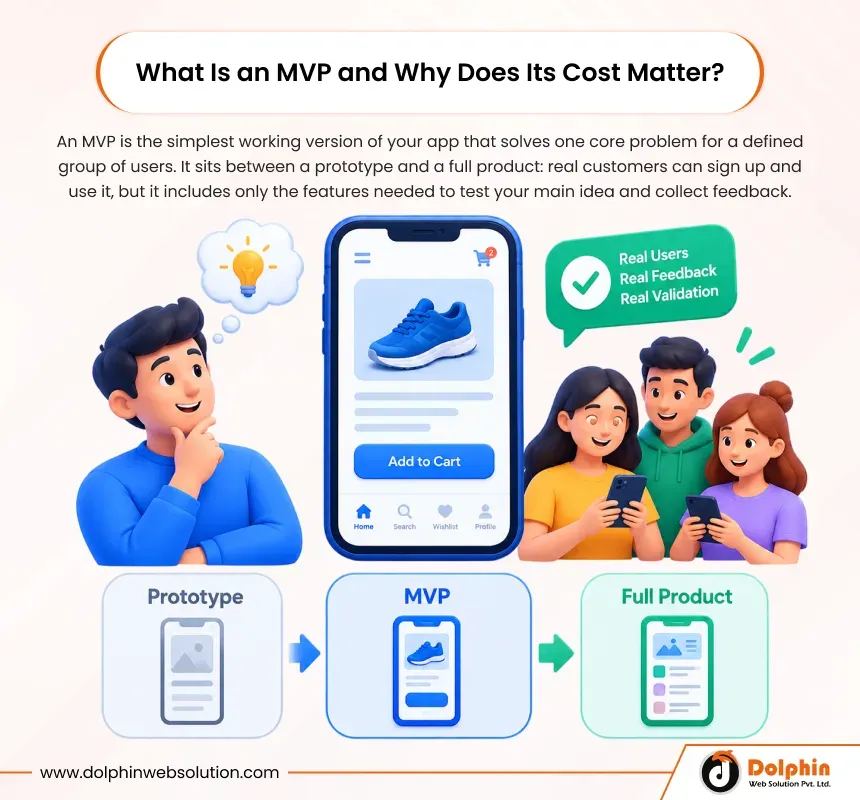
An MVP is the simplest working version of your app that solves one core problem for a defined group of users. It sits between a prototype and a full product: real customers can sign up and use it, but it includes only the features needed to test your main idea and collect feedback.
Cost matters more here than in a full build because an MVP is a test. If you spend on features nobody needs, you lose the main benefit of the approach, which is learning early and at low cost.
MVP vs Prototype vs Full Product
| Stage | Purpose | Usable by real customers? | Typical cost level |
|---|---|---|---|
| Prototype | Show how the idea looks and flows | No | Low |
| MVP | Validate demand with core features | Yes | Medium |
| Full product | Scale with a complete feature set | Yes | High |
Many founders confuse these three stages and pay for the wrong one. A prototype helps you pitch to investors or test a design with a few people, but it can't handle real users or real data. An MVP is the first stage where customers can sign up, use the core feature and show you, through their behavior, what works. A full product comes after that proof, when you know which features deserve more investment.
Going straight to a full product is the most expensive mistake at the early stage. It commits your budget to features that may never be used, while an MVP lets you spend in steps and change direction when the data says so.
MVP App Development Cost in 2027 by Complexity
These ranges are for a professionally built app with proper design, testing and backend work. They assume an experienced team based in India billing roughly $25 to $50 an hour; the next section shows how the price changes with team location. INR figures are converted at about ₹95 to the US dollar.
| Complexity | Example features | Estimated cost (USD) | Estimated cost (INR) | Timeline |
|---|---|---|---|---|
| Simple | Login, profile, one core workflow, basic admin | $10,000 to $25,000 | ₹9.5 lakh to ₹24 lakh | 6 to 10 weeks |
| Medium | Payments, notifications, dashboards, third-party integrations | $25,000 to $60,000 | ₹24 lakh to ₹57 lakh | 10 to 16 weeks |
| Complex | Real-time features, AI modules, several user roles, advanced security | $60,000 to $120,000+ | ₹57 lakh to ₹1.14 crore+ | 16 to 28 weeks |
Here is how to read the three tiers in practice:
- Simple MVPs suit single-purpose apps such as a booking tool, a basic marketplace listing or an internal utility. They use standard screens and one main user role.
- Medium MVPs suit products that handle money or personal data, such as delivery, fintech or learning apps. They need secure payments, user dashboards and admin controls.
- Complex MVPs suit products built around live data, recommendations or several user types that interact with each other. They take longer because each extra role adds design, testing and security work.
If your idea sits between two tiers, ask your development partner to price the lower tier first and list the features that would move you into the next one. Treat these figures as planning ranges, not quotes. For India-specific pricing in more detail, see our guide to mobile app development costs in India. If you are building with a team in India, you can compare these figures with our detailed guide on mobile app development costs in India.
From Our Projects
| Project type | Core features | Platform | Timeline | Final cost |
|---|---|---|---|---|
| E-commerce MVP | 6 features: User registration, product catalogue, search, cart, checkout, payment integration | React Native, Node.js, PostgreSQL, Android and iOS | 8–12 weeks | ₹6–12 lakh (14,000) |
| On-demand Service MVP | 6 features: User profiles, service listings, booking, location tracking, payments, notifications | Flutter, Node.js, MongoDB, Android and iOS | 10–14 weeks | ₹8–15 lakh (17,500) |
| SaaS Dashboard MVP | 6 features: User authentication, dashboard, data management, reports, subscription billing, admin panel | React.js, Node.js, PostgreSQL, Web | 8–12 weeks | ₹5–10 lakh (12,000) |
How Team Location Changes the Cost
Hourly rates vary widely by region:
| Region | Typical hourly rate (USD) |
|---|---|
| United States | $100 to $200 |
| United Kingdom and Western Europe | $70 to $150 |
| Eastern Europe | $40 to $80 |
| India | $20 to $50 |
To see what this means for a whole project, take a simple MVP that needs about 600 hours of design, development, testing and project management:
| Team location | Cost for a 600-hour MVP (USD) |
|---|---|
| United States | $60,000 to $120,000 |
| United Kingdom and Western Europe | $42,000 to $90,000 |
| Eastern Europe | $24,000 to $48,000 |
| India | $12,000 to $30,000 |
A lower rate doesn't automatically mean a better deal. Communication, quality standards and long-term support matter as much as the price per hour.
Freelancer, In-House Team or Development Company
Your engagement model also changes cost and risk:
- Freelancers can suit small, well-defined tasks, but one person rarely covers design, development, testing and project management.
- In-house teams give you full control, but hiring and salaries make them the most expensive option for a first build.
- Development companies bring a complete team and a tested process, which usually means fewer surprises and clearer accountability.
Key Factors That Affect MVP App Development Cost
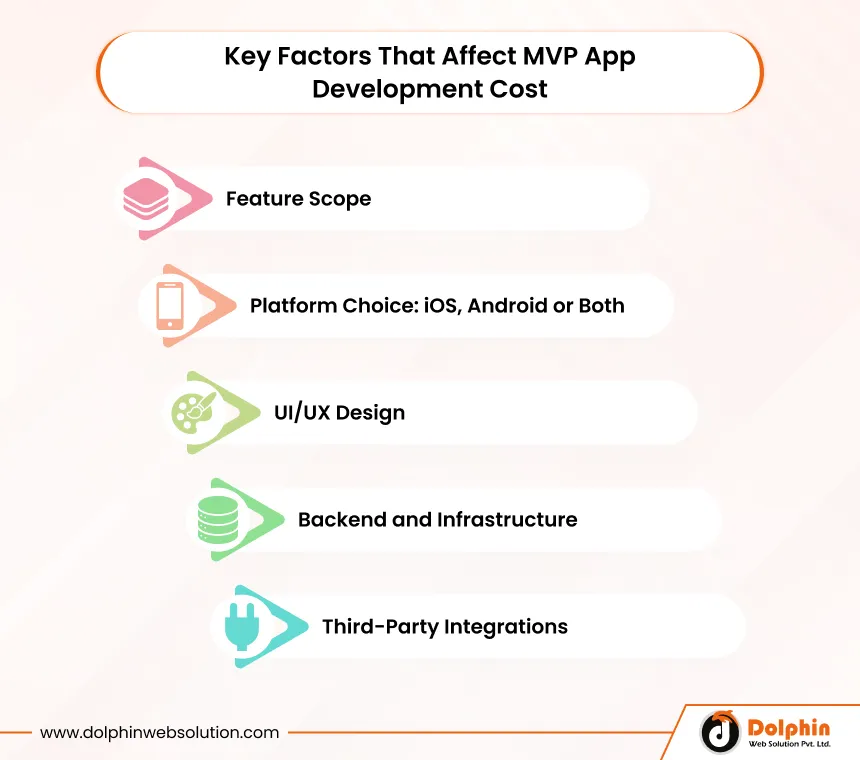
Five decisions shape your budget more than anything else. Understanding them lets you control cost instead of reacting to it.
1. Feature Scope
Every extra feature adds design, development, testing and maintenance effort. A good MVP usually keeps to three to five core features that directly support the main user goal.
- Include only what is needed to test your central idea.
- Move "nice-to-have" features into a later release.
- Use existing services instead of custom-built tools where possible.
A simple test helps here. For each feature, ask whether a first user could still complete the main task without it. If the answer is yes, that feature can wait. A ride-booking app, for example, needs location, booking and payment at launch. Ratings, referral rewards and in-app chat can come once riders are using the service.
Scope creep also raises cost. Every feature added midway through development changes design, code and testing, so agree on a fixed feature list and a clear change process before work starts.
2. Platform Choice: iOS, Android or Both
Building for one platform first is the most common way to control cost. In our projects, separate native apps for iOS and Android have added roughly 50 to 80 percent to development effort . Cross-platform frameworks such as Flutter and React Native remove most of that extra work and give a good user experience for most MVPs.
Consider these points when deciding:
- Where your users are: check whether your audience leans toward iOS or Android in your target market. In India, Android runs on the large majority of smartphones .
- Revenue goals: iOS users tend to spend more per purchase, while Android reaches more users in most regions.
- Hardware needs: features that need deep device access, such as advanced camera or sensor use, may push you toward native development.
- Future plans: a cross-platform codebase can be extended later, so the first build rarely has to be thrown away.
3. UI/UX Design
Design affects whether early users understand your app and stay long enough to give feedback. Research, wireframes and clear interfaces early on prevent expensive rework later. Design usually takes 10 to 20 percent of an MVP budget, and our UI/UX design services team scopes it with the rest of the build so you see the full cost up front.
At the MVP stage, design work usually covers user research, user flows, wireframes, a clickable prototype and a simple visual style. A short round of usability testing on the prototype often reveals confusing steps before any code is written, and changing a screen in a prototype costs far less than rebuilding it in the app.
4. Backend and Infrastructure
Your app needs servers, databases, APIs and security. A simple MVP can run on managed cloud services at a low monthly cost, while apps with heavy data, live tracking or large user loads need more careful architecture.
Backend choices affect both launch cost and future growth. Managed services reduce setup time and let a small team focus on the product, while custom servers give more control at a higher build and maintenance cost. Security basics such as encrypted data, secure login and safe API design are not optional, even at the MVP stage, because adding them later is expensive and risky.
5. Third-Party Integrations
Payment gateways, maps, SMS, email, analytics and CRM connections each add integration time. Some also carry monthly or per-transaction fees that belong in your budget.
Before you add an integration, check how long it takes to connect, what it costs each month, and whether the provider's documentation is reliable. A proven payment gateway or messaging service is almost always cheaper than building your own, and it gets you to launch faster. Keep the list short for version one and add more connections once users ask for them.

What Is Changing in MVP Costs for 2027
Three changes affect MVP budgets more than they did a few years ago.
AI Coding Tools Shorten Routine Work
AI coding assistants now write a share of routine code, such as standard screens, form validation and unit tests. In our recent projects, this has shortened development time on routine parts of the build by about. These tools don't replace design decisions, code review, testing or security work, so expect savings on routine tasks rather than a lower budget across the board. Ask any development partner how they use these tools and how they review the code the tools produce.
AI Features Carry Ongoing Usage Costs
A chatbot, recommendation engine or document reader usually calls an AI model provider's API, and the provider bills per use. Unlike most build costs, this one grows with every active user. Before launch, estimate the AI cost per active user per month, set usage limits, and decide whether the feature belongs in the first release or a later one.
Data Protection Needs Planning From Day One
If your app collects personal data from users in India, plan for the consent and data-handling requirements of the Digital Personal Data Protection Act, 2023. Consent screens, data deletion requests and secure storage are easier and cheaper to build into the MVP than to add later.
MVP Development Cost Breakdown by Phase
Knowing where the money goes helps you review proposals with confidence.
| Phase | Share of budget | What it covers |
|---|---|---|
| Discovery and planning | 5 to 10% | Requirements, feature prioritization, technical plan |
| UI/UX design | 10 to 20% | Wireframes, visual design, clickable prototype |
| Development | 40 to 50% | Frontend, backend, APIs, integrations |
| Testing and QA | 10 to 15% | Functional, device, performance and security testing |
| Launch and deployment | 5 to 8% | Store submission, server setup, release management |
| Project management | 8 to 12% | Coordination, communication, delivery tracking |
Example: How a $30,000 MVP Budget Splits
Here is how those shares work out for a medium MVP with a $30,000 budget (about ₹28.5 lakh):
| Phase | Share | Amount (USD) |
|---|---|---|
| Discovery and planning | 8% | $2,400 |
| UI/UX design | 15% | $4,500 |
| Development | 47% | $14,100 |
| Testing and QA | 12% | $3,600 |
| Launch and deployment | 7% | $2,100 |
| Project management | 11% | $3,300 |
| Total | 100% | $30,000 |
If a proposal puts far less than 10 percent into testing, or leaves out discovery entirely, ask why before you sign.
Hidden Costs Founders Often Miss
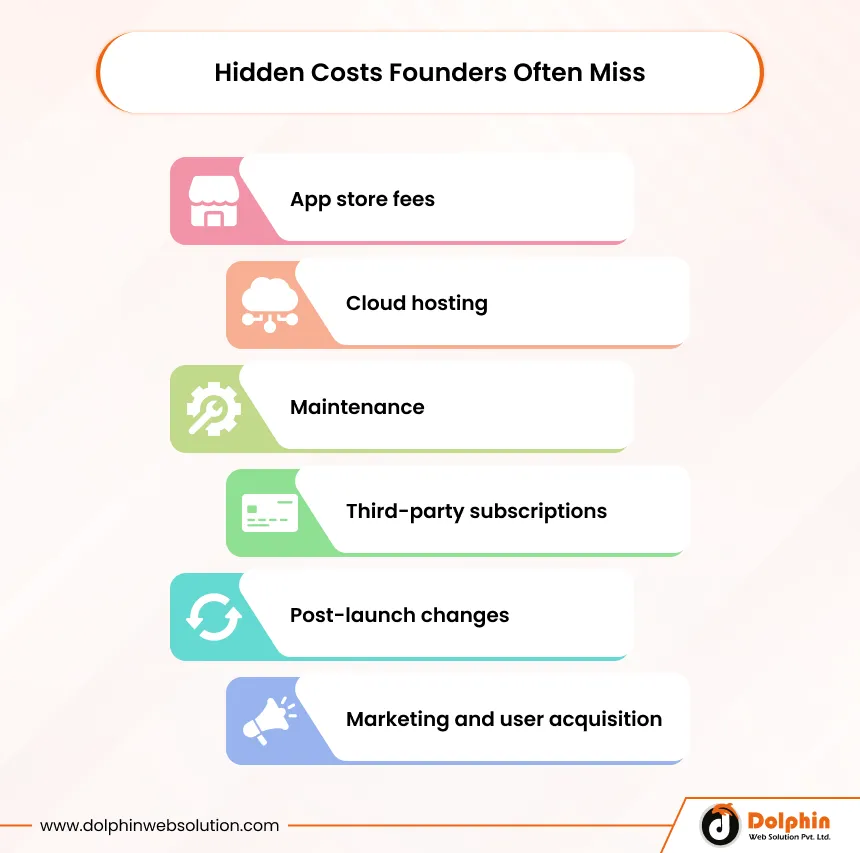
The development quote is rarely the full picture. Plan for these from day one.
- App store fees: Apple's Developer Program costs $99 a year, and Google Play charges a one-time $25 registration fee. The larger cost is the time it takes to prepare store listings, screenshots, privacy policies and age ratings, and to respond if a store review team asks for changes before your app goes live.
- Cloud hosting: servers, databases, file storage and backups are billed monthly, and the bill grows as more people use your app. The first month's cost doesn't predict the cost at 10,000 users, so ask your team to estimate hosting at different usage levels and set billing alerts from the start.
- Maintenance: bug fixes, operating system updates and security patches usually cost 15 to 20 percent of the original build each year. Each new iOS and Android release can break features that worked before, and an app that isn't updated can lose store visibility or stop working for some users.
- Third-party subscriptions: analytics, push notifications, email and SMS delivery, maps and payment processing usually start on free tiers and move to paid plans as you grow. Payment gateways also take a fee on every transaction, which affects your margins and should be part of your pricing from the start.
- Post-launch changes: feedback almost always leads to changes, from small interface fixes to reworked features. Set aside budget and team time for two or three improvement cycles after launch.
- Marketing and user acquisition: an MVP needs real users before it can produce useful feedback. Plan for launch campaigns, app store optimization, early adopter outreach and referral offers.
A practical rule is to set aside an extra 20 to 30 percent of your development budget in the first year for store fees, hosting, maintenance, subscriptions and post-launch changes. Budget marketing separately, because that spend depends on your launch plan rather than on the build.
How to Reduce MVP Development Cost Without Cutting Quality
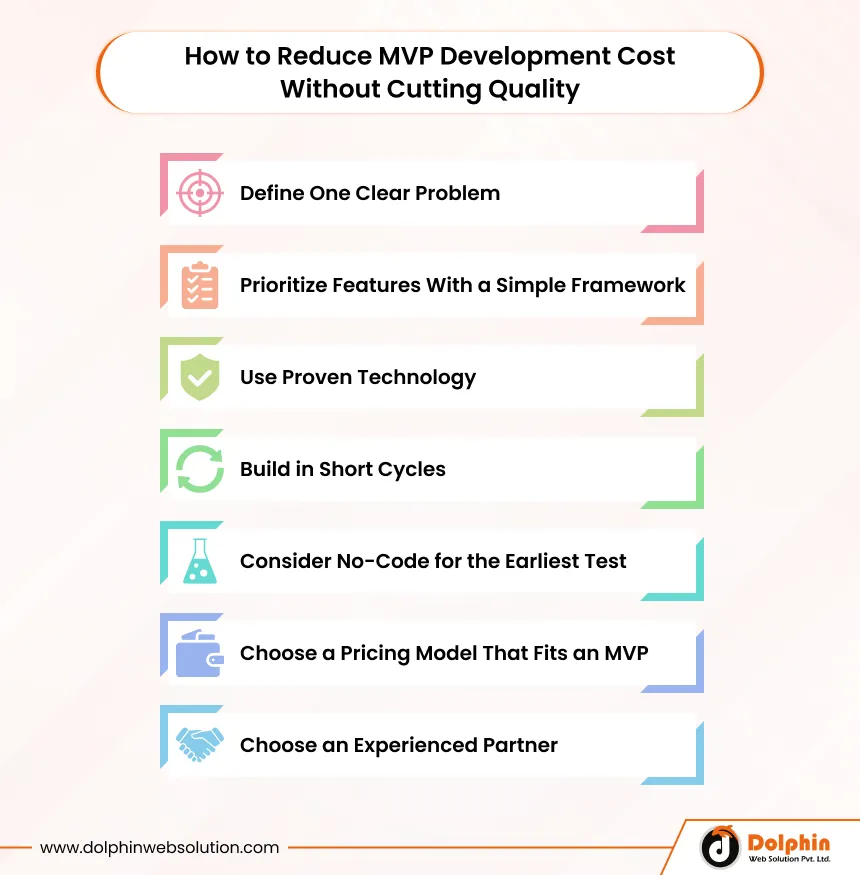
You can lower spending by making deliberate choices rather than by cutting corners.
1. Define One Clear Problem
Start with a single problem and a single user group. Clear focus keeps scope tight and decisions fast.
Write the problem as one sentence, for example: "Small clinics struggle to manage appointments without phone calls." If a proposed feature doesn't help solve that problem, it doesn't belong in the first release. Talking to ten to fifteen people in your target group before development begins often saves weeks of building the wrong thing.
2. Prioritize Features With a Simple Framework
Sort features into three groups and build only the first group at the start:
- Must have: the app can't deliver its core value without it.
- Should have: it improves the experience, but users can manage without it for now.
- Later: it adds value only after you have a stable user base.
Review this list with your development team, because they can point out which items look small but carry a high technical cost.
3. Use Proven Technology
Established frameworks, ready-made components and managed cloud services shorten delivery time. Custom-building everything is rarely necessary at the MVP stage.
Common choices include cross-platform frameworks, managed databases, ready-made login and payment modules, and cloud hosting with automatic scaling. These tools are widely used and well documented, so your team spends its time on what makes your product different. They also make it easier to find developers later when you need to grow the app.
4. Build in Short Cycles
Release in small increments, collect feedback and adjust. This avoids spending months on assumptions that turn out to be wrong.
A typical rhythm is a working release every two to three weeks. After each one, review how people use the app, which screens they skip and what they ask for. Your budget then goes into a series of small, informed decisions instead of one large guess, and you can stop or change direction early if the numbers don't support the idea.
5. Consider No-Code for the Earliest Test
If you mainly need to check whether anyone wants your product, a no-code tool can produce a first version for under $10,000 (about ₹9.5 lakh). The trade-off is less control over performance, security and scaling, and most teams rebuild with custom code once the idea is proven. No-code works well for testing demand and poorly for products that handle payments or sensitive data at scale.
6. Choose a Pricing Model That Fits an MVP
- Fixed price: works when the scope is clear and stable. You know the total in advance, but every change needs a formal change request.
- Time and materials: you pay for hours worked. It suits MVPs whose scope will change after early feedback, as long as you get weekly reports on hours and progress.
- Dedicated team: suits the longer roadmap after launch, when you need a steady team adding features every month.
Many MVPs use a fixed price for discovery and design, then time and materials for development.
7. Choose an Experienced Partner
A skilled team spots scope risks early, which costs far less than fixing them after launch. Ask potential partners how they estimate cost, how they handle changes, and what they would remove from your scope to save money. Their answers tell you more than a low headline price. A partner who questions your assumptions is usually protecting your budget. Working with a team that offers dedicated Mobile App Development expertise helps you avoid rework and keeps the roadmap realistic.

How to Choose the Right MVP Development Partner
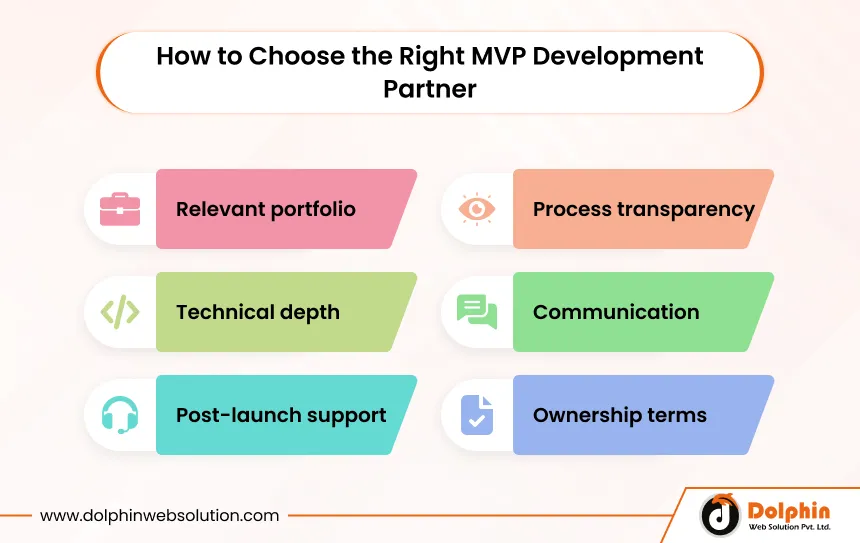
Price is only one part of the decision. Look closely at the following before you sign.
- Relevant portfolio: have they shipped apps similar to yours? Ask to see live apps in the stores, not only screenshots, and find out what role the team played in each project. A strong portfolio in your industry means they already understand your users and the common technical problems.
- Process transparency: do they explain scope, milestones and change requests clearly? A good partner shares a written plan, breaks the work into stages and shows you working software regularly, so you can spot problems before they become expensive.
- Technical depth: can they advise on architecture, security and scalability? Look for a team that explains its technology choices in plain language and plans for data protection and future growth from the MVP stage.
- Communication: will you get regular updates and direct access to the team? Check how quickly they respond during the sales process, which time zones they cover, and whether you will speak with the people building your product or only an account manager.
- Post-launch support: do they offer maintenance and improvements after release? Ask what a warranty period covers, how bug reports are handled and what ongoing support costs, because most MVPs need updates within weeks of launch.
- Ownership terms: is the source code and intellectual property fully yours? Confirm in the contract that you will receive the code, designs, and access to hosting and store accounts, so you never depend on one vendor to keep your product running.
Request references from past clients and compare at least three proposals. Look at what each one includes, not only the total. A cheaper quote that leaves out testing, design or post-launch support often costs more by the time the app is ready for real users.
Why Build Your MVP With Dolphin Web Solution
We have spent more than 15 years building ecommerce platforms, custom software, and mobile applications for businesses across industries. Having supported more than 200 ecommerce stores, we understand the importance of developing practical, scalable digital solutions. Our focus is on helping businesses turn their ideas into functional products that support their goals.
- We tell you which features to cut: We have seen enough products launch to know when a feature adds cost without adding value, and we say so even when it means a smaller project.
- We build for the next stage: Clean code structure, sensible database design and proper security mean you can add features and handle more users later without rebuilding the app.
- You see progress at every milestone: Each stage has a fixed scope, a known cost and working software you can try, so you can adjust the plan before small issues become expensive.
- We stay after launch: The team that built your MVP supports it afterwards, so you work with people who already know your product when it is time to build the next version.
Conclusion
MVP cost in 2027 depends on the decisions you make about scope, platform, design and team. With an experienced India-based team, a well-planned MVP typically costs $10,000 to $60,000 (about ₹9.5 lakh to ₹57 lakh), and complex products cost more. Keep the first release focused, budget for costs beyond the build, and choose a partner who gives you honest advice about scope.
If you are ready to turn your idea into a working product, the next step is a clear scope and a realistic estimate.
Frequently Asked Questions
What is the average cost of MVP app development in 2027?
Most MVPs cost $10,000 to $60,000 (about ₹9.5 lakh to ₹57 lakh) with an experienced India-based team. Simple apps sit near the lower end, while products with payments, integrations or AI features cost more. The same MVP built by a US team can cost several times as much.
How much does it cost to build an MVP in India?
With an Indian development team, a simple MVP typically costs ₹9.5 lakh to ₹24 lakh, a medium MVP ₹24 lakh to ₹57 lakh, and a complex MVP ₹57 lakh or more. The final figure depends on features, platforms and the team's experience.
How long does it take to build an MVP?
A focused MVP usually takes 6 to 16 weeks. Complex products with several user roles or advanced features can take up to 28 weeks.
Should I build my MVP for iOS, Android or both?
If your budget is tight, start with the platform your target users prefer. In India, that is usually Android. Cross-platform frameworks such as Flutter or React Native let you cover both platforms for much less than two separate native apps.
Can I build an MVP for less than $10,000?
Yes, with a very narrow scope or a no-code tool. Quality, scalability and security may be limited, so this works best for testing demand. For a product you plan to grow, a professionally built MVP is safer.
Is a fixed price or hourly billing better for an MVP?
A fixed price suits a clear, stable scope. Hourly billing (time and materials) suits MVPs whose features will change after early feedback. Many teams combine them: a fixed price for discovery and design, then hourly billing for development.
What happens after the MVP launches?
You collect user feedback, track usage, fix issues and decide which features to build next. Most founders also budget for maintenance and a second development phase based on what they learn.
How can I keep my MVP cost under control?
Limit the first release to core features, use proven technology, work in short delivery cycles, and agree on a clear scope and change process with your development partner before work begins.
Rohit Prajapati


Rohit Prajapati is the Chief Executive Officer of Dolphin Web Solution and a recognized expert in eCommerce technologies, digital commerce strategy, and product development. With over 15 years of experience in the technology industry, he helps businesses build high-performing online stores, scalable digital platforms, and innovative customer experiences. As a certified Adobe Commerce Business Practitioner (Magento Solution Specialist), Rohit possesses deep expertise in Shopify, Magento, Shopware, Hyvä, and enterprise eCommerce ecosystems. He has successfully consulted businesses worldwide on platform selection, digital transformation, migration strategies, and growth-focused commerce solutions. Rohit regularly shares insights on eCommerce trends, AI-driven commerce, online business growth, and emerging technologies. His mission is to help organizations create future-ready digital experiences that drive measurable business outcomes and long-term success.

We can help you with
- Dedicated Team
- Setup Extended Team
- Product Development
- Custom App Development
Our Offices

AHMEDABAD (INDIA)
B- 203-206, Empire Business Hub, Science City Road, Sola, Ahmedabad – 380060

BERLIN (GERMANY)
Badensche Str. 28, 10715 Berlin, Germany

CALIFORNIA (USA)
9601 Reseda Blvd, Apt#223, Northridge CA-91324, USA

ALBERTA (CANADA)
302 Skyview Ranch Drive NE, Calgary, Alberta, Canada T3N0P5


Hello!
Click one of our contacts below to chat on WhatsApp