
-
Dolphin Web SolutionMobile AppHow Much Does It Cost to Maintain a Mobile App?
 15 Min Read
How Much Does It Cost to Maintain a Mobile App?


Table of Contents
 Show
Show

Summary :
What makes an app successful in the long run? It's not just the launch—it's regular maintenance. This blog covers the role of mobile app maintenance, how much it costs, and some common maintenance activities. So that you can find an estimated cost of your app maintenance.
Did you know the difference between a successful mobile app and an unsuccessful app? Well, it’s the maintenance.
Many businesses think that building and launching a mobile app is enough for their business success. But that’s not true!
Maintenance is what matters to keep the app running smoothly for years. Especially in today’s digitization, where apps frequently face lots of bugs, glitches, and cyber threats once they launch.
That’s why regular maintenance has become crucial for every app after its launch to resolve these issues.
In fact, as per a recent report, more than 60% of apps required modifications and maintenance every three months to be compatible with both Android and iOS. This clearly shows why it’s essential to stay updated with app needs.
Despite its crucial role, many businesses neglect the importance of maintenance of their app due to confusion and cost worries. But not anymore!
In this blog, we will understand the role of mobile app maintenance, its cost-affecting factors, and the average cost of mobile app maintenance so that you can get an accurate price for your mobile app maintenance and plan.
What Is Mobile App Maintenance?
Maintaining your mobile app means keeping it updated, secure, and in good working condition after launch.
App maintenance includes bug fixes, developing performance upgrades, re-design/update for new Android or iOS versions as needed, and adding new features when needed.
App maintenance not only covers “fixing” issues but also improves the application incrementally to make sure users remain happy and engaged.
If updates do not occur regularly, users may run into issues, and it could lead them to abandon your app.
This happens with new applications because they usually need issues fixed regularly, upgrades, and new features to develop the app based on user input properly. Once this is complete, the app is more stable.
Regularly scheduled app maintenance is necessary to ensure users have a positive experience, the app continues being successful against competitors, and the application continues to meet business objectives over time.
Factors That Influence Mobile App Maintenance Costs
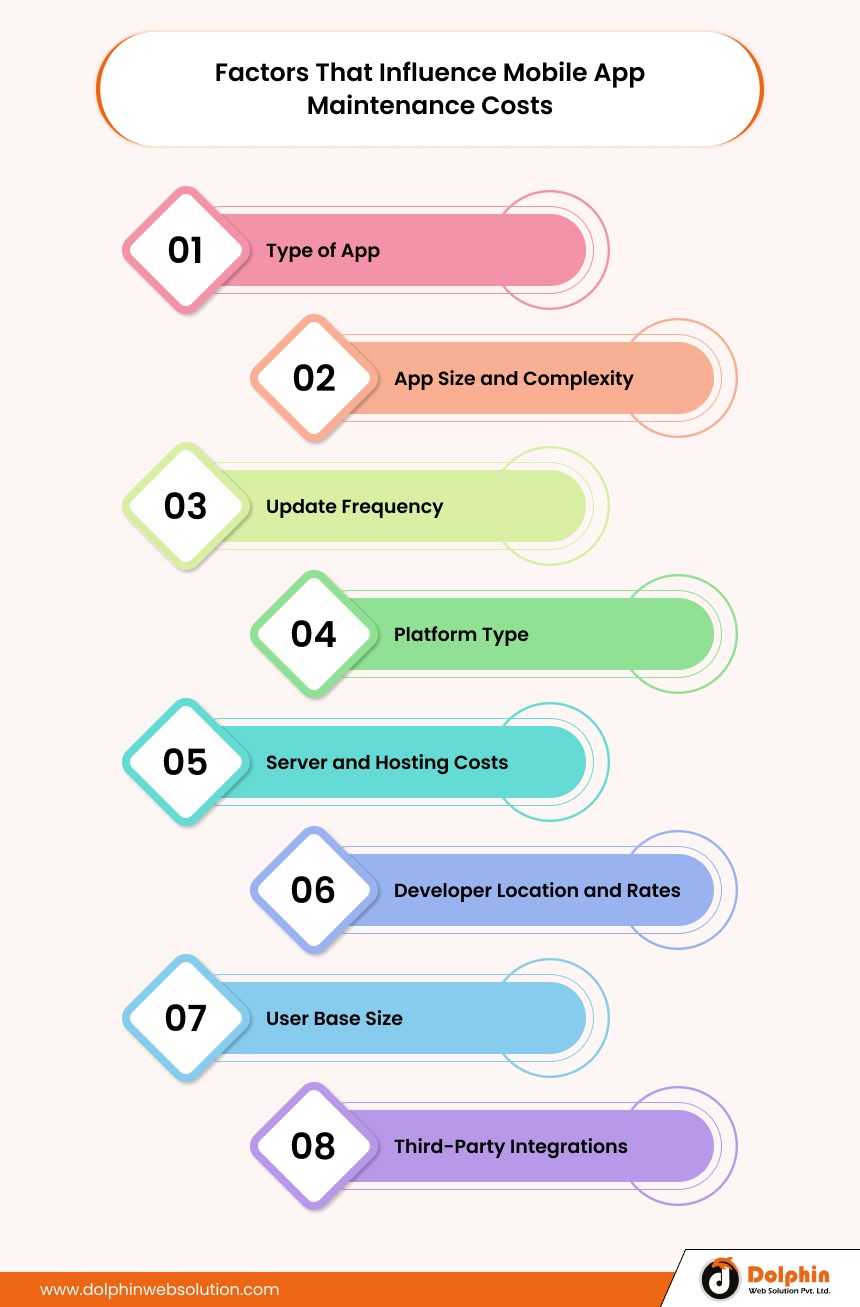
The cost of maintaining a mobile app can vary depending on several key factors. Here are some key factors that mainly affect the price of mobile app maintenance:
1. Type of App
The kind of app you’ve built makes a huge difference.
- A basic app (like a calculator, quiz, or catalog viewer) is simple to maintain because there’s less to go wrong.
- A mid-level app (like a food delivery app or event booking app) may involve things like login systems, user dashboards, and push notifications—these require more regular updates and care.
- A complex app (like an e-commerce app, ride-sharing app, or something using AI) needs frequent updates, advanced testing, and constant backend monitoring. These apps cost significantly more to maintain.
Overall, the more features your app has like payments, chat, or live tracking—the more time it takes to keep everything running smoothly.
2. App Size and Complexity
Your app’s size, functionality, and work must stay up and running and are directly correlated. An app needs more maintenance the more features it has.
For example, an app that has user profiles, in-app chat, payment systems, and real-time notifications will require regular updates and checks for each feature.
Also, if the app connects to a backend server, upon entering the app, syncs data to the server in real-time, or has integrations with advanced technologies like AI or AR, your codebase becomes complex.
3. Update Frequency
If your app gets frequent updates like adding new features or improving performance. It will require a bigger budget than an app that only gets occasional fixes.
Many businesses prefer monthly or quarterly updates to keep their apps fresh and in line with user expectations. Others might only update when necessary.
So the more often you update, the more budget you will need for maintenance.
4. Platform Type
The type of platform your app is built on also affects maintenance costs. If you’ve built an Android app or iOS app, each one needs maintenance. This doubles the workload when operating systems release updates, or new devices hit the market.
At this point, cross-platform apps can be more efficient to maintain because you only need to update one codebase, but even they come with unique challenges.
Generally, managing two native apps costs more than maintaining a single cross-platform one.
5. Server and Hosting Costs
If your app stores data, sends notifications or allows logins, it needs backend servers to process and store that data. Your server and hosting costs will depend on the following:
- How many users are using the app
- How much data is being stored
- How fast your app needs to be (speed = power = cost)
In short, server and hosting are what keep your app running smoothly every day. As your app gets more users or handles more data, this cost will grow, too.
6. Developer Location and Rates
Where your developers are located has a lot of impact. Hourly rates differ significantly from one country to another, and your overall maintenance budget will depend on the hourly rates of where your developers are located.
For example, developers located in North America or Europe charge more (around $80-$150/hour) than skilled developers situated in places like India or the Philippines (around $20–$50/hour).
7. User Base Size
The amount of users on your app directly affects how much it will take to maintain and run everything. Let’s break it down!
Small User Base (<10,000 users)
With a small user base, it is easier to maintain the app. There are fewer problems, a lower server load, fewer updates, and most fixes can be undertaken quickly by one developer or a developer and testers. It keeps maintenance lower.
Medium User Base (10,000–100,000 users)
With a higher base of users comes more server requirements, more enhancements, and more support to maintain the users. The maintenance becomes active and moderately priced.
Large User Base (100,000+ users)
With a high-traffic app, servers time out and crash regularly. At this point, your maintenance process is costly and complex.
In simple words, the more users you have, the more demand on your support, back end, and update cycle, and the more your maintenance increases.
8. Third-Party Integrations
Nowadays, third-party integrations like payments, mapping technologies, user analytics, messaging, social login, etc., are what most mobile applications use.
These integrations have a major influence on the performance, functionalities, and user experience of the mobile app but do add the burden of management and complication of costs overall.
Overall, the more you rely on third-party integration, the more often you will need to check, manage, and change those integrations to keep a mobile application running.
Typical Mobile App Maintenance Activities
Here are some typical activities to maintain a mobile app:
- Bug Fixes: Fixing issues with app crashes, errors, or broken functionality.
- Speed and Performance: Improve load time, reduce lag time, and reduce battery or data use.
- Security Updates: Keep the app secure from hacking and user data.
- OS & Device Updates: Make sure that the app complies with the latest versions of iPhones, Android Phones, and software versions.
- Design Improvements (UI/UX): Update design and user experience to make it more user-friendly and enjoyable.
- New Features: Add new features/update tools or options to keep the app fresh and valuable.
- Tracking Performance: Track the performance of the app in real-time and identify issues early.
- User Feedback: Collect and listen to user feedback, resolve their complaints, and update/change improvements requested by users.
- App Store Updates: Changes to the app listings (title, screenshots, etc) so they are the most useful listing for an increased number of downloads.
- Server & Backend Maintenance: Maintain the servers and services that operate the app, store the app’s data, and make the application accessible online.
Average Cost Range for Mobile App Maintenance
The average cost of mobile app maintenance generally ranges between 15% to 20% of the initial mobile app development cost. However, the actual cost can vary based on several factors. It may include the frequency of updates, the number of users, etc.
Conclusion
App maintenance is not an option; it is a necessity! It helps keep your app efficient, secure, and current across all devices. However, app maintenance costs can vary in price depending on a number of factors. We hope this guide will help you identify why app maintenance is important, the key factors affecting costs of app maintenance, and the average cost of mobile app maintenance in order to estimate the maintenance cost for your app. Still confused? Connect with an experienced mobile app development company and let the professional help you find the accurate cost estimate of your app maintenance.

Nimesh Patel


Nimesh Patel is the Managing Director of Dolphin Web Solution, a global eCommerce, AI, and software development company helping businesses accelerate digital growth. With over 15 years of experience in technology consulting and product development, he has successfully guided startups, SMBs, and enterprise organizations in building scalable digital solutions. Nimesh specializes in eCommerce development, custom software solutions, mobile application development, and digital transformation strategies. Throughout his career, he has worked closely with businesses across retail, healthcare, automotive, manufacturing, and technology sectors, helping them leverage modern technologies to improve operational efficiency and customer experiences. As a business leader, Nimesh is passionate about innovation, entrepreneurship, and helping organizations turn ideas into successful digital products. His insights focus on eCommerce growth, AI adoption, software development trends, and business transformation through technology.

We can help you with
- Dedicated Team
- Setup Extended Team
- Product Development
- Custom App Development
Our Offices

AHMEDABAD (INDIA)
B- 203-206, Empire Business Hub, Science City Road, Sola, Ahmedabad – 380060

BERLIN (GERMANY)
Badensche Str. 28, 10715 Berlin, Germany

CALIFORNIA (USA)
9601 Reseda Blvd, Apt#223, Northridge CA-91324, USA

ALBERTA (CANADA)
302 Skyview Ranch Drive NE, Calgary, Alberta, Canada T3N0P5





Hello!
Click one of our contacts below to chat on WhatsApp