How to Choose the Right AI Tech Stack for Your Project


Table of Contents
 Show

- 1 What Is an AI Technology Stack?
- 2 Start With Your Project Goals Before Choosing Any Tools
- 3 Key Components to Evaluate in Your AI Technology Stack
- 4 Build, Buy, or Customize: Which Approach Fits Your Project?
- 5 A Step by Step Process to Choose the Right AI Technology Stack
- 6 Recommended AI Stack Options by Project Type
- 7 Key Factors That Should Influence Your Technology Decision
- 8 Common Mistakes to Avoid When Choosing an AI Stack
- 9 Why Partner with an Experienced Development Team of Dolphin Web Solution
- 10 Conclusion

Summary :
Choosing an AI technology stack is one of the most important decisions in any AI project. This guide explains the core layers of a stack, how to match tools to your goals, data, budget, and team, and how to avoid common mistakes. It also compares build, buy, and customize approaches and shows what to look for in a development partner.
Most AI projects do not fail because the idea was weak. They fail because the technology underneath the idea did not fit the problem, the data, or the team expected to maintain it.
Your AI technology stack is the combination of data tools, models, frameworks, infrastructure, and deployment systems that powers your product. Pick it well and you get faster delivery, lower running costs, and room to grow. Pick it poorly and you face rewrites, slow performance, and budgets that keep stretching.
This guide walks you through how to choose the right AI technology stack for your project. You will learn what a stack contains, how to match tools to your goals, how to compare build, buy, and customize options, and which mistakes to avoid. Whether you are planning an AI chatbot, a recommendation engine, or a predictive analytics tool, the same decision process applies.
What Is an AI Technology Stack?
An AI technology stack is the full set of technologies used to collect data, train or access models, build the application around them, and run everything reliably in production. Think of it as the foundation, walls, and wiring of a building. Each layer depends on the others, and a weak layer limits everything above it.
The Core Layers of an AI Stack
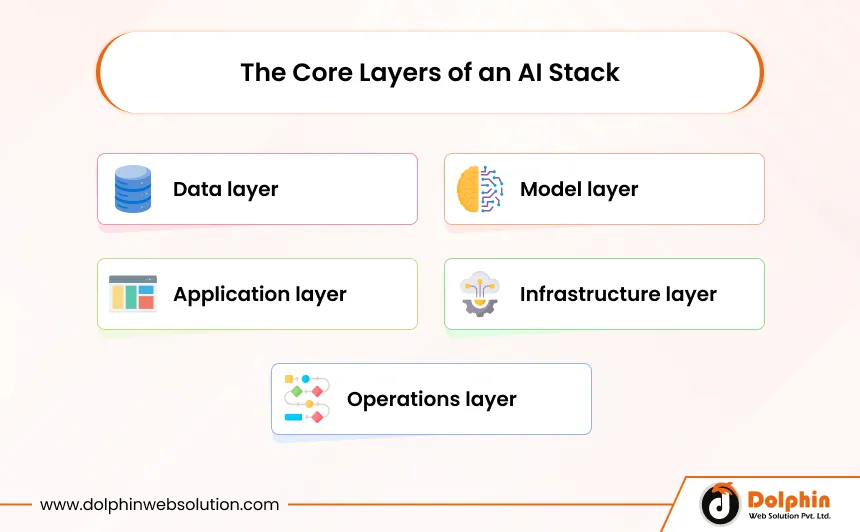
Most AI projects, regardless of size, include the layers below.
| Layer | What It Does | Common Examples |
|---|---|---|
| Data layer | Collects, stores, cleans, and organizes the data your AI learns from | PostgreSQL, MongoDB, BigQuery, Snowflake, data lakes |
| Model layer | Provides the intelligence, either trained by you or accessed through an API | PyTorch, TensorFlow, scikit learn, OpenAI, Anthropic, open source models |
| Application layer | Turns model output into a usable product | Python, Node.js, React, mobile frameworks, REST or GraphQL APIs |
| Infrastructure layer | Supplies the computing power and hosting | AWS, Google Cloud, Microsoft Azure, GPU servers |
| Operations layer | Deploys, monitors, and updates models over time | Docker, Kubernetes, MLflow, CI/CD pipelines, monitoring tools |
Understanding these layers helps you ask better questions before any development begins. Instead of asking which AI tool is best, you ask which combination of tools suits your specific project.
Start With Your Project Goals Before Choosing Any Tools
The most common mistake in AI planning is starting with a tool name. Strong stacks begin with clear answers about the problem, the data, and the constraints.
1. Define the Business Problem Clearly
Write down what the AI needs to do in one or two sentences. "Answer customer questions instantly" and "predict which orders will be returned" lead to very different stacks. A clear problem statement also helps you decide whether AI is needed at all. Some problems are solved faster and cheaper with standard software logic. If you want an outside view at this stage, our AI Consulting Services can help you test the idea before you commit a budget.
2. Assess Your Data Readiness
Data shapes almost every technology decision. Ask these questions early:
- Do you already have enough data, and is it accurate and consistent?
- Is the data structured (tables), unstructured (text, images, audio), or a mix?
- Where does it live today, and how easily can it be accessed?
- Are there privacy rules that limit how it can be used?
- Will new data keep arriving after launch?
If your data is limited, a pretrained model or an API based approach usually makes more sense than training a model from scratch.
3. Set Realistic Budget, Timeline, and Team Capacity
A powerful stack is useless if your team cannot maintain it. Consider the following before you shortlist technologies:
- Budget: Include development, cloud usage, licensing, and ongoing maintenance, not only the build cost.
- Timeline: Tight deadlines favor managed services and existing APIs over custom model training.
- Team skills: Choose tools your developers know or can learn quickly, or plan for a partner who does.
- Long term ownership: Decide who will monitor, retrain, and update the system after launch.
Key Components to Evaluate in Your AI Technology Stack
Once your goals are clear, evaluate each layer of the stack on its own merits.
1. Data Collection, Storage, and Processing
Your data tools should match the volume, speed, and type of data you handle. Relational databases suit structured business data. Document databases and data lakes handle text, logs, and mixed formats. For AI search and recommendation features, a vector database such as Pinecone, Weaviate, or pgvector stores embeddings so the system can find similar content quickly. Data pipelines built with tools like Apache Airflow or dbt keep that data clean and current.
2. Machine Learning Frameworks and Libraries
If you are training your own models, your framework matters.
- PyTorch: Popular for research and flexible custom models, and widely supported.
- TensorFlow: Strong for production deployment and mobile or edge use cases.
- scikit learn: A reliable choice for classical machine learning on structured data.
- Hugging Face Transformers: Gives fast access to pretrained language and vision models.
3. Large Language Models and AI APIs
For chatbots, content tools, search, and document analysis, most teams start with a hosted large language model through an API. This lowers upfront cost and speeds up delivery. Compare providers on output quality for your task, response speed, pricing per request, data handling policies, and availability in your region. Open source models can reduce per request cost and give you more control over data, but they require more engineering and hosting effort.
4. Infrastructure and Cloud Platforms
AWS, Google Cloud, and Microsoft Azure all offer managed AI services, GPU instances, and strong security tooling. The best choice often depends on where your existing systems already run, since moving data between clouds adds cost and complexity. Check GPU availability, regional data rules, and pricing models before you commit.
5. MLOps and Deployment Tools
A model that works in a notebook is not the same as a model that works for thousands of users. MLOps tools handle versioning, deployment, monitoring, and retraining. Docker and Kubernetes support consistent releases, while platforms such as MLflow track experiments and model versions. Monitoring is especially important because AI performance can drift as real world data changes.

Build, Buy, or Customize: Which Approach Fits Your Project?
Before you pick individual tools, decide how much of the AI you will create yourself. There are three common paths, and each suits a different situation.
| Approach | Best For | Advantages | Trade Offs |
|---|---|---|---|
| Buy (use ready made AI APIs and SaaS tools) | Standard use cases, fast launches, small teams | Quick setup, low upfront cost, no model training | Less control, ongoing usage fees, limited differentiation |
| Customize (adapt pretrained models with your data) | Domain specific needs such as support, search, or document processing | Better accuracy for your use case, faster than building from scratch | Needs quality data and some ML expertise |
| Build (train custom models from scratch) | Unique problems, strict data control, long term competitive advantage | Full control, tailored performance, own your IP | High cost, longer timeline, specialist talent required |
How to Decide Between the Three
For most businesses, the sensible starting point is buy or customize. Training a model from scratch rarely pays off unless you have a large proprietary dataset and a problem that existing models cannot solve. Many teams begin with an API, prove the value with real users, and move to a customized or custom model only when the numbers justify it.
If you already know what you want to launch, our AI App Development Services cover everything from architecture and integration to deployment and support, so the stack you choose is built to work inside your real product.
A Step by Step Process to Choose the Right AI Technology Stack
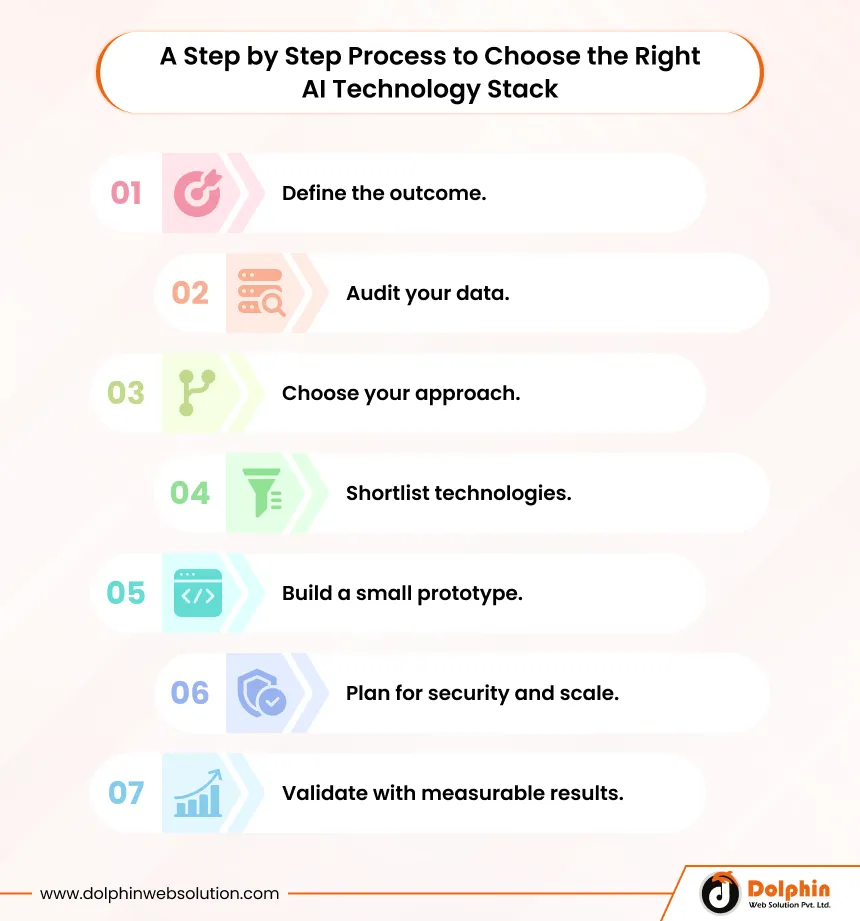
Use this process to move from idea to a confident technology decision.
Follow These Seven Steps
- Define the outcome: State the business result you want, such as fewer support tickets or higher repeat purchases, and how you will measure it.
- Audit your data: Review quality, volume, format, and access. Fix major gaps before choosing tools.
- Choose your approach: Decide whether you will buy, customize, or build, using the comparison above.
- Shortlist technologies: Pick two or three options per layer and compare them on fit, cost, community support, and long term viability.
- Build a small prototype: Test the top options on a narrow use case with real data. A prototype reveals problems that a spec sheet never will.
- Plan for security and scale: Check how the stack handles user growth, data privacy, and compliance requirements.
- Validate with measurable results: Compare accuracy, speed, and cost against the targets from step one, then commit to the winner.
This process keeps decisions grounded in evidence rather than trends, and it gives your stakeholders a clear record of why each technology was selected.
Recommended AI Stack Options by Project Type
There is no single best stack. The right combination depends on what you are building. The table below shows typical starting points, which you can adjust based on your data and constraints.
| Project Type | Typical Model Approach | Common Supporting Tools | Key Consideration |
|---|---|---|---|
| AI chatbot or assistant | Hosted LLM API with retrieval over your own content | Vector database, Python or Node.js backend, React frontend | Answer accuracy and data privacy |
| Recommendation engine | Collaborative filtering or embedding based models | Python, PyTorch or scikit learn, feature store, Redis | Fresh data and fast response |
| Computer vision | Pretrained vision models, fine tuned on your images | PyTorch, OpenCV, GPU cloud instances | Image quality and labeling effort |
| Predictive analytics | Gradient boosting or time series models | Python, scikit learn, XGBoost, BI dashboards | Data history and explainability |
| Document processing | OCR plus LLM extraction | Cloud OCR services, queue systems, secure storage | Accuracy on messy documents |
1. AI Chatbots and Virtual Assistants
For most chatbot projects, retrieval augmented generation is the practical choice. The model answers using your own documents, which keeps responses relevant and reduces made up answers. Focus your stack choices on the retrieval layer, access controls, and logging so you can review and improve responses.
2. Personalization and Recommendation Engines
Ecommerce and content platforms benefit from systems that learn from browsing and purchase behavior. Speed matters here, so choose tools that can serve results in milliseconds and update as customer behavior changes.
3. Predictive Analytics and Forecasting
Demand forecasting, churn prediction, and fraud detection often work well with proven machine learning methods rather than large neural networks. Simpler models are easier to explain, cheaper to run, and quicker to maintain.
Key Factors That Should Influence Your Technology Decision
Beyond features and performance, a few practical factors decide whether your stack succeeds over time.
1. Scalability and Performance
Ask how the stack behaves when usage grows tenfold. Managed cloud services, containerized deployments, and caching strategies make it easier to scale without rebuilding. Test response time under realistic load, since AI features can be slower and more resource heavy than standard application features.
2. Security, Privacy, and Compliance
AI systems often handle sensitive customer or business data. Review how each tool stores, processes, and shares that data. Depending on your industry and region, you may need to meet requirements such as GDPR, HIPAA, or PCI DSS. Look for encryption, access controls, audit logs, and clear data retention policies from every vendor in your stack.
3. Integration With Your Existing Systems
Your AI feature must work with your current website, CRM, ERP, payment systems, and databases. Check that the tools you choose offer stable APIs and documentation. A technically impressive model that cannot connect to your existing platform will create delays and extra cost.
4. Total Cost of Ownership
License fees are only one part of the cost. Include cloud computing, API usage, data storage, monitoring, security, and the engineering time needed to maintain the system. Starting with a focused first release helps you control spending while you validate demand. Our guide on MVP App Development Cost in 2027 explains how to budget for a lean launch before scaling.
Use this checklist to compare finalists:
- Does it fit our data type, volume, and quality?
- Can our team build and maintain it?
- Does it meet our security and compliance needs?
- Will it scale without a costly rebuild?
- Is the total cost clear for the first year and beyond?
- Is the technology actively supported and widely adopted?

Common Mistakes to Avoid When Choosing an AI Stack
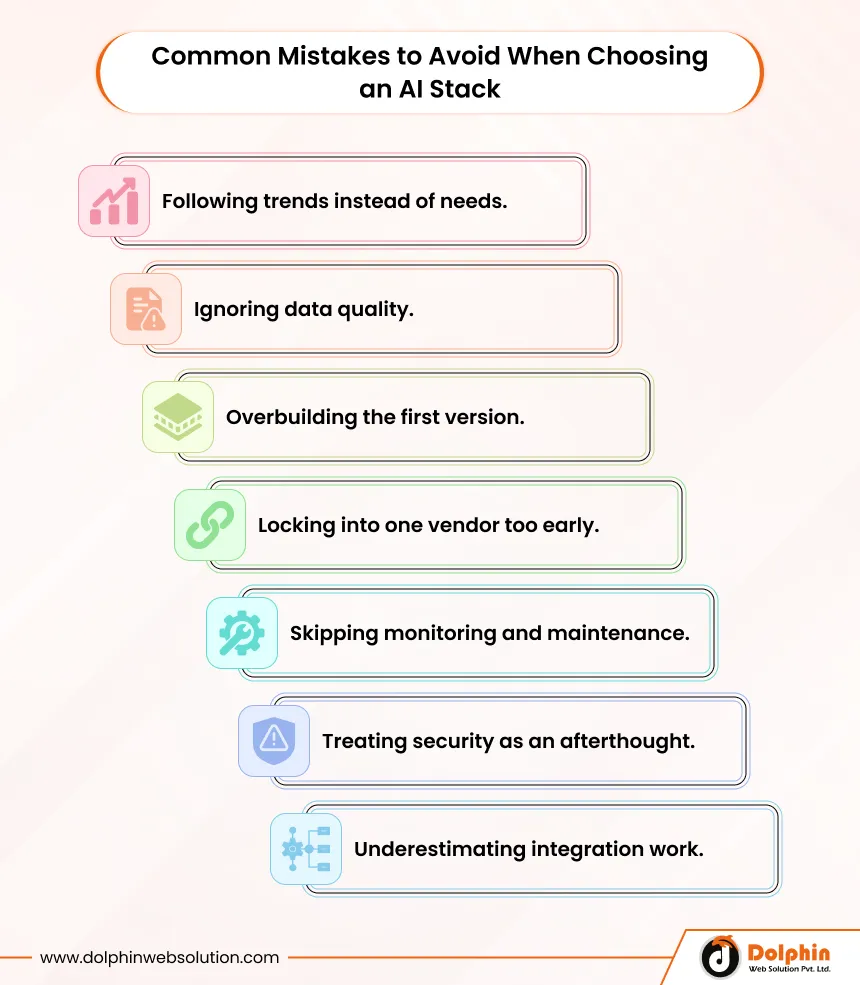
These errors show up again and again in AI projects, and most are avoidable with early planning.
- Following trends instead of needs: The newest framework is not always the right one. Choose based on your problem, not on headlines.
- Ignoring data quality: Even the best model produces weak results from poor data. Budget time for cleaning and preparation.
- Overbuilding the first version: Complex architectures slow delivery. Start with the simplest stack that proves the value.
- Locking into one vendor too early: Keep your architecture flexible so you can switch models or providers as the market changes.
- Skipping monitoring and maintenance: AI systems change in performance over time. Plan for tracking, retraining, and updates from day one.
- Treating security as an afterthought: Adding compliance and protection later is slower and more expensive than designing for it at the start.
- Underestimating integration work: Connecting AI to existing platforms often takes more effort than building the model itself.
Why Partner with an Experienced Development Team of Dolphin Web Solution
Choosing the right AI technology stack is easier when your team understands both software engineering and applied AI. That depth shows up in practical ways.
You get honest advice, including when a simpler tool, or no AI at all, is the better fit. You get a solid architecture that keeps AI features secure, stable, and easy to maintain. You also get a team that knows the gap between a working demo and a production ready system, and that stays with you after launch for ongoing support and improvement.
Dolphin Web Solution has spent more than 15 years building ecommerce platforms, custom software, and now AI powered features for businesses across industries. That mix of engineering discipline and applied AI experience is often what is missing when AI projects fail to move past the prototype stage.
Conclusion
The right AI technology stack is not the most advanced one. It is the one that fits your goals, your data, your budget, and your team. Start with a clear business problem, assess your data honestly, choose between buying, customizing, and building, and test your shortlist with a small prototype before you commit.
Keep security, scalability, and total cost in view throughout, and avoid the common traps of chasing trends or overbuilding the first release. With a thoughtful approach and the right partner, your AI project can move from idea to a reliable, production ready product that delivers measurable value.
Frequently Asked Questions
What is an AI technology stack?
An AI technology stack is the combination of data tools, machine learning frameworks, models, infrastructure, and deployment systems used to build and run an AI powered application.
How do I know if my project needs a custom AI model?
Most projects do not. If a pretrained model or an AI API can handle your task with acceptable accuracy, that is usually faster and cheaper. Custom models make sense when you have unique data, strict privacy needs, or a problem that existing models cannot solve well.
Which programming language is best for AI development?
Python is the most common choice because of its large ecosystem of AI libraries and tools. JavaScript and TypeScript are often used for the application layer, and languages like Java or Go appear in high performance backend systems.
How much does it cost to build an AI application?
Cost depends on scope, data readiness, the approach you choose, and ongoing cloud and maintenance needs. A focused first version that uses existing AI APIs costs far less than a fully custom model, so many businesses start small and expand once the value is proven.
Should I choose open source or proprietary AI models?
It depends on your priorities. Proprietary models through APIs offer faster setup and strong performance with less engineering work. Open source models give more control over data and hosting but need more technical effort. Many teams start with APIs and consider open source later.
How long does it take to choose and set up an AI stack?
A clear evaluation, including data review and a small prototype, often takes a few weeks. Timelines vary with project complexity, data quality, and how many integrations are required.
Nimesh Patel


Nimesh Patel is the Managing Director of Dolphin Web Solution, a global eCommerce, AI, and software development company helping businesses accelerate digital growth. With over 15 years of experience in technology consulting and product development, he has successfully guided startups, SMBs, and enterprise organizations in building scalable digital solutions. Nimesh specializes in eCommerce development, custom software solutions, mobile application development, and digital transformation strategies. Throughout his career, he has worked closely with businesses across retail, healthcare, automotive, manufacturing, and technology sectors, helping them leverage modern technologies to improve operational efficiency and customer experiences. As a business leader, Nimesh is passionate about innovation, entrepreneurship, and helping organizations turn ideas into successful digital products. His insights focus on eCommerce growth, AI adoption, software development trends, and business transformation through technology.

We can help you with
- Dedicated Team
- Setup Extended Team
- Product Development
- Custom App Development
Our Offices

AHMEDABAD (INDIA)
B- 203-206, Empire Business Hub, Science City Road, Sola, Ahmedabad – 380060

BERLIN (GERMANY)
Badensche Str. 28, 10715 Berlin, Germany

CALIFORNIA (USA)
9601 Reseda Blvd, Apt#223, Northridge CA-91324, USA

ALBERTA (CANADA)
302 Skyview Ranch Drive NE, Calgary, Alberta, Canada T3N0P5


Hello!
Click one of our contacts below to chat on WhatsApp