
AI Consulting vs AI Development: What’s the Difference?


Table of Contents
 Show
Show
- 1 What Is AI Consulting?
- 2 What Is AI Development?
- 3 AI Consulting vs AI Development: What's the Difference?
- 4 When Does Your Business Need AI Consulting?
- 5 When Does Your Business Need AI Development?
- 6 Why Most Businesses Need Both AI Consulting and AI Development
- 7 Benefits of Combining AI Consulting and AI Development
- 8 How to Choose the Right AI Partner
- 9 Why Choose Dolphin Web Solution for AI Consulting and Development?
- 10 Conclusion

Summary :
Confused about AI consulting and AI development? Learn the key differences, when your business needs each service, and why combining strategy with implementation leads to successful AI adoption. Discover how the right AI partner can help you maximise your investment and achieve long term business growth.
AI adoption is growing fast, and so is the confusion around how to actually get started. Business leaders often reach out asking for AI development when what they really need first is AI consulting, or the reverse: they have a clear strategy already and just need someone to build it. The two terms get used interchangeably, but they describe genuinely different work, done at different stages of an AI initiative.
Understanding the difference matters because getting the order wrong is expensive. Businesses that jump into development without a strategy often build something technically impressive that never delivers real value, while businesses that only ever consult, without ever building, never see a return on the planning at all.
This guide explains what AI consulting and AI development are, how they differ, when your business needs each, why most businesses eventually need both, and how to choose the right partner for each stage.
What Is AI Consulting?
Understanding AI Consulting
It focuses on understanding a business’s goals, data, and constraints well enough to determine which AI initiatives are actually worth pursuing, and in what order. The output of a consulting engagement is typically a strategy, a prioritized set of use cases, and a roadmap, rather than working software. Our own AI Consulting Services team works with businesses at exactly this stage, helping them figure out the right target before anyone starts building toward it.
What Does an AI Consultant Do?
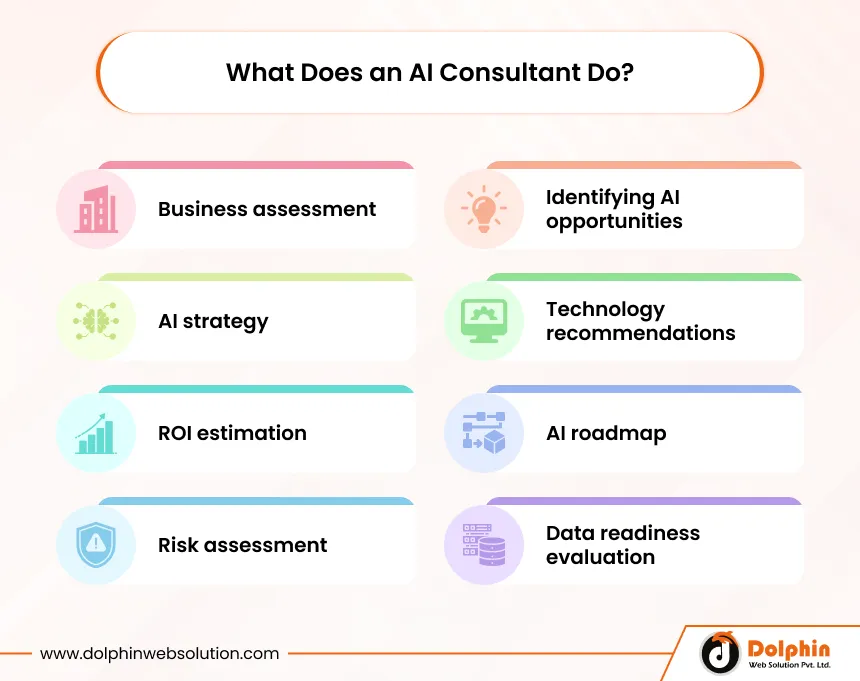
A consulting engagement typically covers the following areas:
| Consulting Activity | What It Involves |
|---|---|
| Business assessment | Understanding current operations and where AI could realistically add value |
| Identifying AI opportunities | Separating promising use cases from ones that sound interesting but will not deliver results |
| AI strategy | Defining the overall approach and priorities for AI adoption |
| Technology recommendations | Suggesting the right models, platforms, and vendors for the business’s needs |
| ROI estimation | Projecting the expected return for each proposed use case |
| AI roadmap | Sequencing initiatives into a realistic, phased plan |
| Risk assessment | Identifying security, compliance, and operational risks before they become problems |
| Data readiness evaluation | Assessing whether existing data can actually support the proposed use cases |
What Is AI Development?
Understanding AI Development
AI development is where a validated strategy becomes a real, working product. Developers take the priorities and technical direction defined during consulting and turn them into software that integrates with a business’s existing systems and actually gets used day to day. This is a technical, hands on process involving model selection, coding, testing, and deployment, distinct from the more advisory nature of consulting.
AI Development Services Include
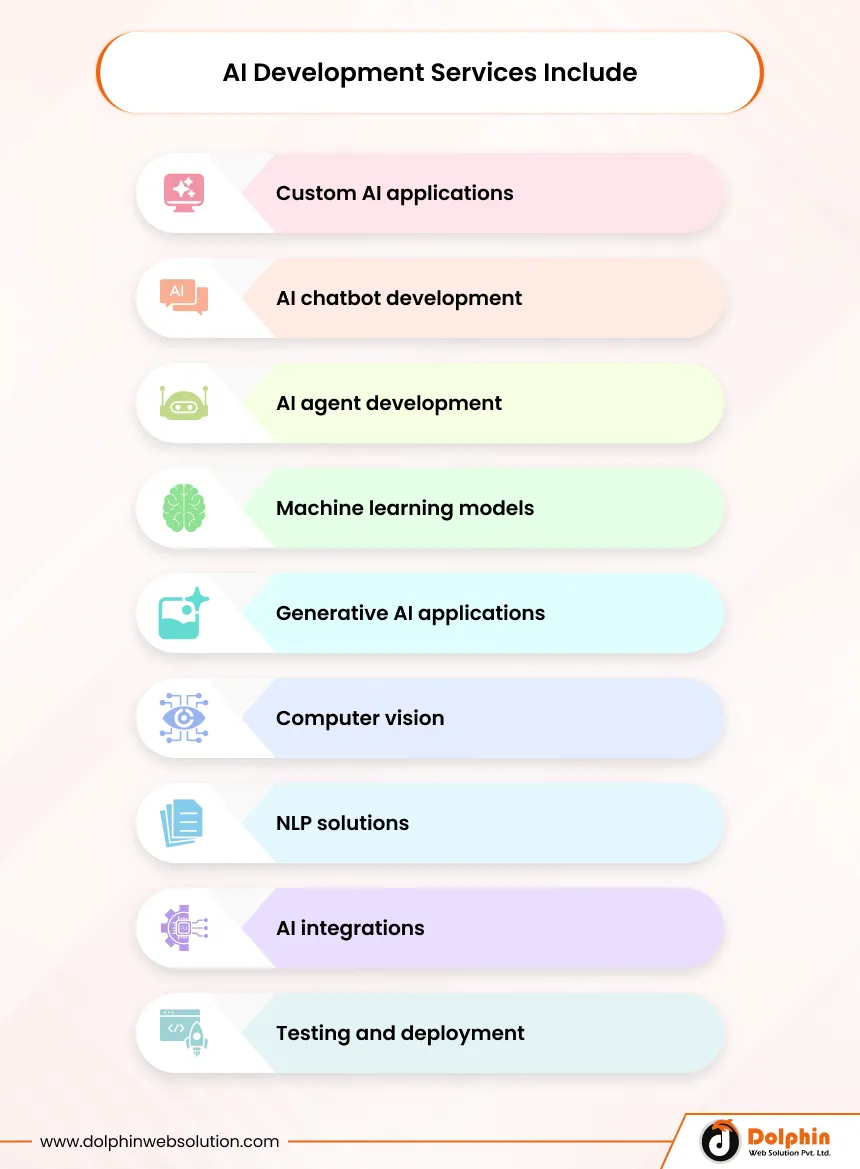
Development work spans a range of technical services, most commonly:
| Development Service | What It Involves |
|---|---|
| Custom AI applications | Purpose built software designed around a specific business use case |
| AI chatbot development | Conversational assistants for customer support or internal use |
| AI agent development | Systems that can plan and execute multi step tasks autonomously |
| Machine learning models | Custom models trained on business data for prediction and classification |
| Generative AI applications | Tools that create content, summaries, or responses using large language models |
| Computer vision | Image and video analysis for tasks like inspection and recognition |
| NLP solutions | Text understanding tools such as sentiment analysis and document processing |
| AI integrations | Connecting new AI capabilities into existing CRM, ERP, or other business systems |
| Testing and deployment | Validating performance and safely launching the solution into production |
Our AI App Development team handles this full range of work, from a single custom model to a fully integrated enterprise AI system.
AI Consulting vs AI Development: What's the Difference?
Although both services contribute to successful AI adoption, they serve different purposes within the overall implementation process.
| AI Consulting | AI Development |
|---|---|
| Focuses on business strategy | Focuses on building AI solutions |
| Identifies opportunities | Implements AI technologies |
| Creates implementation roadmap | Develops working applications |
| Evaluates business readiness | Writes code and trains AI models |
| Analyses risks and ROI | Tests, deploys, and maintains solutions |
| Recommends suitable technologies | Integrates AI into business systems |
| Guides decision making | Delivers functional AI products |
When Does Your Business Need AI Consulting?
- You are at the beginning of your AI journey: If your business has not yet used AI in any meaningful way, consulting helps you avoid the expensive trial and error of figuring it out through direct experience.
- You are unsure where AI actually fits: A general sense that AI could help, without a specific use case in mind, is the clearest sign that strategy work needs to happen first.
- Multiple departments need automation: When several teams have overlapping AI needs, consulting helps prioritize and sequence them instead of letting each department pursue its own uncoordinated project.
- You need a clear AI roadmap: Businesses planning a multi year digital transformation benefit from a sequenced plan rather than a series of disconnected pilots.
- You are planning your AI budget: Consulting gives leadership a realistic picture of cost and expected return before committing significant spend.
- You are undergoing broader digital transformation: AI initiatives tend to succeed more reliably when they are planned alongside other technology and process changes, not bolted on separately.
When Does Your Business Need AI Development?
Once you have a clear strategy, the next step is turning ideas into practical solutions. This is where AI development becomes essential. AI development focuses on designing, building, testing, deploying, and maintaining applications that solve real business problems.
Your organisation may need AI development if:
- Your AI Strategy Is Already Defined: If you have identified your business objectives and know which AI solution you require, development teams can begin creating the application.
- You Need Custom AI Applications: Every business has unique processes and requirements. Custom AI solutions are designed specifically for your workflows rather than forcing your organisation to adapt to generic software.
- You Want to Automate Manual Processes: Businesses often use AI to automate repetitive activities such as document processing, customer support, inventory management, lead qualification, fraud detection, and workflow approvals.
- You Need AI Integration: Many organisations already use CRM, ERP, accounting, or ecommerce platforms. AI developers integrate intelligent capabilities into existing systems, allowing businesses to improve efficiency without replacing their current technology.
- You Want to Improve Customer Experience: AI powered chat assistants, recommendation engines, personalised experiences, and intelligent search capabilities help businesses provide faster and more relevant customer interactions.

Why Most Businesses Need Both AI Consulting and AI Development
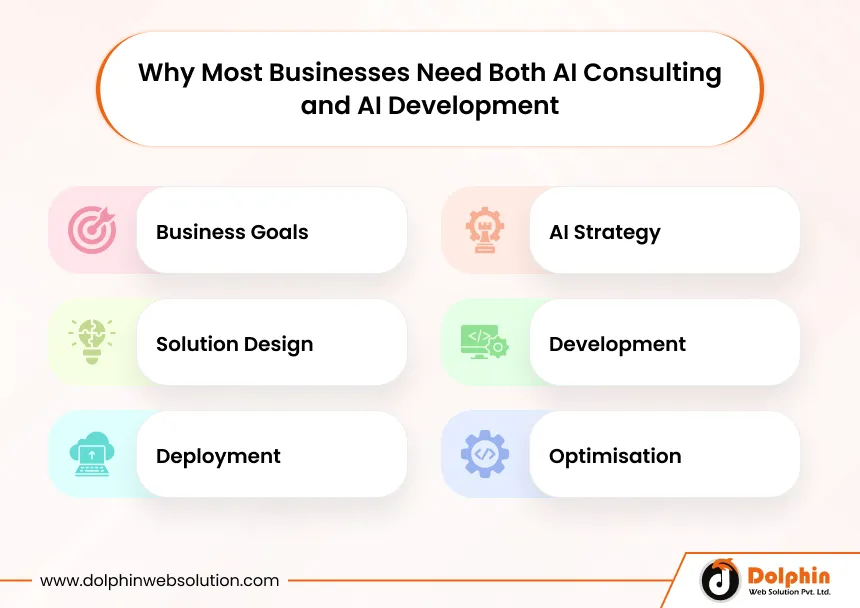
In practice, most successful AI initiatives move through both phases in sequence, rather than treating them as competing options. The typical flow looks like this:
- Business Goals: Start by clarifying what the business actually wants to achieve, separate from any specific technology.
- AI Strategy: Translate those goals into a prioritized set of AI use cases and a realistic roadmap.
- Solution Design: Define the technical approach for the highest priority use case, including architecture and technology choices.
- Development: Build the actual solution based on the validated strategy and design.
- Deployment: Launch the solution into production and integrate it with existing systems.
- Optimisation: Monitor performance and refine the system as real usage data comes in.
Consulting without implementation does not create business value on its own, since a strategy document that never gets built delivers nothing measurable. Development without strategy carries the opposite risk, often producing technically working software that solves the wrong problem or never gets meaningfully adopted. The two are complementary, not competing, services.
Benefits of Combining AI Consulting and AI Development
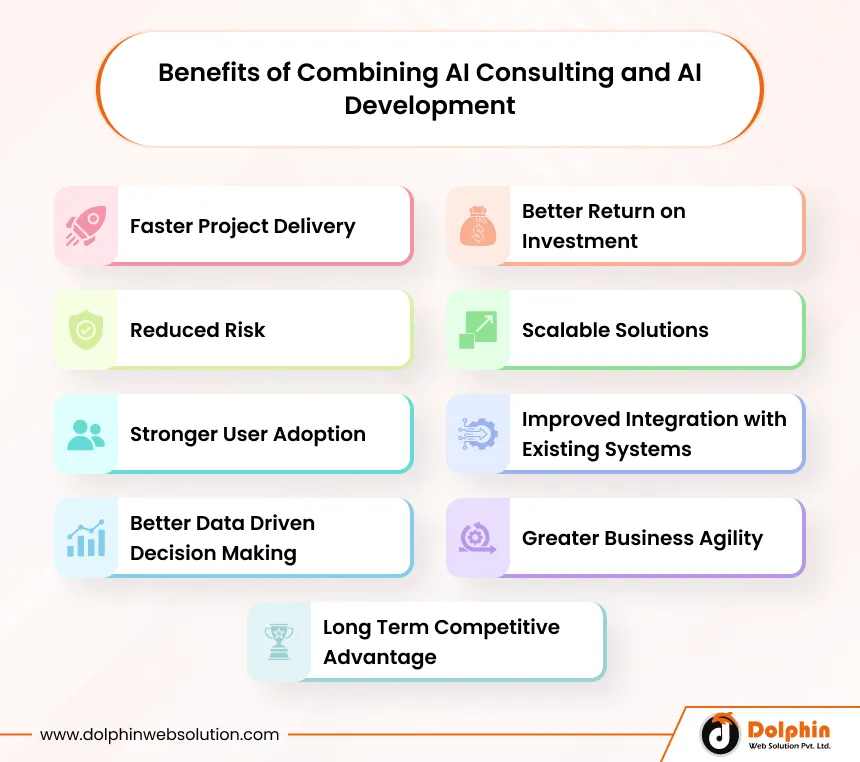
Businesses achieve the best outcomes when strategic planning and technical execution work together. AI consulting helps define the right direction, while AI development transforms that vision into practical solutions that deliver measurable business value. Combining both services creates a smoother implementation process and increases the chances of long term success.
1. Faster Project Delivery
AI consultants establish clear objectives, identify priorities, and create a structured roadmap, allowing development teams to focus on execution rather than making decisions during the project. This reduces delays, minimises rework, and accelerates the delivery of AI solutions.
2. Better Return on Investment
By combining consulting and development, businesses ensure that resources are invested in projects aligned with their strategic goals. This approach helps prioritise high impact use cases, optimise budgets, and maximise the overall return on AI investments.
3. Reduced Risk
Launching an AI project without proper planning can lead to technical challenges, budget overruns, and poor user adoption. AI consulting identifies potential technical, operational, and financial risks before development starts.
4. Scalable Solutions
Combining consulting and development ensures applications are built on a scalable architecture that supports future enhancements, increasing data volumes, additional users, and new business requirements without requiring a complete rebuild.
5. Stronger User Adoption
AI consultants evaluate existing workflows and user requirements before development begins, ensuring solutions are intuitive and aligned with day to day business operations. This improves employee confidence, encourages adoption, and helps organisations realise value more quickly.
6. Improved Integration with Existing Systems
A combined consulting and development approach ensures AI solutions integrate seamlessly with existing technologies, enabling smooth data flow, minimising operational disruption, and improving overall efficiency.
7. Better Data Driven Decision Making
AI performs best when supported by high quality data and clearly defined objectives. Consultants help businesses identify the right data sources and performance metrics, while developers build intelligent applications that transform this data into meaningful insights.
8. Greater Business Agility
Market conditions, customer expectations, and technology trends change rapidly. Businesses that combine AI consulting with AI development can adapt more quickly because they have both a strategic roadmap and the technical capability to implement improvements efficiently.
9. Long Term Competitive Advantage
Organisations that combine strategic planning with expert implementation are better positioned to innovate and stay ahead of competitors. Rather than deploying isolated AI tools, they create intelligent ecosystems that continuously improve operational efficiency, customer experiences, and business performance.
How to Choose the Right AI Partner
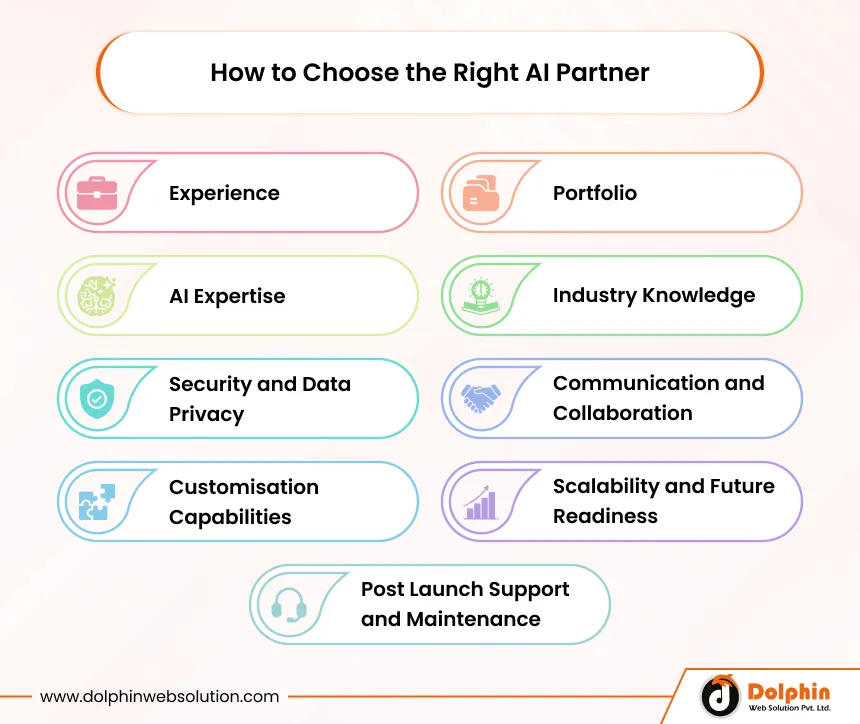
Selecting the right AI partner is one of the most important decisions in your AI adoption journey. The success of your project depends not only on the technology being used but also on the expertise, experience, and collaboration offered by your technology partner. Whether you need AI consulting, AI development, or both, evaluating potential partners against the following criteria can help you make an informed decision.
- Experience: Building AI powered solutions requires specialised knowledge of machine learning, natural language processing, generative AI, data engineering, and intelligent automation. An experienced AI partner understands the challenges involved in designing, training, deploying, and maintaining AI systems that deliver real business value.
- Portfolio: Review the company’s portfolio to understand the types of AI solutions they have successfully delivered. Look for real world projects, case studies, and measurable business outcomes rather than theoretical concepts or prototypes. A strong portfolio demonstrates the partner’s ability to solve complex business challenges across different industries and provides confidence in their technical capabilities.
- AI Expertise: Your technology partner should have in depth knowledge of AI models, data management, model training, system integration, and performance optimisation. They should also be able to recommend the most suitable technologies based on your business goals instead of promoting a single solution for every project.
- Industry Knowledge: A partner with experience in your sector can better understand your business processes and recommend AI solutions that address industry specific problems. Whether you operate in ecommerce, healthcare, manufacturing, finance, logistics, or retail, relevant domain expertise can significantly improve project outcomes.
- Security and Data Privacy: Ensure your AI partner follows strong security practices and complies with relevant data protection standards. Ask about their approach to data encryption, secure development, access controls, compliance requirements, and responsible AI practices. Protecting your data should be a priority throughout the entire project lifecycle.
- Communication and Collaboration: Choose a partner that communicates clearly, provides regular project updates, and explains technical concepts in a way that business leaders can easily understand. Transparent communication helps manage expectations, resolve challenges quickly, and ensures the project stays aligned with your objectives.
- Customisation Capabilities: Avoid partners who rely solely on generic or one size fits all AI solutions. Instead, choose a company that can design and develop customised AI applications tailored to your specific requirements. Custom solutions are more flexible, scalable, and better aligned with long term business growth.
- Scalability and Future Readiness: A reliable AI partner builds solutions that can scale as your organisation grows. This includes designing flexible architectures, supporting increasing data volumes, accommodating additional users, and enabling future AI enhancements without requiring major redevelopment.
- Post Launch Support and Maintenance: Launching an AI solution is only the beginning. AI models require continuous monitoring, performance optimisation, updates, and maintenance to remain accurate and effective. Choose a partner that provides long term support, regularly evaluates system performance, and helps improve the solution as your business evolves and new requirements emerge.
If you want a deeper breakdown of these criteria, our guide on how to Choose the Right AI Development Company covers each one in detail.
Why Choose Dolphin Web Solution for AI Consulting and Development?
Choosing the right technology partner is just as important as choosing the right AI solution. While many companies offer AI services, successful implementation requires a combination of strategic thinking, technical expertise, and a deep understanding of business processes.
With more than 15 years of experience in software development and digital transformation, Dolphin Web Solution helps businesses move from AI ideas to real business outcomes. Our team works closely with clients to understand their goals, evaluate opportunities, and build intelligent solutions that improve efficiency, productivity, and customer experience.
Our approach goes beyond simply developing AI applications. We focus on creating solutions that solve real business challenges and continue delivering value as your organisation grows.
1. Business First Approach
Every AI initiative begins with understanding your business objectives rather than recommending technology for its own sake. We identify opportunities where AI can create measurable improvements in operations, customer engagement, and decision making.
2. End to End AI Expertise
From strategy and planning to development, deployment, and ongoing optimisation, our team provides comprehensive AI services under one roof. This ensures consistency throughout the project while reducing communication gaps between different vendors.
3. Custom AI Solutions
Every organisation operates differently. We design AI solutions that align with your existing workflows, systems, and long term business goals instead of relying on one size fits all products.
4. Seamless Integration
Our developers integrate AI capabilities with your existing software ecosystem, including CRM platforms, ERP systems, ecommerce applications, and other enterprise tools. This allows businesses to improve efficiency without disrupting current operations.
5. Scalable Architecture
Technology should support future growth. We build scalable AI solutions that can adapt as your organisation expands, customer expectations evolve, and new business opportunities emerge.
6. Long Term Partnership
Launching an AI solution is only the beginning. We continue supporting our clients through monitoring, optimisation, feature enhancements, and ongoing maintenance to ensure their AI investment continues delivering value.
Conclusion
AI consulting and AI development solve different problems. Consulting answers the question of what to build and why, while development answers the question of how to actually build it. Neither one is more important than the other, and most businesses that see real, lasting value from AI eventually need both, applied in the right order.
Before choosing a partner, take an honest look at where your business currently stands. If you do not yet have a clear strategy, start with consulting. If your strategy is already defined, development is the logical next step. Either way, the goal is the same: AI that is grounded in a real business need, not built for its own sake.
Frequently Asked Questions
What is the difference between AI consulting and AI development?
AI consulting focuses on strategy, planning, and identifying the right opportunities before any code is written, while AI development focuses on actually building, integrating, and deploying the AI solution.
Do I need AI consulting before AI development?
Not always, but it helps significantly if you do not yet have a clear, validated use case. Businesses with an existing strategy can often move straight into development.
Can one company provide both AI consulting and AI development?
Yes, and it is often preferable, since it removes the risk of a strategy and a build team working from different assumptions about what is technically feasible.
How much does AI consulting cost?
Cost depends on the scope of the engagement and the complexity of the business's systems. A clearly defined scope at the outset is the best way to get an accurate estimate.
How long does an AI development project take?
Timelines vary based on complexity, but most projects move through design, development, testing, and deployment over a period of several weeks to several months.
What industries benefit from AI consulting?
Retail, healthcare, manufacturing, finance, logistics, and nearly every other industry can benefit, since the core value of consulting, avoiding costly missteps, applies regardless of sector.
Is AI consulting worth it for small businesses?
Yes, arguably even more so, since smaller businesses have less budget to absorb a failed AI pilot and benefit significantly from getting the strategy right the first time.
What should I look for in an AI consulting company?
Look for real AI specific experience, a track record of finished work, industry relevant knowledge, and a clear, honest approach to communication throughout the engagement.
Nimesh Patel


Nimesh Patel is the Managing Director of Dolphin Web Solution, a global eCommerce, AI, and software development company helping businesses accelerate digital growth. With over 15 years of experience in technology consulting and product development, he has successfully guided startups, SMBs, and enterprise organizations in building scalable digital solutions. Nimesh specializes in eCommerce development, custom software solutions, mobile application development, and digital transformation strategies. Throughout his career, he has worked closely with businesses across retail, healthcare, automotive, manufacturing, and technology sectors, helping them leverage modern technologies to improve operational efficiency and customer experiences. As a business leader, Nimesh is passionate about innovation, entrepreneurship, and helping organizations turn ideas into successful digital products. His insights focus on eCommerce growth, AI adoption, software development trends, and business transformation through technology.

We can help you with
- Dedicated Team
- Setup Extended Team
- Product Development
- Custom App Development
Our Offices

AHMEDABAD (INDIA)
B- 203-206, Empire Business Hub, Science City Road, Sola, Ahmedabad – 380060

BERLIN (GERMANY)
Badensche Str. 28, 10715 Berlin, Germany

CALIFORNIA (USA)
9601 Reseda Blvd, Apt#223, Northridge CA-91324, USA

ALBERTA (CANADA)
302 Skyview Ranch Drive NE, Calgary, Alberta, Canada T3N0P5





Hello!
Click one of our contacts below to chat on WhatsApp