
-
Dolphin Web SolutionArtificial IntelligenceHow to Choose the Right AI Development Company in 2026
 15 Min Read
How to Choose the Right AI Development Company in 2026


Table of Contents
 Show
Show
- 1 Why Businesses Are Investing in AI Development
- 2 What Does an AI Development Company Do?
- 3 10 Factors to Consider When Choosing an AI Development Company
- 4 Comparison: What to Look For vs. What to Avoid
- 5 Common Mistakes Businesses Make
- 6 Why the Right AI Development Partner Matters
- 7 Future Trends in AI Development
- 8 Conclusion

Summary :
Choosing the right AI development company can determine the success of your AI project. This guide covers 10 key factors to evaluate an AI partner, essential questions to ask, common hiring mistakes to avoid, future AI trends, and includes a comparison table, pre-hire checklist, and FAQs to help you make an informed decision.
Artificial intelligence has moved from a competitive advantage to a baseline expectation. Recent industry research puts organizational AI usage well above three quarters of all companies, with generative AI usage alone jumping from 33% in 2023 to 71% in 2024. That kind of momentum explains why so many businesses, from early stage startups to established enterprises, are actively searching for a development partner who can turn AI ambition into a working product.
But adoption numbers only tell half the story. Recent McKinsey research indicates that while 72% of enterprises now run at least one AI workload in production, the depth and maturity of those deployments varies widely, and a large share of AI initiatives never make it past the pilot stage. The difference between a company that ships a genuinely useful AI product and one that burns budget on a stalled proof of concept usually comes down to one decision: who you choose to build it with.
At Dolphin Web Solution, we have spent over 15 years building software and ecommerce solutions for businesses across industries, and that experience shapes how we think about AI development today. This guide walks through why businesses are investing in AI, what an AI development company actually does, the ten factors that separate a reliable partner from a risky one, the questions you should ask before signing a contract, and the mistakes that trip up even well resourced projects. Whether you are building your first AI chatbot or scaling a computer vision system across a supply chain, this is the framework to use before you hire anyone.
If you are still comparing vendors, our roundup of the top AI software development companies in India for 2026 is a useful companion to this guide.
Why Businesses Are Investing in AI Development
The appetite for AI is not hype, it is driven by measurable operational gains. Companies adopt AI for a handful of consistent reasons:
- Process automation: Repetitive, rule based work such as data entry, document processing, and ticket routing is increasingly handled by AI agents and machine learning pipelines, freeing employees for higher value work.
- Better customer experiences: AI powered chatbots, recommendation engines, and personalization systems let businesses respond faster and more relevantly, at a scale human teams alone cannot match.
- Data driven decisions: Predictive analytics and machine learning models turn historical data into forward looking insight, reducing guesswork in planning, pricing, and risk management.
- Cost reduction: Automating manual workflows and optimizing operations through AI consistently reduces overhead, especially in customer support, logistics, and back office functions.
- Competitive advantage: Businesses that fail to adopt AI risk falling behind competitors who already have, particularly as AI shifts from a differentiator to a baseline capability across most industries.
Return on investment is also becoming easier to quantify. Companies report a 3.7x return for every dollar invested in generative AI and related technologies, a figure that is pushing even cautious industries to accelerate their AI roadmaps.
What Does an AI Development Company Do?
An AI development company builds, integrates, and maintains AI powered systems tailored to a business's specific goals, rather than offering a one size fits all product. Our own AI app development services at Dolphin Web Solution cover the full range of what a modern AI partner should provide:
- AI consulting: Assessing your business processes, data readiness, and use cases to define a realistic AI roadmap before any code is written.
- Machine learning solutions: Custom models for classification, forecasting, recommendation, and pattern detection built on your own data.
- Generative AI applications: Content generation tools, AI copilots, and workflow assistants built on large language models. If you want a deeper look at this category, our comprehensive guide to generative AI development services breaks down use cases, architecture choices, and costs.
- AI chatbot development: Customer facing or internal chat assistants that integrate with your existing CRM, helpdesk, or knowledge base.
- Computer vision: Image and video analysis for use cases like quality inspection, security monitoring, and inventory tracking.
- NLP solutions: Sentiment analysis, document summarization, entity extraction, and language understanding tools.
- Predictive analytics: Models that forecast demand, churn, fraud risk, or maintenance needs before they become costly problems.
- AI integration: Connecting AI capabilities into your existing software stack, including ERP, CRM, mobile apps, and websites, rather than building in isolation.
- AI maintenance and optimization: Ongoing model monitoring, retraining, and performance tuning after launch, since AI systems degrade without upkeep.
A capable partner does not just write code for one of these, they help you figure out which of them your business actually needs.

10 Factors to Consider When Choosing an AI Development Company
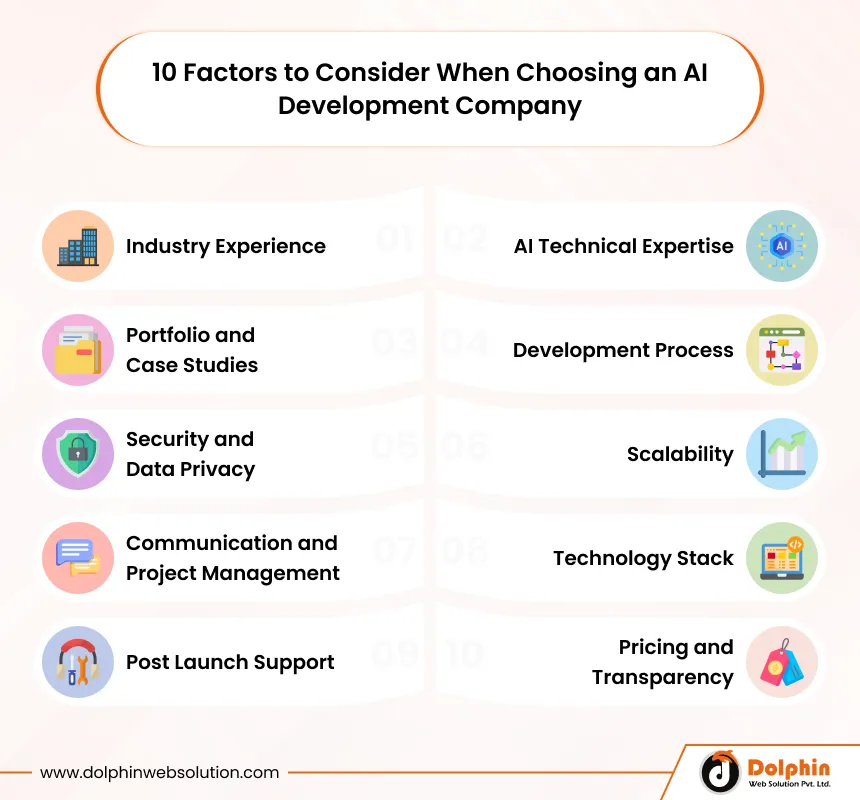
1. Industry Experience
AI behaves differently in healthcare than it does in retail or logistics. A company that has already solved problems in your industry understands the data patterns, compliance requirements, and edge cases specific to it, which shortens your timeline and reduces costly rework.
2. AI Technical Expertise
Look past marketing language and verify real technical depth: experience with machine learning frameworks, large language models, MLOps, and data engineering. Ask which models they typically work with and why. A partner who can explain trade offs between, say, a custom tuned open source model and a hosted API is one who actually understands the technology.
3. Portfolio and Case Studies
A credible AI development company should be able to show finished, in production work, not just mockups or slide decks. Look for case studies with concrete outcomes: reduced processing time, increased conversion, lower support costs. If a portfolio only shows generic dashboards, dig deeper.
4. Development Process
AI projects fail more often from process gaps than from bad algorithms. Ask how the company structures work. Do they run discovery sprints? Do they prototype before committing to a full build? Is there a defined process for data collection, model evaluation, and iteration? A structured, transparent process is one of the strongest predictors of on time delivery.
5. Security and Data Privacy
AI systems often touch sensitive business or customer data. Your partner should be able to speak clearly about data encryption, access controls, compliance frameworks such as GDPR, HIPAA, or SOC 2 as relevant, and how they prevent your proprietary data from leaking into outside training sets.
6. Scalability
A prototype that works for 100 users can fail completely at 100,000. Ask how the company designs for scale from day one, including cloud infrastructure choices, model serving architecture, and cost per inference as usage grows. Scalability planned late is scalability planned poorly.
7. Communication and Project Management
AI projects involve more ambiguity than typical software builds. Model performance can shift, data issues surface mid project, and scope often needs to adapt. A partner with clear communication cadences, such as weekly syncs, shared project boards, and transparent status reporting, prevents small surprises from becoming large ones.
8. Technology Stack
Ask what frameworks, cloud platforms, and tools the team uses day to day, such as TensorFlow, PyTorch, AWS, Azure, GCP AI services, vector databases, and orchestration frameworks. The right answer is not a single correct stack, it is whether their stack matches your scale, budget, and existing systems.
9. Post Launch Support
AI models are not done at launch, they need monitoring, retraining, and adjustment as real world data drifts from what the model was trained on. Confirm what support after launch looks like, what it costs, and how quickly issues get addressed.
10. Pricing and Transparency
Get a clear breakdown of costs across discovery, development, infrastructure, and ongoing maintenance, rather than a single bundled number. Transparent pricing is often a proxy for how transparent the company will be throughout the entire engagement.
Comparison: What to Look For vs. What to Avoid
| Factor | Look For | Red Flag |
|---|---|---|
| Experience | Proven work in your industry or a closely related one | Vague, generic portfolio with no named outcomes |
| Technical depth | Team can explain model choices and trade-offs clearly | Buzzword-heavy answers with no specifics |
| Process | Defined discovery, prototyping, and iteration stages | "We'll figure it out as we go" |
| Security | Clear data handling, compliance, and access policies | No documented security practices |
| Scalability | Cloud-native architecture planned from the start | Scalability treated as an afterthought |
| Communication | Regular updates, shared dashboards, defined points of contact | Long silences between updates |
| Pricing | Itemized costs across all project phases | One flat number with no breakdown |
| Support | Defined SLA for post-launch monitoring and fixes | No mention of what happens after go-live |
Common Mistakes Businesses Make
Even well resourced companies make avoidable errors when hiring an AI partner:
- Choosing based only on price: The cheapest bid is often cheapest because it skips discovery, testing, or support after launch, costs that resurface later, usually at a higher price.
- Ignoring AI specific expertise: A general software agency is not automatically qualified to build machine learning systems. AI development requires distinct skills in data science, model evaluation, and MLOps.
- Skipping scalability planning: Building only for today's user base, without a path to scale, means expensive rearchitecture later.
- Not defining business goals up front: Wanting to use AI is not a project brief. Without clear success metrics, it is impossible to know if the finished product actually worked.
- Forgetting ongoing maintenance: AI models drift as real world data changes. Skills, governance, and use case identification continue to dominate the cost of AI initiatives well after initial deployment, treating launch as the finish line is a common and costly mistake.
Why the Right AI Development Partner Matters
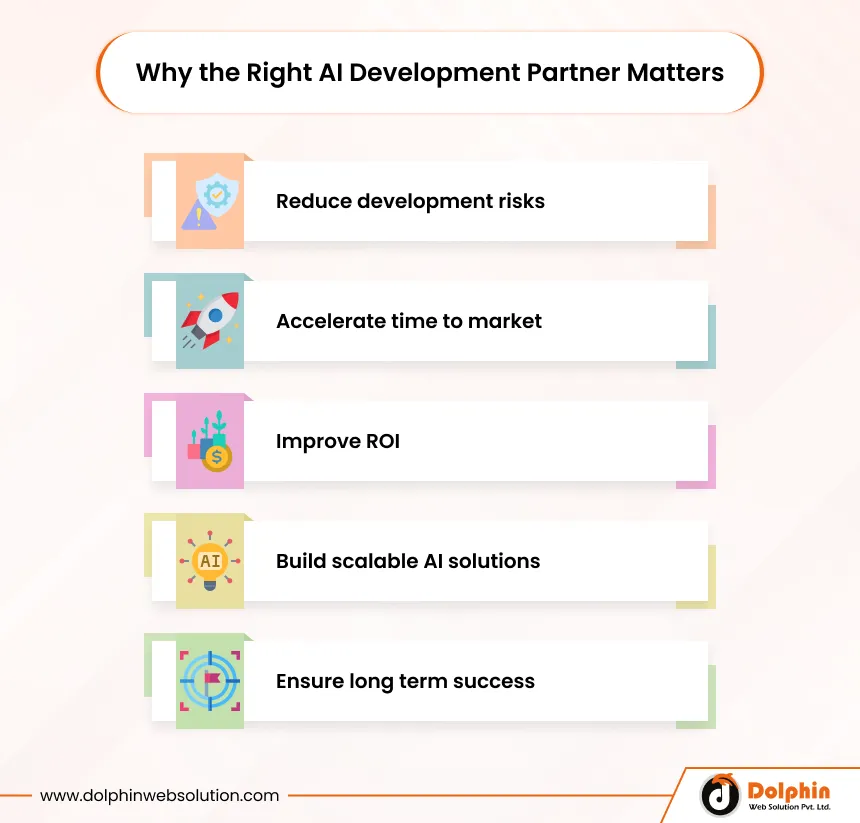
The right partner does more than write code, they shape the trajectory of the entire project:
- Reduce development risks: By identifying data and scope issues before they derail a build.
- Accelerate time to market: Through proven, repeatable development processes rather than trial and error.
- Improve ROI: By focusing engineering effort on the use cases most likely to produce measurable business value.
- Build scalable AI solutions: Designed to grow with your user base and data volume, not just survive a demo.
- Ensure long term success: Through monitoring, retraining, and iteration after launch as your business and data evolve.
Given that only about a third of organizations have scaled AI beyond initial pilots, the partner you choose is often the deciding factor in whether your AI investment becomes a durable business asset or a stalled experiment.
Future Trends in AI Development
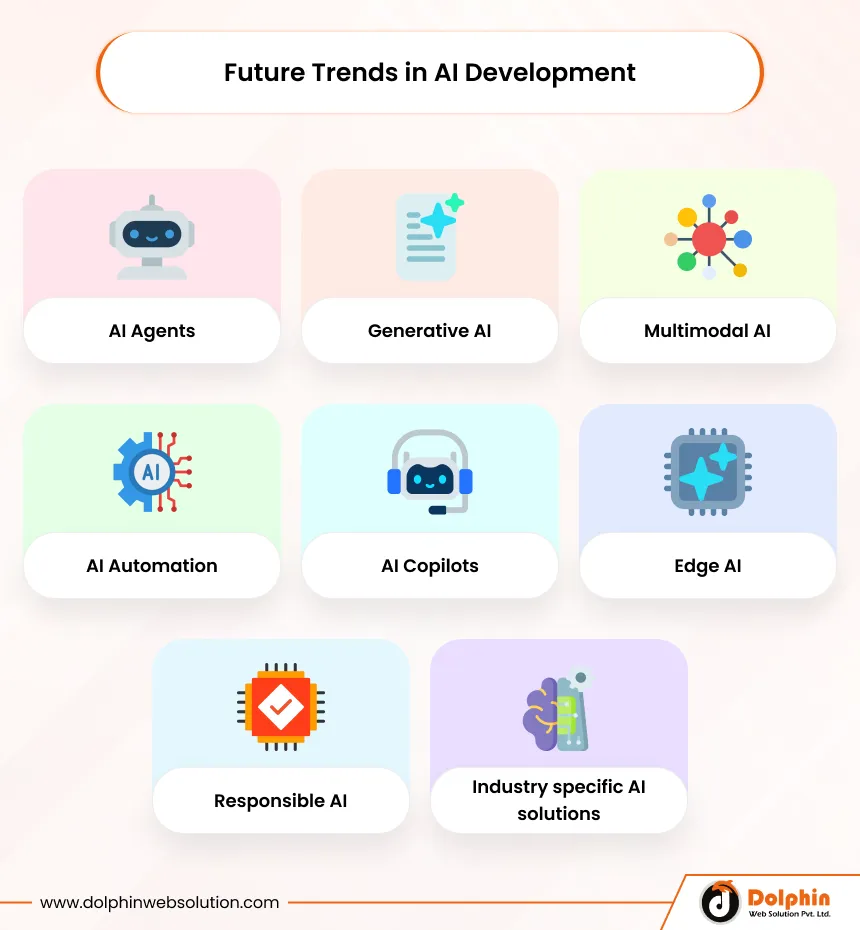
Choosing a development partner today also means thinking about where AI is heading. Keep an eye on:
- AI Agents: Autonomous systems that can plan and execute multi step tasks, not just respond to single prompts.
- Generative AI: Increasingly embedded directly into business workflows rather than used as a standalone tool. Our services are like generative AI development services where this technology is headed in more depth.
- Multimodal AI: Models that combine text, image, audio, and video understanding in a single system.
- AI Automation: End to end automation of business processes, from data intake to decision to action.
- AI Copilots: Embedded assistants inside existing software such as CRMs, project tools, and internal dashboards that support daily work.
- Edge AI: Models running directly on devices for lower latency and better data privacy.
- Responsible AI: Growing emphasis on transparency, fairness, and governance as regulation catches up with adoption.
- Industry specific AI solutions: Increasingly tailored models built for the nuances of specific sectors rather than generic use cases.
A development partner who is already building toward these trends will keep your product relevant well beyond launch.

Conclusion
Choosing the right AI consulting company is not about finding the lowest bid, it is about finding a partner whose technical expertise, industry experience, and long term support align with your business objectives. The factors that matter most, proven expertise, a transparent process, strong security practices, scalability, and reliable support after launch, are the same factors that separate AI investments that deliver lasting value from those that stall after the pilot phase.
At Dolphin Web Solution, we work with businesses to build AI systems that are grounded in real use cases, engineered to scale, and supported well beyond launch. If you are evaluating AI development partners, use the factors and questions in this guide as your starting point, and choose a partner who is building for your business's long term success, not just a one time delivery. Explore our AI app development services to see how our team approaches AI projects from discovery through long term support.
Frequently Asked Questions
Nimesh Patel


Nimesh Patel is the Managing Director of Dolphin Web Solution, a global eCommerce, AI, and software development company helping businesses accelerate digital growth. With over 15 years of experience in technology consulting and product development, he has successfully guided startups, SMBs, and enterprise organizations in building scalable digital solutions. Nimesh specializes in eCommerce development, custom software solutions, mobile application development, and digital transformation strategies. Throughout his career, he has worked closely with businesses across retail, healthcare, automotive, manufacturing, and technology sectors, helping them leverage modern technologies to improve operational efficiency and customer experiences. As a business leader, Nimesh is passionate about innovation, entrepreneurship, and helping organizations turn ideas into successful digital products. His insights focus on eCommerce growth, AI adoption, software development trends, and business transformation through technology.

We can help you with
- Dedicated Team
- Setup Extended Team
- Product Development
- Custom App Development
Our Offices

AHMEDABAD (INDIA)
B- 203-206, Empire Business Hub, Science City Road, Sola, Ahmedabad – 380060

BERLIN (GERMANY)
Badensche Str. 28, 10715 Berlin, Germany

CALIFORNIA (USA)
9601 Reseda Blvd, Apt#223, Northridge CA-91324, USA

ALBERTA (CANADA)
302 Skyview Ranch Drive NE, Calgary, Alberta, Canada T3N0P5





Hello!
Click one of our contacts below to chat on WhatsApp