
-
Dolphin Web SolutionArtificial IntelligenceAll You Need to Know About AI Website Development: A Complete Business Guide
 15 Min Read
All You Need to Know About AI Website Development: A Complete Business Guide


Table of Contents
 Show
Show
- 1 Introduction
- 2 Key Takeaways
- 3 AI Website Development: Market Overview
- 4 What Is AI Website Development?
- 5 Key Benefits of AI Website Development
- 6 Common Use Cases of AI-Powered Websites
- 7 Core Technologies Used in AI Website Development
- 8 AI Website Development Process
- 9 AI Website Development Cost Factors
- 10 Challenges in AI Website Development
- 11 Conclusion

Summary :
This comprehensive guide explores AI website development, covering its benefits, technologies, implementation process, and business value. Learn how artificial intelligence transforms web experiences and why it matters for your digital strategy.
Introduction
The digital landscape has transformed dramatically over the past few years. Websites are no longer static information repositories—they have evolved into intelligent platforms that learn, adapt, and respond to user needs in real time.
AI website development represents this fundamental shift. Businesses now leverage artificial intelligence, including advanced AI Agent Development Services, to create web experiences that understand user intent, predict behavior, and deliver personalized content automatically. This technology has moved beyond experimental phases into practical business applications.
For decision-makers and business owners, understanding AI website development is essential. Companies that adopt intelligent web solutions powered by AI Agent Development Services gain competitive advantages through improved customer engagement, operational efficiency, and scalability. This guide provides a comprehensive overview of what AI website development entails and how it can benefit your organization.
Key Takeaways
- AI website development uses machine learning and automation to create personalized, intelligent web experiences that adapt to user behavior.
- Businesses benefit from enhanced user engagement, operational efficiency, and data-driven decision-making through AI-powered websites.
- Core technologies include machine learning, natural language processing, big data analytics, and cloud computing infrastructure.
- Implementation requires strategic planning, proper integration, and ongoing maintenance to maximize ROI.
- AI websites address modern business challenges like personalization at scale, 24/7 customer support, and competitive differentiation.
AI Website Development: Market Overview
Digital transformation has accelerated across industries, with AI adoption becoming a strategic priority rather than a luxury. Organizations recognize that traditional websites no longer meet the expectations of modern users who demand instant, personalized experiences.
The shift toward AI-powered digital solutions reflects broader market trends. Businesses face increasing pressure to deliver seamless customer experiences while managing growing data volumes and operational complexity. AI website development addresses these challenges by automating routine tasks, analyzing user behavior patterns, and enabling real-time personalization.
Enterprise adoption continues to expand beyond early innovators. Companies in e-commerce, healthcare, finance, education, and professional services now implement AI features to remain competitive. This widespread adoption demonstrates the technology’s maturity and proven business value.
Small and medium businesses also increasingly explore AI website solutions. Cloud-based platforms and accessible development frameworks have lowered entry barriers, making intelligent web features achievable for organizations of various sizes and budgets.
What Is AI Website Development?
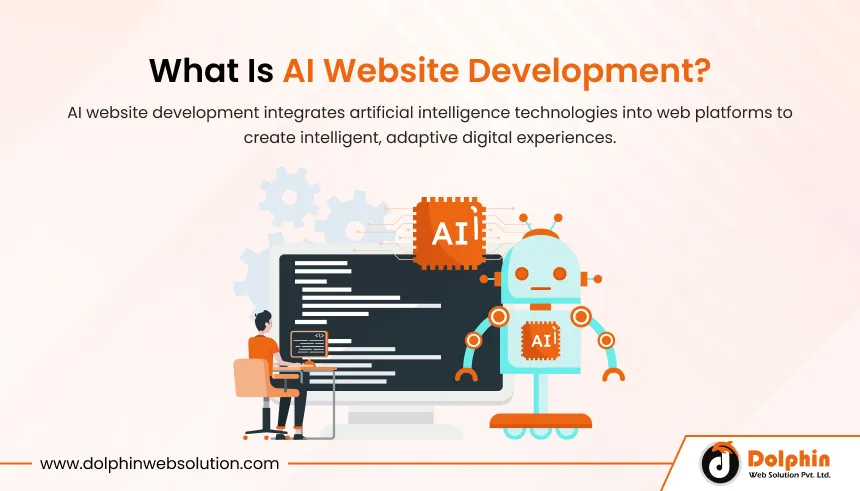
AI website development integrates artificial intelligence technologies into web platforms to create intelligent, adaptive digital experiences. These websites use machine learning algorithms, natural language processing, and data analytics to understand user behavior and respond dynamically.
Traditional websites follow predetermined logic and display the same content to all visitors based on fixed rules. They require manual updates and cannot learn from user interactions or adapt their functionality over time.
AI-powered websites operate differently. They analyze visitor data in real time, identify patterns, and adjust content, recommendations, and functionality automatically. The system continuously learns from user interactions, improving its responses and predictions without manual intervention.
Key distinguishing features include automated personalization, predictive analytics, intelligent chatbots, smart search capabilities, and adaptive user interfaces. These elements work together to create web experiences that feel responsive and tailored to individual needs.
The technology processes structured and unstructured data from multiple sources—user behavior, preferences, historical interactions, and external signals. This comprehensive data analysis enables sophisticated decision-making that would be impossible with traditional programming approaches.
Key Benefits of AI Website Development
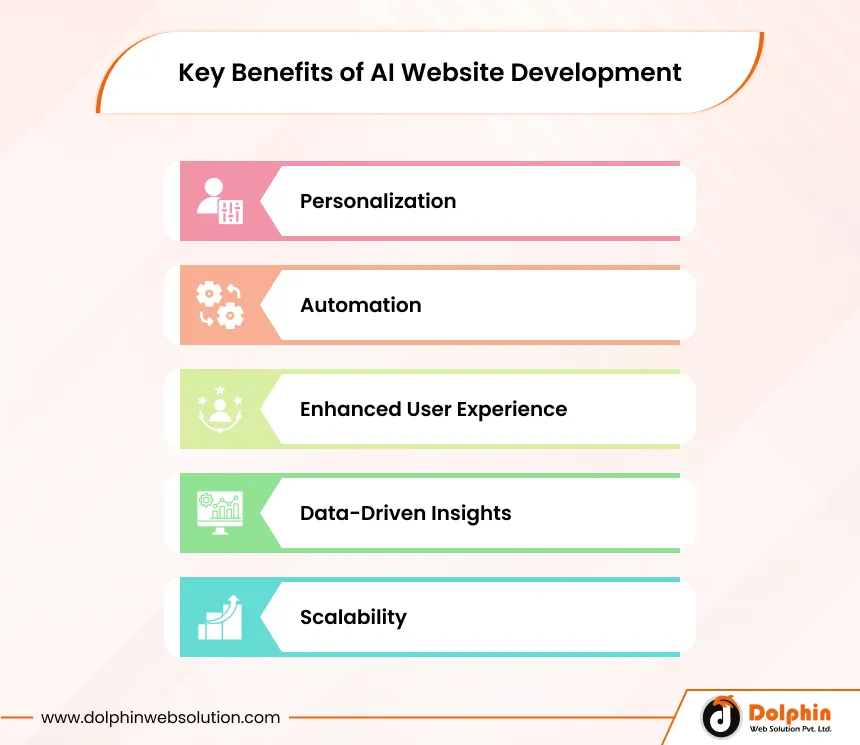
1. Personalization
AI websites deliver individualized experiences by analyzing user behavior, preferences, and context. The system automatically adjusts content, product recommendations, and navigation based on each visitor’s unique profile. This level of personalization increases engagement and conversion rates while creating more satisfying user experiences.
2. Automation
Intelligent automation handles repetitive tasks like customer inquiries, content categorization, and data processing. AI chatbots provide instant support around the clock, while automated systems manage routine operations without human intervention. This reduces operational costs and allows teams to focus on strategic activities.
3. Enhanced User Experience
AI improves usability through features like intelligent search, voice interfaces, and predictive navigation. The system anticipates user needs and streamlines interactions, reducing friction points. Visual recognition, natural language understanding, and contextual awareness create intuitive interfaces that adapt to different user types.
4. Data-Driven Insights
AI systems analyze vast amounts of user data to uncover actionable insights about behavior patterns, preferences, and trends. Businesses gain a deeper understanding of their audience, enabling informed decisions about content strategy, product development, and marketing approaches. Predictive analytics help anticipate future needs and opportunities.
5. Scalability
AI-powered websites handle growing user volumes and increasing complexity without proportional resource increases. Automated systems manage peak traffic periods, while machine learning models improve efficiency over time. This scalability supports business growth without requiring constant manual expansion of capabilities.
Common Use Cases of AI-Powered Websites
1. AI Chatbots
Intelligent chatbots provide instant customer support, answer questions, and guide users through complex processes. These systems understand natural language, maintain conversation context, and escalate issues to human agents when necessary. They operate continuously, handling multiple conversations simultaneously while learning from each interaction.
2. Recommendation Engines
AI analyzes user behavior, purchase history, and preferences to suggest relevant products, content, or services. These systems identify patterns across large user bases and apply collaborative filtering to predict what individual users might find valuable. Recommendation engines significantly impact conversion rates and customer satisfaction.
3. Personalized Content
AI-powered content management systems dynamically adjust website content based on user segments, behavior, and context. The technology determines which headlines, images, and calls-to-action perform best for different audiences. Content personalization extends to email campaigns, landing pages, and product descriptions.
4. Smart Search
Intelligent search understands user intent beyond exact keyword matches. Natural language processing interprets conversational queries, while machine learning improves result relevance based on click-through patterns. Features include autocomplete suggestions, semantic search, and visual search capabilities that enhance content discovery.
5. Voice-Enabled Websites
Voice interfaces allow users to navigate websites and perform actions through spoken commands. Natural language understanding processes voice input, while text-to-speech systems provide audio responses. This accessibility feature benefits users with disabilities and supports hands-free interaction scenarios.
Core Technologies Used in AI Website Development
1. Artificial Intelligence and Machine Learning
Machine learning algorithms form the foundation of intelligent website features. These systems learn from data patterns without explicit programming, improving their performance over time. Supervised learning trains models on labeled datasets, while unsupervised learning discovers hidden patterns. Deep learning neural networks handle complex tasks like image recognition and natural language understanding.
2. Natural Language Processing
NLP enables websites to understand, interpret, and generate human language. This technology powers chatbots, sentiment analysis, content generation, and voice interfaces. Key capabilities include text classification, entity recognition, language translation, and semantic analysis that captures meaning beyond individual words.
3. Big Data Analytics
AI websites process large volumes of structured and unstructured data from multiple sources. Big data platforms store and analyze user interactions, transaction histories, and behavioral signals. Real-time analytics enable immediate responses, while batch processing handles complex analytical tasks that inform strategic decisions.
4. Cloud Computing
Cloud infrastructure provides the computational resources necessary for AI processing. Scalable cloud platforms handle variable workloads efficiently, while managed AI services reduce implementation complexity. Cloud deployment enables global accessibility, automatic scaling, and cost-effective resource utilization based on actual usage.
5. APIs and Automation
Application programming interfaces connect AI services with website functionality. Third-party APIs provide access to specialized AI capabilities like image recognition, language translation, and predictive analytics. Automation frameworks orchestrate complex workflows, triggering actions based on specific events or conditions without manual intervention.
AI Website Development Process
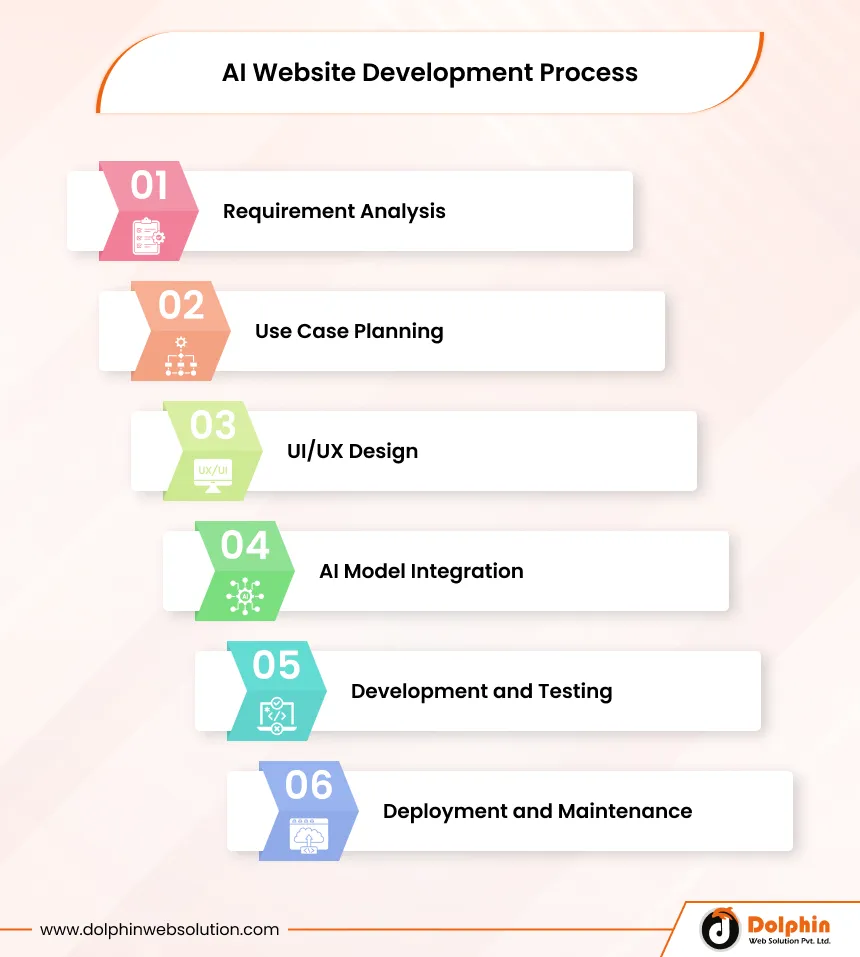
1. Requirement Analysis
The development process begins with thorough understanding of business objectives, target audience, and specific challenges. Teams identify use cases where AI provides measurable value and define success metrics. This phase includes stakeholder interviews, competitive analysis, and technical feasibility assessment.
2. Use Case Planning
Developers prioritize AI features based on business impact and technical complexity. Detailed specifications outline how each AI component will function, what data it requires, and how it integrates with existing systems. Planning addresses data privacy requirements, performance standards, and user experience goals.
3. UI/UX Design
Design teams create interfaces that effectively present AI-driven features while maintaining usability. This includes conversation flows for chatbots, visualization of personalized recommendations, and clear communication of automated actions. Designs consider how AI features enhance rather than complicate user interactions.
4. AI Model Integration
Technical teams select appropriate algorithms, train machine learning models, and integrate AI services into the website architecture. This phase involves data preparation, model training and validation, and API integration. Developers implement fallback mechanisms for scenarios where AI predictions have low confidence.
5. Development and Testing
Engineers build the website using selected technologies while continuously testing AI components for accuracy, performance, and reliability. Quality assurance includes functional testing, load testing, and validation of AI predictions against expected outcomes. Testing also covers edge cases and unusual user behaviors.
6. Deployment and Maintenance
The completed website launches with monitoring systems that track AI performance, user engagement, and technical metrics. Post-deployment activities include ongoing model retraining with new data, feature refinement based on user feedback, and regular updates to maintain security and performance standards.
AI Website Development Cost Factors
Several variables influence the investment required for AI website development. Project complexity represents the primary cost driver—websites with multiple AI features, custom machine learning models, and extensive integrations require more resources than those using standard AI services.
Data requirements significantly impact costs. Projects needing custom data collection, cleaning, and preparation involve additional work. The volume of data processed and storage requirements affect ongoing operational expenses.
Technology choices influence both initial and recurring costs. Building custom AI models from scratch requires substantial development effort, while leveraging pre-built AI services through APIs offers faster implementation at lower upfront costs but with ongoing usage fees.
Integration complexity varies based on existing systems and infrastructure. Connecting AI features with legacy platforms, third-party services, and internal databases requires careful planning and technical expertise.
Ongoing maintenance and optimization represent continuous investments. AI systems require regular monitoring, model retraining, performance tuning, and updates to maintain effectiveness as user behavior and business needs evolve.
Team expertise and location affect development rates. Projects benefit from experienced AI developers, data scientists, and UX designers who understand both technical implementation and business applications.
Challenges in AI Website Development
1. Security and Data Privacy
AI systems process sensitive user data, creating security and privacy responsibilities. Organizations must implement robust data protection measures, comply with regulations like GDPR and CCPA, and maintain transparent data practices. Securing AI models against adversarial attacks and ensuring safe data storage require specialized expertise.
2. Integration Complexity
Connecting AI components with existing infrastructure often presents technical challenges. Legacy systems may lack APIs or data structures that AI requires. Ensuring seamless data flow between multiple systems while maintaining performance and reliability demands careful architectural planning.
3. Model Accuracy and Bias
Machine learning models can produce inaccurate predictions or exhibit bias based on training data. Ensuring AI systems make fair, reliable decisions requires careful dataset curation, ongoing monitoring, and regular validation. Addressing bias in AI recommendations and automated decisions is both a technical and ethical imperative.
4. Scalability Requirements
As user bases grow and AI features expand, maintaining performance becomes challenging. Systems must handle increasing data volumes, processing demands, and concurrent users without degradation. Scaling AI infrastructure requires proper architecture design and resource planning from the project’s inception.
5. Change Management
Introducing AI features affects internal operations and user expectations. Organizations must train staff to work with AI systems, adjust business processes, and communicate changes to users effectively. Managing this transition while maintaining service quality requires thoughtful planning and stakeholder engagement.
6. The Bottom Line
AI website development represents a strategic investment in digital capabilities that deliver long-term competitive advantages. Businesses implementing intelligent web solutions improve customer engagement, operational efficiency, and decision-making quality.
The technology has matured beyond experimental phases into practical applications with proven ROI. Organizations that adopt AI-powered websites position themselves to meet evolving customer expectations while managing complexity effectively.
Success requires careful planning, appropriate technology selection, and experienced implementation partners. When executed properly, AI website development transforms digital presence from static information delivery into dynamic, intelligent platforms that drive business growth.
Conclusion
Modern businesses need websites that do more than display information—they require intelligent platforms that engage users, automate operations, and adapt to changing needs. AI website development provides these capabilities through proven technologies and practical implementations, supported by expert AI Consulting Services.
Whether you’re exploring AI features for the first time or planning to enhance existing digital capabilities, the right development partner and reliable AI Consulting Services make the difference between technical implementation and business transformation.
Dolphin Web Solution helps organizations navigate AI website development from strategy through deployment and beyond. Our team combines technical expertise with business understanding and comprehensive AI Consulting Services to create intelligent web solutions that deliver measurable results.
Contact Dolphin Web Solution today to discuss your AI website development needs and discover how intelligent web technologies can transform your digital presence. Let’s explore how AI can solve your specific business challenges and create competitive advantages in your market.
Rohit Prajapati


Rohit Prajapati is the Chief Executive Officer of Dolphin Web Solution and a recognized expert in eCommerce technologies, digital commerce strategy, and product development. With over 15 years of experience in the technology industry, he helps businesses build high-performing online stores, scalable digital platforms, and innovative customer experiences. As a certified Adobe Commerce Business Practitioner (Magento Solution Specialist), Rohit possesses deep expertise in Shopify, Magento, Shopware, Hyvä, and enterprise eCommerce ecosystems. He has successfully consulted businesses worldwide on platform selection, digital transformation, migration strategies, and growth-focused commerce solutions. Rohit regularly shares insights on eCommerce trends, AI-driven commerce, online business growth, and emerging technologies. His mission is to help organizations create future-ready digital experiences that drive measurable business outcomes and long-term success.

We can help you with
- Dedicated Team
- Setup Extended Team
- Product Development
- Custom App Development
Our Offices

AHMEDABAD (INDIA)
B- 203-206, Empire Business Hub, Science City Road, Sola, Ahmedabad – 380060

BERLIN (GERMANY)
Badensche Str. 28, 10715 Berlin, Germany

CALIFORNIA (USA)
9601 Reseda Blvd, Apt#223, Northridge CA-91324, USA

ALBERTA (CANADA)
302 Skyview Ranch Drive NE, Calgary, Alberta, Canada T3N0P5





Hello!
Click one of our contacts below to chat on WhatsApp