
-
Dolphin Web SolutionArtificial IntelligenceAI in Healthcare: Examples, Use Cases, and Benefits
 15 Min Read
AI in Healthcare: Examples, Use Cases, and Benefits


Table of Contents
 Show
Show
- 1 Introduction
- 2 What Is AI in Healthcare?
- 3 How AI Is Transforming the Healthcare Industry
- 4 Real-World Examples of AI in Healthcare
- 5 Key Use Cases of AI in Healthcare
- 6 Benefits of AI in Healthcare
- 7 Challenges and Considerations of AI in Healthcare
- 8 Future of AI in Healthcare
- 9 Why Choose Dolphin Web Solution for Healthcare AI
- 10 Conclusion

Summary :
Artificial intelligence is revolutionizing healthcare through improved diagnostics, personalized treatments, and operational efficiency. This comprehensive guide explores real-world AI applications, key use cases, measurable benefits, and how healthcare organizations can leverage AI to enhance patient care and business outcomes.
Introduction
The healthcare industry is experiencing a technological revolution driven by artificial intelligence. From accelerating drug discovery to enabling precision medicine, AI is addressing critical challenges including rising costs, physician burnout, diagnostic errors, and limited access to quality care.
Healthcare providers worldwide are adopting AI-powered solutions, including advanced AI App Development, to improve patient outcomes, streamline operations, and make data-driven clinical decisions. Machine learning algorithms can now analyze medical images with radiologist-level accuracy, predict patient deterioration hours before clinical signs appear, and personalize treatment plans based on genetic profiles.
This guide examines how AI is transforming healthcare delivery, presents real-world examples from leading institutions, explores practical use cases across clinical and administrative functions, and outlines the strategic benefits for healthcare organizations. Whether you’re a hospital administrator, healthcare IT leader, or medical professional, understanding AI’s potential and the role of AI App Development is essential for staying competitive in modern healthcare.
What Is AI in Healthcare?
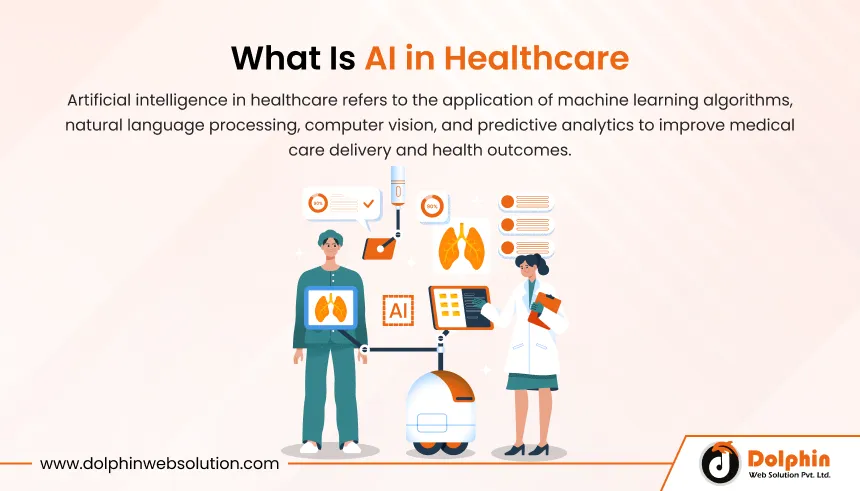
Artificial intelligence in healthcare refers to the application of machine learning algorithms, natural language processing, computer vision, and predictive analytics to improve medical care delivery and health outcomes. These technologies enable computer systems to perform tasks that traditionally required human intelligence, such as pattern recognition, decision-making, and language understanding.
Several AI technologies are transforming healthcare operations. Machine learning models analyze vast datasets to identify patterns and make predictions about disease progression or treatment responses. Natural language processing extracts meaningful information from unstructured clinical notes, enabling better documentation and coding accuracy. Computer vision algorithms interpret medical images including X-rays, CT scans, and pathology slides to detect abnormalities. Predictive analytics forecast patient risks, resource needs, and operational bottlenecks.
Healthcare AI applications range from patient-facing tools like symptom checkers and virtual health assistants to backend systems that optimize hospital workflows, automate administrative tasks, and support clinical decision-making. These solutions integrate with electronic health records, medical devices, and imaging systems to provide actionable insights at the point of care.
How AI Is Transforming the Healthcare Industry
AI is fundamentally reshaping healthcare delivery across three critical dimensions: operational efficiency, clinical excellence, and strategic decision-making. Healthcare organizations implementing AI solutions report significant improvements in workflow automation, resource utilization, and patient satisfaction scores.
Operational efficiency gains come from automating repetitive administrative tasks such as appointment scheduling, insurance verification, and medical coding. AI-powered systems process claims faster, reduce billing errors, and free clinical staff to focus on patient care. Predictive models optimize bed management, staff scheduling, and supply chain operations by forecasting patient volumes and resource requirements.
Clinical outcomes improve through AI-assisted diagnostics that reduce errors and detect diseases earlier when treatment is most effective. AI algorithms analyze patient data continuously to identify deterioration risks, enabling proactive interventions. Precision medicine platforms recommend personalized treatments based on genetic profiles, medical history, and real-time health data, leading to better response rates and fewer adverse events.
Data-driven decision-making capabilities allow healthcare leaders to identify quality gaps, benchmark performance, and allocate resources strategically. AI analytics reveal trends in readmission rates, length of stay, and cost per episode, supporting value-based care initiatives. Population health management systems use predictive models to stratify risk and target interventions for high-risk patients.
Real-World Examples of AI in Healthcare
1. Diagnostic Imaging and Radiology
Google Health’s AI system detects breast cancer in mammograms with greater accuracy than human radiologists, reducing false positives by 5.7% and false negatives by 9.4%. The algorithm was trained on over 76,000 mammograms and validated across diverse patient populations in the UK and US.
Zebra Medical Vision analyzes CT scans, X-rays, and MRIs to identify cardiovascular conditions, liver disease, bone health issues, and lung diseases. Their AI solutions are deployed in over 1,000 healthcare facilities worldwide, processing millions of scans annually.
2. Virtual Health Assistants
Babylon Health’s AI-powered chatbot conducts symptom assessments and provides triage recommendations based on medical history and reported symptoms. The platform serves over 24 million members across multiple countries, reducing unnecessary emergency room visits by 15%.
Ada Health’s symptom checker has completed over 30 million assessments in 10 languages, helping patients understand their symptoms and determine appropriate care levels. The platform achieves 74% accuracy in matching patient symptoms to correct conditions.
3. Drug Discovery and Development
Insilico Medicine used AI to identify a novel drug candidate for idiopathic pulmonary fibrosis in just 18 months, compared to the traditional 4-5 year timeline. Their generative chemistry platform designed the molecule, which advanced to Phase I clinical trials.
BenevolentAI accelerated COVID-19 treatment research by analyzing vast scientific literature and identifying baricitinib as a potential therapy. The AI-driven hypothesis was validated in clinical trials, and the drug received emergency use authorization.
Key Use Cases of AI in Healthcare
1. Remote Patient Monitoring
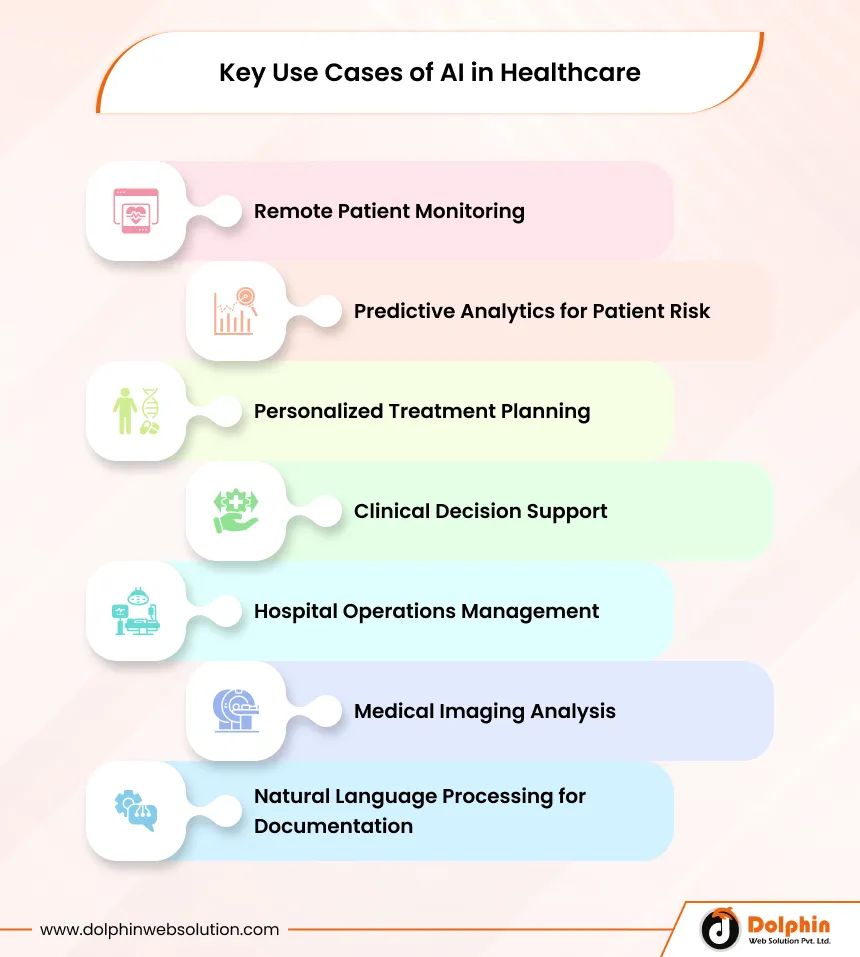
AI-powered wearable devices and sensors continuously track vital signs including heart rate, blood pressure, glucose levels, and oxygen saturation. Machine learning algorithms detect anomalies and alert healthcare providers to potential complications before symptoms escalate. This proactive approach reduces hospital readmissions by 38% for chronic disease patients.
2. Predictive Analytics for Patient Risk
Healthcare systems deploy AI models that analyze electronic health records to predict sepsis risk up to 12 hours before onset, enabling early intervention that reduces mortality by 18%. Similar algorithms forecast hospital-acquired infections, patient deterioration, and readmission likelihood, allowing care teams to implement preventive measures.
3. Personalized Treatment Planning
Oncology platforms use AI to analyze tumor genetics, patient characteristics, and treatment outcomes data to recommend individualized cancer therapies. These precision medicine approaches increase treatment success rates by matching patients to therapies most likely to be effective based on their unique biological profile.
4. Clinical Decision Support
AI-powered clinical decision support systems provide real-time recommendations at the point of care, suggesting appropriate diagnostic tests, flagging drug interactions, and recommending evidence-based treatment protocols. These tools reduce medical errors by 40% and improve adherence to clinical guidelines.
5. Hospital Operations Management
AI optimizes emergency department flow by predicting patient volumes and acuity levels, enabling better staff allocation. Predictive models forecast bed availability, surgical suite utilization, and equipment needs, reducing patient wait times by 30% and improving resource efficiency.
6. Medical Imaging Analysis
Deep learning algorithms analyze pathology slides, retinal images, and radiological scans to detect diseases including cancer, diabetic retinopathy, and pneumonia. AI assists radiologists by highlighting suspicious areas, quantifying disease progression, and reducing image interpretation time by 50%.
7. Natural Language Processing for Documentation
AI scribes automatically generate clinical notes from physician-patient conversations, reducing documentation time by 2 hours per physician per day. NLP systems also extract structured data from unstructured clinical notes, improving coding accuracy and enabling better data analytics.
Benefits of AI in Healthcare
Healthcare organizations implementing AI solutions realize substantial benefits across clinical, operational, and financial dimensions.
- Improved diagnostic accuracy through AI algorithms that detect patterns invisible to human observation, reducing misdiagnosis rates and enabling earlier disease detection when treatment outcomes are optimal.
- Enhanced operational efficiency by automating administrative workflows including scheduling, billing, and insurance verification, allowing staff to focus on high-value patient care activities.
- Reduced healthcare costs through optimized resource allocation, decreased length of stay, fewer medical errors, and prevention of costly complications through early intervention.
- Increase access to care via AI-powered telemedicine platforms and virtual assistants that provide 24/7 symptom assessment and triage, particularly benefiting underserved rural populations.
- Accelerated drug development using AI to identify promising drug candidates, predict molecular interactions, and optimize clinical trial design, reducing development timelines from years to months.
- Personalized medicine capabilities that match patients to treatments based on genetic profiles, medical history, and real-time data, improving response rates and reducing adverse reactions.
- Better patient outcomes through continuous monitoring, predictive alerts, and proactive interventions that prevent complications and support chronic disease management.
- Physician burnout reduction by automating documentation tasks, streamlining workflows, and providing decision support that reduces cognitive load and administrative burden.
- Scalable healthcare delivery enabled by AI systems that process unlimited volumes of data, support multiple concurrent users, and maintain consistent quality without fatigue.
Challenges and Considerations of AI in Healthcare
Implementing AI in healthcare requires careful attention to regulatory compliance, data security, and ethical considerations. Healthcare organizations must navigate complex challenges to realize AI benefits while protecting patient safety and privacy.
Data privacy and security concerns are paramount given the sensitive nature of health information. AI systems require access to large datasets for training and operation, creating potential vulnerabilities. Organizations must implement robust encryption, access controls, and audit trails while ensuring compliance with HIPAA in the US, GDPR in Europe, and similar regulations globally.
Regulatory compliance requirements vary by jurisdiction and application type. AI systems used for clinical decision-making may require FDA clearance in the United States or CE marking in Europe. Organizations must document validation studies, clinical evidence, and quality management processes to satisfy regulatory authorities.
Integration complexities arise when connecting AI solutions with legacy electronic health record systems, medical devices, and imaging equipment. Interoperability standards including HL7 FHIR facilitate data exchange, but technical implementation requires significant IT resources and clinical workflow redesign.
Algorithm bias and fairness issues emerge when AI models are trained on datasets that underrepresent certain demographic groups. Biased algorithms may perform poorly for minority populations, exacerbating health disparities. Organizations must validate AI performance across diverse patient populations and monitor for bias continuously.
Ethical considerations include questions about algorithmic transparency, physician autonomy, and liability when AI-assisted decisions lead to adverse outcomes. Healthcare leaders must establish governance frameworks defining appropriate AI use cases, human oversight requirements, and accountability structures.
Future of AI in Healthcare
The next generation of healthcare AI will be characterized by increasingly sophisticated capabilities, broader adoption, and deeper integration into clinical workflows. Several transformative trends are reshaping the healthcare AI landscape.
Generative AI models like large language models will revolutionize clinical documentation, patient education, and medical research. These systems can generate personalized discharge instructions, synthesize clinical evidence, and draft research protocols, dramatically improving productivity and information accessibility.
AI agents capable of autonomous task execution will manage complex workflows spanning multiple systems and departments. These intelligent agents will coordinate care transitions, optimize supply chains, and orchestrate diagnostic workflows with minimal human intervention, enabling healthcare organizations to scale operations efficiently.
Remote care platforms powered by AI will expand access to specialist expertise through automated triage, preliminary assessments, and treatment monitoring. Rural hospitals will leverage AI to provide subspecialty care locally, reducing patient travel and improving outcomes through earlier intervention.
Predictive healthcare models will shift the focus from reactive treatment to proactive prevention. AI systems analyzing continuous health data from wearables and sensors will identify disease risks years in advance, enabling lifestyle interventions and preventive therapies that reduce chronic disease burden.
Digital twins representing individual patients will simulate treatment responses, allowing clinicians to test therapeutic strategies virtually before implementation. These personalized models will optimize treatment selection, dosing, and timing based on each patient’s unique physiology.
Ambient clinical intelligence will embed AI seamlessly into care delivery environments, providing real-time insights without disrupting workflows. Voice-activated assistants, smart rooms, and augmented reality displays will present relevant information contextually, enhancing clinical decision-making.
Why Choose Dolphin Web Solution for Healthcare AI
Dolphin Web Solution brings 15+ years of proven experience in developing secure, scalable, and compliant AI solutions for healthcare organizations worldwide. Our deep expertise in both artificial intelligence and healthcare software development positions us as a trusted partner for digital transformation initiatives.
Our healthcare AI capabilities span the complete development lifecycle from strategy and design through implementation and ongoing support. We build custom solutions including predictive analytics platforms, AI-powered diagnostic tools, clinical decision support systems, and intelligent automation solutions tailored to your organization’s unique requirements.
Security and compliance are embedded in our development process. Our solutions adhere to HIPAA, GDPR, HITECH, and other regulatory frameworks governing health data. We implement end-to-end encryption, role-based access controls, comprehensive audit logging, and regular security assessments to protect patient information.
Scalability drives our architecture decisions. Our cloud-native solutions built on robust frameworks handle growing data volumes and user loads while maintaining performance. We design systems that integrate seamlessly with existing electronic health records, medical devices, and healthcare IT infrastructure using industry-standard interoperability protocols.
Our global delivery model combines technical excellence with cost efficiency. Teams across multiple locations provide 24/7 support and rapid development cycles. We follow agile methodologies that deliver working software incrementally, allowing you to realize value quickly and adjust priorities based on feedback.
Healthcare domain expertise sets us apart. Our team includes developers with healthcare backgrounds who understand clinical workflows, medical terminology, and care delivery challenges. This knowledge ensures our solutions align with real-world needs and drive meaningful improvements in patient care and operational efficiency.
Conclusion
Artificial intelligence is transforming healthcare delivery by improving diagnostic accuracy, personalizing treatments, automating workflows, and enabling data-driven decisions. Organizations implementing AI solutions realize substantial benefits including better patient outcomes, reduced costs, increased efficiency, and enhanced access to care.
Success requires careful planning that addresses regulatory compliance, data security, integration complexity, and ethical considerations. Healthcare leaders must select technology partners with deep expertise in both AI development, Generative AI Development, and healthcare software solutions.
The future of healthcare will be shaped by increasingly sophisticated AI capabilities including generative models, autonomous agents, predictive analytics, and ambient intelligence. Organizations that embrace these technologies strategically will gain competitive advantages through superior care quality, operational excellence, and patient satisfaction.
Partner with Dolphin Web Solution to build secure, scalable, and intelligent AI healthcare solutions tailored to your organization’s needs. Our 15+ years of experience, healthcare domain expertise, and commitment to compliance ensure successful implementations that drive measurable business results. Contact us today to discuss how AI can transform your healthcare delivery and achieve your strategic objectives.
FAQs
What types of AI are used in healthcare?
Healthcare organizations use machine learning for predictive analytics and pattern recognition, natural language processing for clinical documentation and data extraction, computer vision for medical image analysis, and deep learning for complex diagnostic tasks. Robotics and automation technologies handle surgical assistance and pharmacy operations.
How does AI improve patient safety?
AI enhances patient safety by detecting potential medication errors, predicting patient deterioration before clinical signs appear, identifying diagnostic anomalies in medical images, reducing documentation errors through automation, and providing clinical decision support that flags dangerous drug interactions and contraindications.
Is AI in healthcare compliant with privacy regulations?
Properly implemented healthcare AI solutions comply with HIPAA, GDPR, and other privacy regulations through strong encryption, access controls, audit logging, and data minimization practices. Organizations must conduct privacy impact assessments, implement business associate agreements, and ensure AI vendors maintain appropriate security certifications.
How long does it take to implement AI in a healthcare organization?
Implementation timelines vary based on solution complexity, integration requirements, and organizational readiness. Simple applications like chatbots may deploy in 2-3 months, while comprehensive predictive analytics platforms typically require 6-12 months for development, integration, validation, and training. Phased approaches allow organizations to realize value incrementally.
What is the ROI of AI in healthcare?
Healthcare AI delivers ROI through multiple channels including reduced operational costs from automation, decreased length of stay from better care coordination, fewer medical errors and associated costs, improved coding accuracy increasing revenue capture, and enhanced patient satisfaction driving volume growth. Organizations typically see positive ROI within 18-24 months.
Can small healthcare practices benefit from AI?
Absolutely. Cloud-based AI solutions provide small practices access to sophisticated capabilities without large upfront investments. Applications like AI scribes, automated scheduling, and virtual assistants reduce administrative burden, while diagnostic support tools enhance clinical capabilities. Subscription pricing models make AI accessible to organizations of all sizes.
How do you ensure AI algorithms are unbiased?
Bias mitigation requires training algorithms on diverse, representative datasets that include patients across demographic groups. Organizations should validate AI performance separately for different populations, monitor outcomes continuously for disparities, implement fairness metrics in algorithm development, and maintain human oversight of AI recommendations to catch potential bias issues.
Jigar Shah


Jigar Shah serves as the Chief Operating Officer of Dolphin Web Solution, overseeing business operations, project delivery, client success, and organizational growth initiatives. With more than 15 years of experience in the IT and digital services industry, he plays a vital role in ensuring operational excellence and delivering exceptional outcomes for global clients. His expertise spans strategic planning, project management, process optimization, resource management, and technology operations. Jigar has successfully managed complex eCommerce, AI, web, and mobile application projects while building scalable processes that support sustainable business growth. Passionate about leadership and continuous improvement, Jigar focuses on creating efficient systems, empowering teams, and maintaining the highest standards of quality. He frequently shares perspectives on digital transformation, project execution, operational efficiency, and business growth strategies.

We can help you with
- Dedicated Team
- Setup Extended Team
- Product Development
- Custom App Development
Our Offices

AHMEDABAD (INDIA)
B- 203-206, Empire Business Hub, Science City Road, Sola, Ahmedabad – 380060

BERLIN (GERMANY)
Badensche Str. 28, 10715 Berlin, Germany

CALIFORNIA (USA)
9601 Reseda Blvd, Apt#223, Northridge CA-91324, USA

ALBERTA (CANADA)
302 Skyview Ranch Drive NE, Calgary, Alberta, Canada T3N0P5





Hello!
Click one of our contacts below to chat on WhatsApp