
AI Consulting Services: Why Businesses Need Expert Guidance


Table of Contents
 Show
Show

Summary :
Most AI projects fail because of poor planning, not poor technology. This guide breaks down what AI consulting services actually cover, why expert guidance lowers risk and cost, the real benefits it delivers, which industries gain the most, and how to choose the right consulting partner for your business.
Every business leader today feels the pressure to do something with AI. The harder question is knowing what to actually do, in what order, and with what expectation of return. Jumping straight into a build without a clear strategy is one of the most common and most expensive mistakes companies make with AI, and it is rarely a technology problem. It is a planning problem.
That is where AI consulting comes in. At Dolphin Web Solution, we have spent over 15 years helping businesses plan and build technology that actually works for their operations, and the pattern with AI is consistent: the companies that see real returns are the ones that get expert guidance before they start building, not after something has already gone wrong. As one of the top AI development companies in India, we help organisations identify high-impact AI opportunities, create practical implementation roadmaps, and develop scalable AI solutions that deliver measurable business value.
What Are AI Consulting Services?
AI consulting is the practice of helping businesses evaluate, plan, and prepare for AI adoption before any code gets written. Rather than jumping straight to building a chatbot or a predictive model, a consulting engagement starts by answering more fundamental questions: which problems are actually worth solving with AI, what data and systems are already in place, and what a realistic path forward looks like given the business's budget, timeline, and risk tolerance. Our own AI Consulting Services team works with businesses at exactly this stage, before a single line of code is written, to make sure the eventual build is aimed at the right target.
A full consulting engagement typically covers the following areas of work:
| Area | What It Involves |
|---|---|
| Business assessment | Reviewing current operations, systems, and goals to understand where AI could realistically add value |
| AI readiness evaluation | Assessing data quality, technical infrastructure, and team capabilities against what AI adoption actually requires |
| Opportunity identification | Separating AI ideas that sound interesting from ones that will deliver measurable business value |
| AI strategy development | Building a sequenced plan for which AI initiatives to pursue first, and why |
| Technology selection | Recommending the right models, platforms, and vendors for the business's specific needs and budget |
| Implementation planning | Defining the technical approach, resourcing, and timeline for moving from plan to production |
| Governance and compliance | Establishing policies for data privacy, security, and responsible AI use before deployment |
| Change management | Preparing teams for how their workflows will change once AI tools are introduced |
Not every engagement covers all eight areas in equal depth, but a serious consulting partner should be able to speak to each one with specifics, not generalities.
Why Businesses Need AI Consulting
AI is unlike most technology investments because the cost of getting the strategy wrong is often far greater than the cost of getting it right. Many businesses lack in-house AI expertise, making it difficult to evaluate the best approach or avoid costly mistakes. A wrong decision early on—such as building a custom model when an existing API would have been enough—can consume a significant portion of the budget before the issue is recognized.
The technology itself evolves rapidly, making it challenging for businesses to keep pace while managing day-to-day operations. Data quality is another common obstacle, as information often exists across disconnected systems that were never designed to work together. In many cases, solving these data issues before implementing AI is what ultimately determines a project's success.
Security, compliance, and system integration add further complexity, especially for organizations handling sensitive data or operating in regulated industries. Integrating AI with existing CRM, ERP, or internal systems is rarely straightforward, and without clear success metrics from the start, measuring ROI and proving business value becomes difficult.

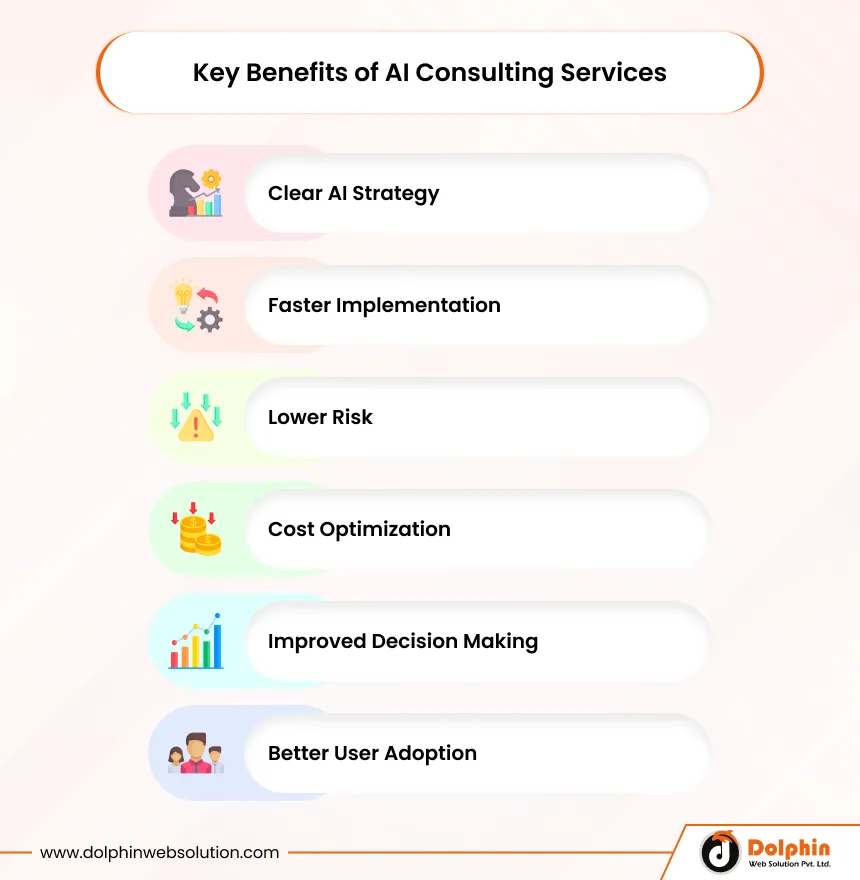
Key Benefits of AI Consulting Services
1. Clear AI Strategy
AI consulting aligns every AI initiative with actual business goals, rather than pursuing technology for its own sake. This keeps effort focused on the use cases most likely to move a real metric, instead of spreading resources thin across projects that sound impressive but do not connect to the business's priorities.
2. Faster Implementation
Consultants bring proven frameworks and lessons learned from previous engagements, which shortens the path from idea to working system. Businesses avoid the trial and error that comes from figuring out the process for the first time on their own.
3. Lower Risk
Expert planning surfaces the mistakes that typically only become visible mid project, such as data gaps or unrealistic scope, while there is still time to correct course cheaply. This avoids the far more expensive alternative of discovering these problems after significant development work is already underway.
4. Cost Optimization
Consulting helps businesses invest only in AI solutions that deliver measurable value, rather than funding every idea that gets pitched internally. This discipline around prioritization tends to pay for the consulting engagement itself many times over.
5. Improved Decision Making
Data-driven insights from a proper readiness assessment help businesses prioritize projects based on evidence rather than internal politics or whoever has the loudest voice in the room. This leads to a roadmap that reflects actual opportunity rather than assumption.
6. Better User Adoption
Good consulting includes a plan for employee training and organizational change, not just the technical rollout. A technically excellent AI system that employees do not trust or understand still fails, so preparing people is as important as preparing the technology.
Industries That Benefit from AI Consulting
AI consulting is not limited to any single sector. Different industries tend to see value from different starting points, though the underlying need for planning is consistent across all of them.
| Industry | Where AI Consulting Typically Adds the Most Value |
|---|---|
| Retail and eCommerce | Personalization, demand forecasting, and inventory optimization |
| Healthcare | Patient triage support, administrative automation, and diagnostic assistance |
| Manufacturing | Predictive maintenance, quality inspection, and supply chain forecasting |
| Finance | Fraud detection, risk modeling, and process automation |
| Logistics | Route optimization, demand prediction, and warehouse automation |
| Education | Personalized learning paths and administrative efficiency |
| Real Estate | Property valuation models and lead scoring |
| SaaS | In product AI features, churn prediction, and customer support automation |
| Travel and Hospitality | Dynamic pricing, personalized recommendations, and booking automation |
Especially for the healthcare industry, AI consulting helps healthcare organisations implement solutions for patient triage, administrative automation, and diagnostic support while ensuring secure, scalable, and compliant adoption. Beyond clinical settings, AI is also improving preventive healthcare through tools like FactsScan’s Healthy Food Scanner Mobile App, which helps consumers make informed food choices by analysing packaged food ingredients and nutritional information.
AI Consulting Process
While every engagement is tailored to the business, most AI consulting projects follow a similar sequence from initial discovery through ongoing optimization:
1. Discovery Workshop
Sit down with key stakeholders to understand business goals, pain points, and current priorities. This session also surfaces internal disagreements about what success looks like, which is far better to resolve early than midway through a build.
2. Business Analysis
Review existing operations, systems, and workflows to identify where AI could realistically create value. This step often uncovers inefficiencies the business has simply gotten used to working around.
3. AI Opportunity Assessment
Evaluate potential use cases against expected impact, feasibility, and cost. Each opportunity is scored against the others so the business can see clearly which ones deserve attention first.
4. Data Readiness Evaluation
Assess the quality, structure, and accessibility of the data needed to support the highest priority use cases. This often reveals gaps that need to be addressed before any model can be trained reliably.
5. Roadmap Creation
Sequence the prioritized use cases into a realistic plan with timelines and milestones. The roadmap also accounts for dependencies, so teams know what needs to happen before the next phase can start.
6. Proof of Concept
Build a small, scoped version of the highest priority use case to validate the approach before committing further budget. This keeps risk low while giving stakeholders something tangible to evaluate.
7. AI Development
Move from proof of concept into full development of the solution, whether in-house or with a development partner. This is where the validated approach gets built out into a production-ready system.
8. Integration
Connect the new AI system with existing tools such as a CRM, ERP, or internal databases. Careful integration planning here prevents the kind of workflow gaps that cause employees to abandon a new tool.
9. Testing
Rigorously test model accuracy, performance, and edge cases before the system goes live. This includes stress testing under realistic usage conditions, not just the clean scenarios used during development.
10. Deployment
Launch the solution into production with a plan for rollout and initial monitoring. A phased rollout to a smaller group first often catches issues before they affect the whole organization.
11. Monitoring and Optimization
Track performance against the metrics defined earlier and refine the system as real usage data comes in. AI systems tend to drift over time, so this stage never really ends as long as the system stays in use.
Common Mistakes Businesses Make Without AI Consulting
Businesses that skip consulting and move straight into development tend to run into the same handful of problems.
- Starting with technology instead of business problems: Choosing a trendy AI tool first and then looking for a use case for it almost always produces something that never gets meaningful adoption.
- Choosing the wrong AI model: Without expert evaluation, teams often pick a model based on hype or familiarity rather than fit, leading to poor performance or unnecessary cost.
- Ignoring data quality: Assuming existing data is ready for AI, when it is not, causes delays and rework once the gaps surface mid-project.
- Underestimating integration complexity: Connecting a new AI system to existing tools is rarely as simple as it looks in a demo, and poor integration is one of the top reasons AI tools get abandoned.
- Lack of governance: Skipping security, privacy, and oversight planning until after deployment turns a manageable problem into an expensive one.
- Unrealistic ROI expectations: Expecting immediate, dramatic returns sets a project up to look like a failure even when it is on a normal, realistic timeline.
- No adoption strategy: Building a technically capable system without a plan for training and change management leads to low usage, regardless of how well the technology performs.
How to Choose the Right AI Consulting Partner
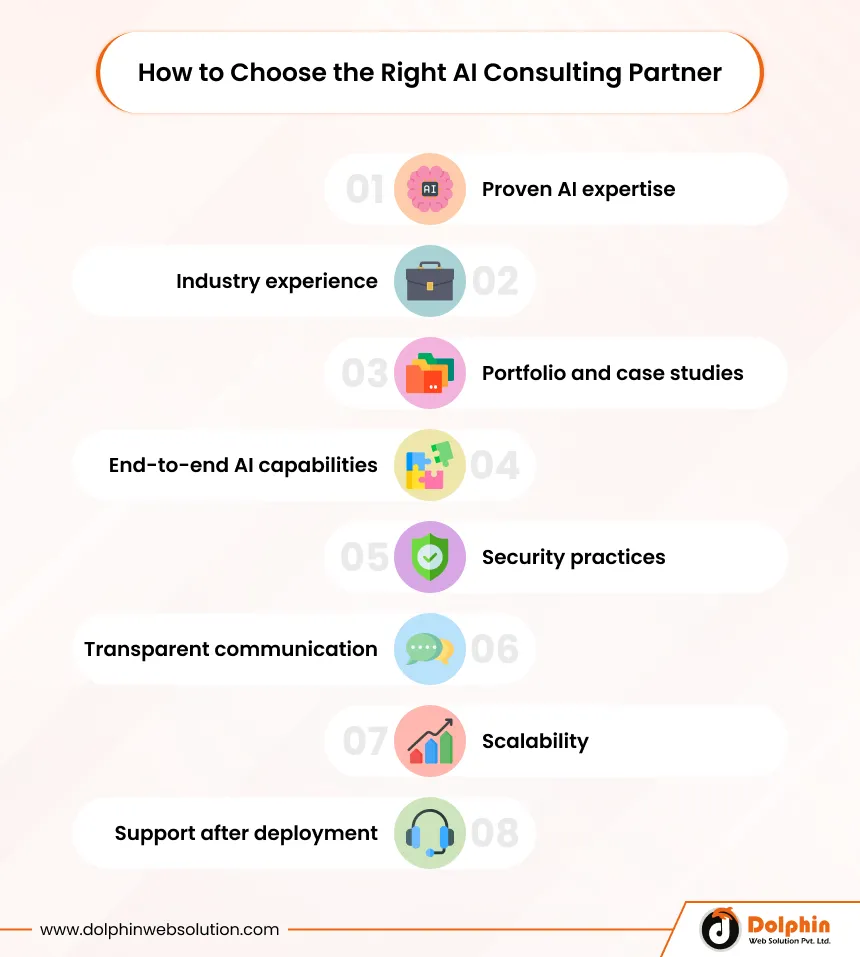
Not every consulting firm brings the same level of depth. When evaluating a potential partner, look for these criteria:
- Proven AI expertise: Demonstrated through real project experience rather than general technology consulting dressed up as AI expertise.
- Industry experience: Relevant to your sector, since AI use cases and constraints vary significantly between industries.
- Portfolio and case studies: With specific, measurable outcomes rather than vague claims of success.
- End-to-end AI capabilities: Meaning the partner can support you from strategy through development and deployment, not just the planning phase.
- Security practices: That are clearly documented and appropriate for the sensitivity of your data.
- Transparent communication: Including honest assessments, even when the answer is that a use case is not worth pursuing.
- Scalability: With the ability to design solutions that grow with your business rather than needing to be rebuilt at the next stage.
- Support after deployment: A good partner stays involved to monitor and refine the system after launch rather than disappearing once it ships.
If you are further along and evaluating development partners specifically, our guide on how to choose the Right AI Development Company covers this in more depth.
Why Choose Dolphin Web Solution for AI Consulting?
- AI strategy consulting tailored to business goals: We start every engagement by understanding what actually matters to your business, rather than applying a generic AI playbook regardless of context.
- Expertise in AI application development and integration: Consulting and execution are connected at Dolphin Web Solution. Our AI App Development team can take a validated strategy and turn it into a working, integrated product without losing the context built during the consulting phase.
- Experience delivering scalable enterprise solutions: Over 15 years of building software for businesses across industries means we design with growth in mind from the start, not as an afterthought once usage outgrows the initial build.
- End-to-end support, from strategy to deployment: We work with businesses through the full journey, from the first discovery workshop through deployment and ongoing optimization, rather than handing off halfway through.
- Focus on measurable business outcomes and long-term growth: Every recommendation is tied to a metric that matters to your business, so success is defined in terms you actually care about, not just technical milestones.

Conclusion
AI consulting exists because strategy and execution are different skills, and getting them out of order is expensive. Expert guidance helps businesses avoid the costly mistakes that come from choosing the wrong use case, underestimating data readiness, or skipping governance until it is too late. The businesses seeing real returns from AI are consistently the ones that invested in planning before building.
If you are evaluating your next AI initiative, start with an honest assessment of where your business actually stands. Our AI Consulting Services team can help you build a strategy grounded in your real data and goals, so that when you are ready to build, you are building the right thing.
Frequently Asked Questions
What is included in AI consulting services?
AI consulting typically includes a business assessment, AI readiness evaluation, opportunity identification, strategy development, technology selection, implementation planning, governance and compliance guidance, and change management support.
How is AI consulting different from AI development?
Consulting focuses on strategy, planning, and readiness before any code is written, while development focuses on building and deploying the actual AI solution. Many businesses use consulting first to define direction, then move into development.
How long does an AI consulting engagement take?
Most consulting engagements are shorter and more focused than development projects, typically running from a few weeks to a couple of months, depending on the scope of the assessment and roadmap.
Do small and mid-sized businesses need AI consulting, or only large enterprises?
Businesses of any size can benefit from AI consulting, since the risk of choosing the wrong use case or underestimating data readiness applies regardless of company size. Smaller businesses often benefit even more, since they have less room to absorb a failed pilot.
How much does AI consulting cost?
Cost depends on the scope of the engagement, the complexity of the business's systems, and the depth of the assessment required. A clearly defined scope at the start is the best way to get an accurate estimate.
What happens after an AI consulting engagement ends?
Most engagements end with a clear roadmap and a defined next step, whether that is running a proof of concept, selecting a development partner, or beginning implementation with the same team that led the consulting phase.
Nimesh Patel


Nimesh Patel is the Managing Director of Dolphin Web Solution, a global eCommerce, AI, and software development company helping businesses accelerate digital growth. With over 15 years of experience in technology consulting and product development, he has successfully guided startups, SMBs, and enterprise organizations in building scalable digital solutions. Nimesh specializes in eCommerce development, custom software solutions, mobile application development, and digital transformation strategies. Throughout his career, he has worked closely with businesses across retail, healthcare, automotive, manufacturing, and technology sectors, helping them leverage modern technologies to improve operational efficiency and customer experiences. As a business leader, Nimesh is passionate about innovation, entrepreneurship, and helping organizations turn ideas into successful digital products. His insights focus on eCommerce growth, AI adoption, software development trends, and business transformation through technology.

We can help you with
- Dedicated Team
- Setup Extended Team
- Product Development
- Custom App Development
Our Offices

AHMEDABAD (INDIA)
B- 203-206, Empire Business Hub, Science City Road, Sola, Ahmedabad – 380060

BERLIN (GERMANY)
Badensche Str. 28, 10715 Berlin, Germany

CALIFORNIA (USA)
9601 Reseda Blvd, Apt#223, Northridge CA-91324, USA

ALBERTA (CANADA)
302 Skyview Ranch Drive NE, Calgary, Alberta, Canada T3N0P5





Hello!
Click one of our contacts below to chat on WhatsApp