
Difference Between AI Development and Software Development in 2026


Table of Contents
 Show
Show
- 1 What Is Software Development?
- 2 What Is AI Development?
- 3 Key Differences Between AI Development and Software Development
- 4 Where AI Development and Software Development Overlap
- 5 When Your Business Needs Traditional Software Development
- 6 When Your Business Needs AI Development
- 7 How to Decide Which Path Fits Your Business
- 8 Common Mistakes Businesses Make
- 9 Cost and Timeline Considerations
- 10 The Future of AI and Software Development
- 11 Why Partner with an Experienced Development Team of Dolphin Web Solution
- 12 Conclusion

Summary :
AI development and traditional software development both focus on building digital solutions, but they differ in how they are designed, developed, and used. This blog explains the key differences between AI development and software development, including technologies, development processes, data requirements, testing, and real world applications. It also highlights when businesses may consider AI based solutions compared with traditional software to choose the right approach for their specific needs.
Every business leader exploring digital growth eventually asks the same question: should we invest in traditional software development, or is it time to explore AI development? The answer is rarely simple, because the two are not really rivals. They are two branches of the same discipline, built on different foundations, aimed at different problems, and often working best when combined.
At Dolphin Web Solution, we have spent more than 15 years building software for ecommerce brands, startups, and enterprise teams, and in recent years a growing share of that work involves artificial intelligence. This guide breaks down both approaches in plain language, so you can make an informed decision rather than one based on buzzwords.
What Is Software Development?
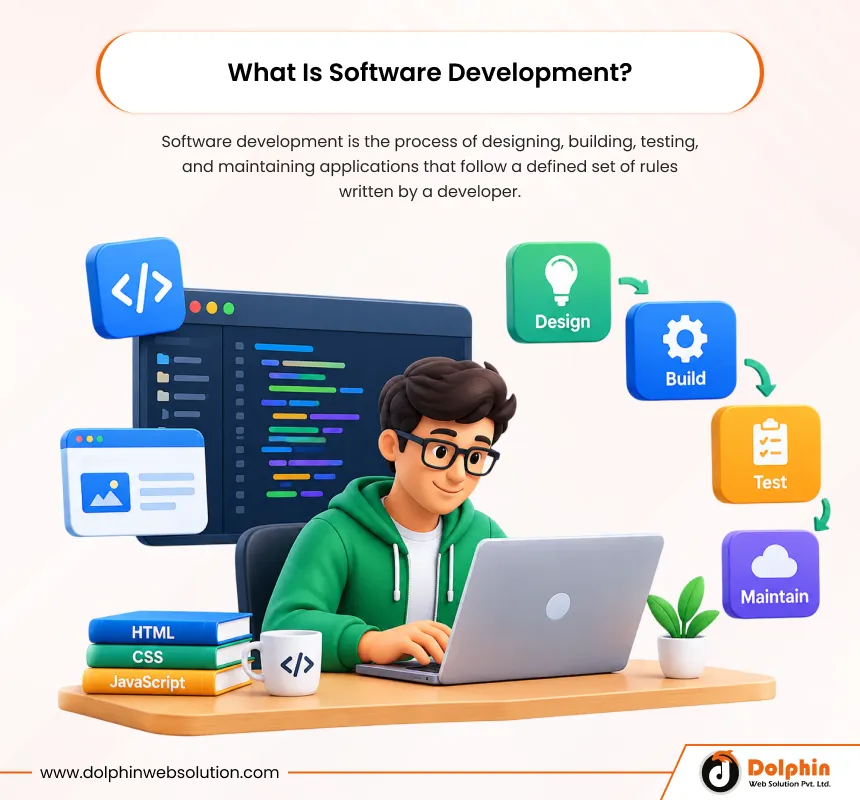
Software development is the process of designing, building, testing, and maintaining applications that follow a defined set of rules written by a developer. A traditional software application does exactly what it is programmed to do, nothing more and nothing less. If a rule is not written into the code, the software will not perform that behavior on its own.
This includes:
- Ecommerce websites and storefronts
- Custom web applications
- Mobile applications for iOS and Android
- Internal business tools and dashboards
- APIs that connect different systems
- Content management systems
The logic behind traditional software is deterministic. Given the same input, it will always return the same output, because a developer explicitly coded that outcome. This predictability is exactly why software development remains the backbone of almost every digital business today.
What Is AI Development?
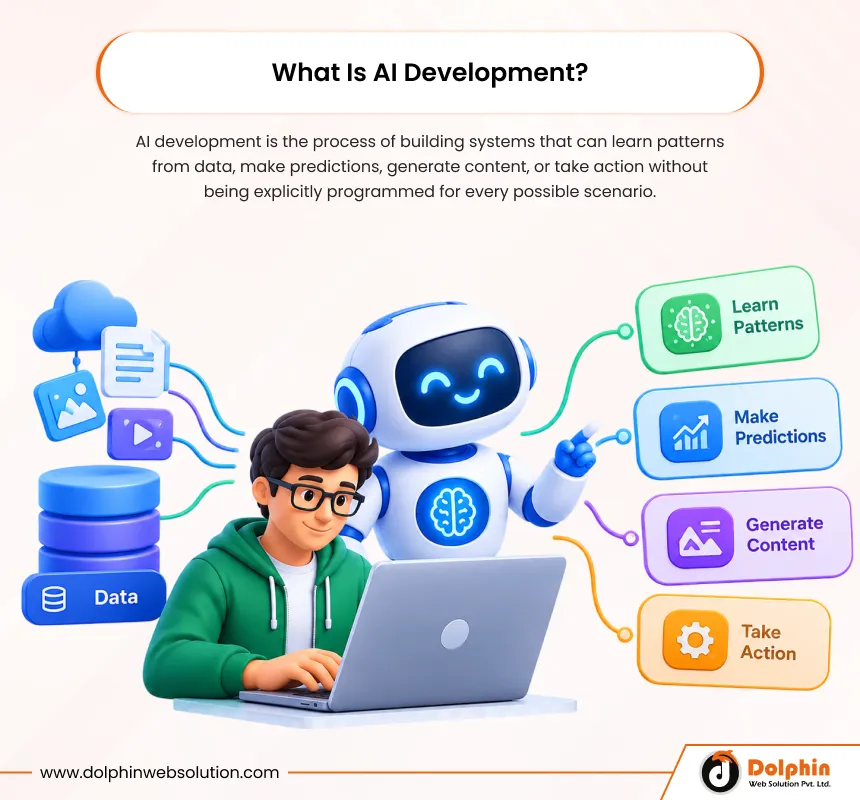
AI development is the process of building systems that can learn patterns from data, make predictions, generate content, or take action without being explicitly programmed for every possible scenario. Instead of following a fixed set of instructions, an AI system is trained on data and learns to recognize patterns, then applies that learning to new, unseen situations.
Modern AI development typically involves:
- Machine learning models trained on historical data
- Natural language processing for chatbots and virtual assistants
- Computer vision for image and video recognition
- Generative AI for content, code, or design creation
- AI agents that can complete multi step tasks with limited human input
Unlike traditional software, AI systems are probabilistic rather than fully deterministic. The same input can sometimes produce a slightly different output, and the system’s accuracy depends heavily on the quality and volume of data used to train it.
Key Differences Between AI Development and Software Development
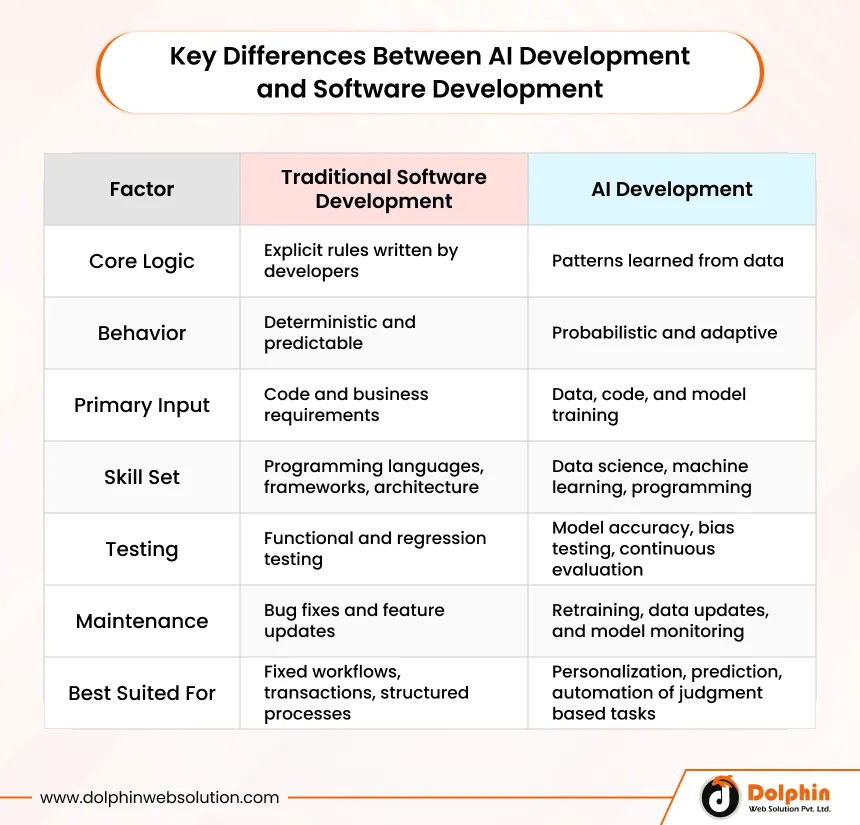
| Factor | Traditional Software Development | AI Development |
|---|---|---|
| Core Logic | Explicit rules written by developers | Patterns learned from data |
| Behavior | Deterministic and predictable | Probabilistic and adaptive |
| Primary Input | Code and business requirements | Data, code, and model training |
| Skill Set | Programming languages, frameworks, architecture | Data science, machine learning, programming |
| Testing | Functional and regression testing | Model accuracy, bias testing, continuous evaluation |
| Maintenance | Bug fixes and feature updates | Retraining, data updates, and model monitoring |
| Best Suited For | Fixed workflows, transactions, structured processes | Personalization, prediction, automation of judgment based tasks |
This table is a simplified view. Most real projects sit somewhere between the two columns, which brings us to the next point.
Where AI Development and Software Development Overlap
It is a mistake to treat AI development as something separate from software development. In practice, every AI feature still needs to live inside a software application. A chatbot needs a website or app to sit in. A recommendation engine needs an ecommerce platform to plug into. A fraud detection model needs a backend system to process transactions.
This means AI projects still require:
- Solid software architecture
- Secure APIs and integrations
- User interface and user experience design
- Cloud infrastructure and hosting
- Ongoing maintenance and support
AI development does not replace software development. It adds a new capability layer on top of it. The strongest AI projects are the ones where experienced software engineers and AI specialists work together, rather than treating AI as an isolated side project.
When Your Business Needs Traditional Software Development
Traditional software development is usually the right starting point when your goal involves a clear, repeatable process. Common examples include:
- Launching an ecommerce store on Shopify, Magento, or WooCommerce
- Building a custom web application for internal operations
- Creating a mobile app for customers to browse products, book services, or manage accounts
- Automating a workflow that follows fixed business rules
- Connecting existing systems through APIs
If you are planning a customer facing app, our team offers dedicated Mobile App Development services covering iOS, Android, and cross platform builds, built on the same engineering discipline that has supported our clients for over 15 years.
Software development is also the right choice when predictability matters most. Payment processing, inventory management, and order fulfillment are not places where you want a system guessing at outcomes. You want fixed, testable, repeatable logic.
When Your Business Needs AI Development
AI development becomes valuable when your business faces problems that are too complex, too varied, or too data heavy for fixed rules to handle well. Common use cases include:
- Personalized product recommendations based on browsing and purchase history
- Chatbots and virtual assistants that handle customer support at scale
- Fraud detection systems that flag unusual transaction patterns
- Demand forecasting based on historical sales data
- Generative AI tools that create content, summaries, or code
- AI agents that can research, plan, and execute multi step tasks
If any of these sound familiar, it may be time to explore our AI App Development services, where we help businesses design and deploy AI features that solve real operational problems rather than adding technology for its own sake.
A useful rule of thumb: if the task involves judgment, prediction, or pattern recognition across large volumes of unstructured data, AI development is worth considering. If the task involves following clear, fixed rules, traditional software development will usually get you there faster and at lower risk.

How to Decide Which Path Fits Your Business
Rather than choosing based on trends, work through these questions before committing to either path:
- Does the task follow a fixed, repeatable process, or does it require judgment based on patterns?
- Do you have enough historical data to train a reliable AI model?
- Is predictability more important than adaptability for this specific feature?
- What is your tolerance for occasional errors while a model learns and improves?
- Do you have the internal resources to monitor and retrain an AI model over time?
- Would a simpler, rule based software solution solve most of the problem at a fraction of the cost?
Many businesses find that the right answer is not AI or software development, but a combination of both, with software forming the foundation and AI layered on top for specific, high value features.
Common Mistakes Businesses Make
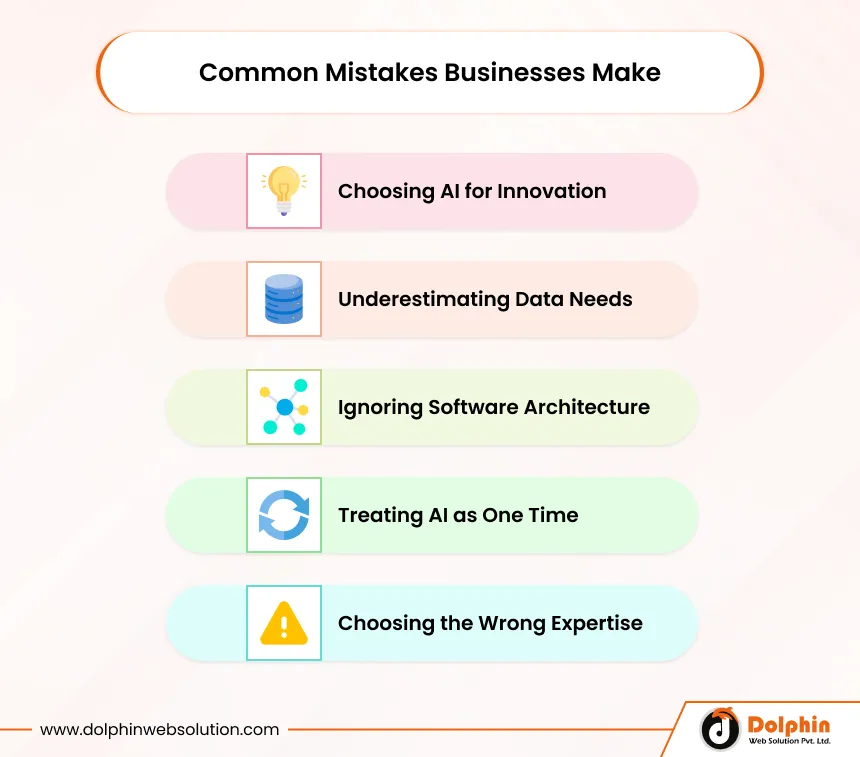
Businesses often approach AI development and software development as if they follow the same process. This can lead to avoidable challenges, especially when organizations do not understand the differences between the two. Some common mistakes include:
- Choosing AI for Innovation: Businesses may choose AI simply because it is an emerging technology. However, AI development should be considered when intelligent prediction, automation, personalization, or data driven decision making can address a specific business need.
- Underestimating Data Needs: Unlike traditional software, many AI solutions depend heavily on data for training and improving models. Using incomplete, inaccurate, or poorly structured data can affect the reliability and performance of an AI solution.
- Ignoring Software Architecture: AI does not replace the need for a strong software foundation. Attaching AI capabilities to an unstable or poorly designed application can create performance, security, scalability, and integration issues.
- Treating AI as One Time: Traditional software may require updates and maintenance, but AI systems can also require continuous monitoring, model evaluation, data updates, and retraining as business requirements and real world data change.
- Choosing the Wrong Expertise: AI development and software development require different areas of expertise. A business may face challenges when its development partner has strong traditional software experience but limited AI expertise, or strong AI knowledge without sufficient experience in building reliable software systems.
If you are still evaluating vendors, our guide on How to Choose the Right AI Development Company walks through the criteria worth checking before signing a contract.
Cost and Timeline Considerations
Exact costs vary depending on scope, so we won’t pretend to give you a fixed number without knowing your project. What we can share are the factors that typically drive cost and timeline differences between the two approaches.
Traditional software development costs are primarily driven by:
- Number of features and screens
- Complexity of integrations with third party systems
- Platform choice, such as web, iOS, Android, or all three
- Design complexity and custom functionality
AI development costs are typically driven by:
- Availability and quality of training data
- Complexity of the model required, from simple classification to advanced generative systems
- Need for ongoing retraining and monitoring after launch
- Integration effort with existing software systems
As a general pattern, AI projects tend to need more upfront discovery and data preparation time, while traditional software projects tend to follow a more linear timeline once requirements are locked. The most reliable way to get an accurate estimate is a detailed scoping conversation with a team that has delivered both types of projects.
The Future of AI and Software Development
The line between AI development and software development is steadily blurring. Many software platforms now ship with built in AI features as standard, not optional add ons. Search bars understand natural language. Support systems triage tickets automatically. Ecommerce platforms recommend products without a developer writing explicit rules for every scenario.
This doesn’t mean traditional software development is fading. It means AI is becoming another tool in the software development toolkit, similar to how cloud computing or mobile development became standard skills rather than separate specialties. Businesses that treat AI and software development as one connected discipline, rather than two competing options, will be better positioned for what comes next.
Why Partner with an Experienced Development Team of Dolphin Web Solution
Choosing between AI development and software development is easier when you work with a team that has genuine depth in both. Experience matters here in practical ways:
- An experienced team can tell you honestly when AI is not the right fit for your problem
- Strong software architecture keeps AI features stable, secure, and maintainable
- A team that has shipped real projects understands the gap between a working demo and a production ready system
- Long standing client relationships mean ongoing support, not a one time handoff
Dolphin Web Solution has spent more than 15 years building ecommerce platforms, custom software, and now AI powered features for businesses across industries. That combination of software engineering discipline and applied AI experience is often exactly what’s missing when AI projects fail to move past the prototype stage.
Conclusion
AI development and software development are not competing choices. They are two complementary disciplines that solve different kinds of problems. Traditional software gives you predictable, rule based systems that businesses depend on every day. AI development adds the ability to learn from data, personalize experiences, and automate judgment based tasks that fixed rules cannot handle well.
The right approach depends entirely on the problem you are trying to solve, the data you have available, and how much predictability your business needs. In many cases, the strongest results come from combining both, with solid software architecture as the foundation and AI layered on top where it adds real, measurable value.

Frequently Asked Questions
What is the difference between AI development and software development?
Software development follows fixed rules written by a developer, producing predictable outcomes every time. AI development trains systems on data so they can recognize patterns and make predictions, which means outcomes can vary and improve as the model learns.
Do I need AI for my business, or is traditional software enough?
Most businesses do not need AI for every feature. If your process follows clear, repeatable rules, traditional software development is usually faster, more affordable, and more reliable. AI becomes valuable when you are dealing with personalization, prediction, or judgment based tasks at scale.
Can AI features be added to an existing software product later?
Yes. Many businesses start with a solid software foundation and add AI features later, such as recommendations, chat support, or fraud detection, once they have a clear use case and enough data to support it.
How long does it take to build an AI powered application compared to traditional software?
AI projects typically require more upfront time for data collection, cleaning, and model training. Traditional software projects tend to follow a more predictable timeline once requirements are finalized. Exact timelines depend on the scope of the project.
Is AI development more expensive than traditional software development?
It depends on the complexity of the model and the state of your data. Simple AI features can be affordable, while advanced generative or agentic systems require more investment in data preparation, training, and ongoing monitoring.
How do I choose the right development partner for an AI or software project?
Look for a team with proven experience in both software engineering and applied AI, a transparent process, and a track record of production ready projects rather than demos. We've published a separate guide walking through this evaluation in more detail on our blog.
Nimesh Patel


Nimesh Patel is the Managing Director of Dolphin Web Solution, a global eCommerce, AI, and software development company helping businesses accelerate digital growth. With over 15 years of experience in technology consulting and product development, he has successfully guided startups, SMBs, and enterprise organizations in building scalable digital solutions. Nimesh specializes in eCommerce development, custom software solutions, mobile application development, and digital transformation strategies. Throughout his career, he has worked closely with businesses across retail, healthcare, automotive, manufacturing, and technology sectors, helping them leverage modern technologies to improve operational efficiency and customer experiences. As a business leader, Nimesh is passionate about innovation, entrepreneurship, and helping organizations turn ideas into successful digital products. His insights focus on eCommerce growth, AI adoption, software development trends, and business transformation through technology.

We can help you with
- Dedicated Team
- Setup Extended Team
- Product Development
- Custom App Development
Our Offices

AHMEDABAD (INDIA)
B- 203-206, Empire Business Hub, Science City Road, Sola, Ahmedabad – 380060

BERLIN (GERMANY)
Badensche Str. 28, 10715 Berlin, Germany

CALIFORNIA (USA)
9601 Reseda Blvd, Apt#223, Northridge CA-91324, USA

ALBERTA (CANADA)
302 Skyview Ranch Drive NE, Calgary, Alberta, Canada T3N0P5





Hello!
Click one of our contacts below to chat on WhatsApp