
-
Dolphin Web SolutionSoftwareCustom Software Development Explained: Benefits, Process, and Key Insights
 15 Min Read
Custom Software Development Explained: Benefits, Process, and Key Insights


Table of Contents
 Show
Show
- 1 Introduction
- 2 What Is Custom Software Development?
- 3 How Is Custom Software Different from Ready-Made Applications
- 4 Examples of Custom Software in Today's World
- 5 Benefits of Custom Software Development
- 6 The Custom Software Development Process
- 7 Custom Software vs Ready-Made Solutions
- 8 Cost Factors in Custom Software Development
- 9 Software Development Cost
- 10 Trends in Custom Software Development for 2025 and Beyond
- 11 How to Choose the Right Custom Software Development Company
- 12 Conclusion

Summary :
Custom software development is not just about coding. It is about creating solutions built around your unique business goals. In this blog you will learn what custom software really means, why it often outshines ready made tools, how the process works, and what it costs. Discover how Dolphin Web Solution turns ideas into powerful scalable software that drives real growth.
Introduction
In today’s fast-paced digital landscape, one-size-fits-all solutions rarely suffice. If you want a competitive edge or wish to simplify complex operations, customized software is often a must. More and more organizations are realizing that true innovation only happens when technology molds itself around their unique goals, not the other way around. This realization is fueling the demand for custom software development.
But what exactly is custom software and how can it transform your business? In this in-depth guide, you will learn:
- What custom software development means in simple terms
- The major differences between customized solutions and ready-made applications
- The top benefits of going custom
- A peek into the development process itself
- When you should choose custom development over off-the-shelf products
- Key cost factors
- The biggest technology trends of 2025
- How to select the right partner and what makes Dolphin Web Solution unique
- Real-world case studies showing the impact of effective custom software
Let us dive in so you can discover how tailored software can unlock new levels of performance for your company.
What Is Custom Software Development?
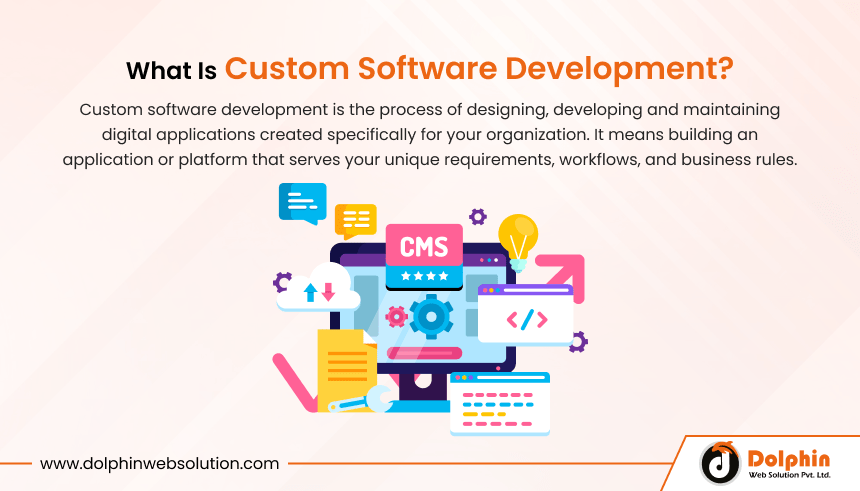
Custom software development is the process of designing, developing and maintaining digital applications created specifically for your organization. It means building an application or platform that serves your unique requirements, workflows, and business rules.
Unlike ready-made software, which is designed with general features for a broad audience, custom solutions are purpose-built for your exact needs. Every feature, screen, and integration is determined by how you work and what will help you succeed.
How Is Custom Software Different from Ready-Made Applications
Let us compare side by side:
| Aspect | Custom Software | Off the Shelf Software |
|---|---|---|
| Development | Built entirely to your specifications | Pre-made, buy or subscribe |
| Fit | Designed for your processes and goals | Generic, may not suit unique needs |
| Ownership | You control updates, code, features | Controlled by external vendor |
| Cost | Higher initial, but better value long term | Lower upfront but often recurring fees |
| Flexibility | Unlimited customization options | Limited changes allowed |
| Examples | Tailor-made CRM, custom ERP, niche platforms | Microsoft Office, standard QuickBooks |
Examples of Custom Software in Today's World
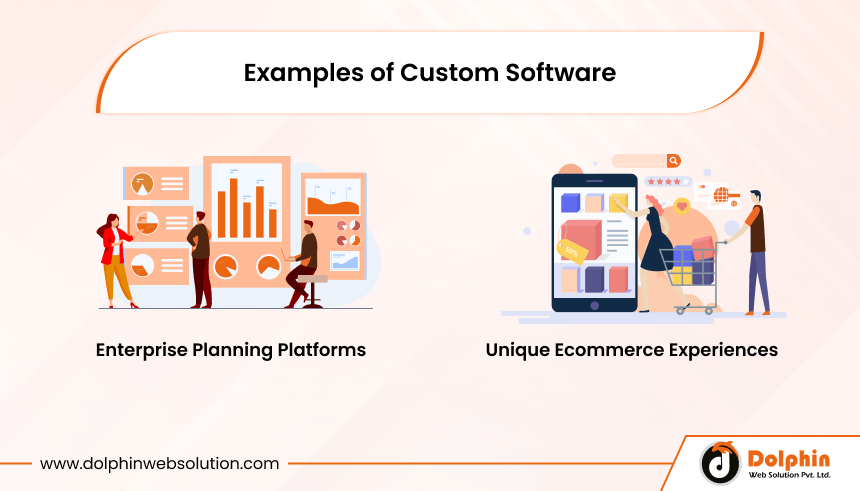
- Customer Relationship Management: Robust solutions shaped for your sales approach or support workflows
- Enterprise Planning Platforms: Connecting finance, HR, supply chain and more for manufacturers or large organizations
- Industry Specific Applications: Such as healthcare record tracking, real estate management, learning portals, or hospitality booking systems
- Unique Ecommerce Experiences: Stores with advanced personalization or complex logistics needs
Benefits of Custom Software Development
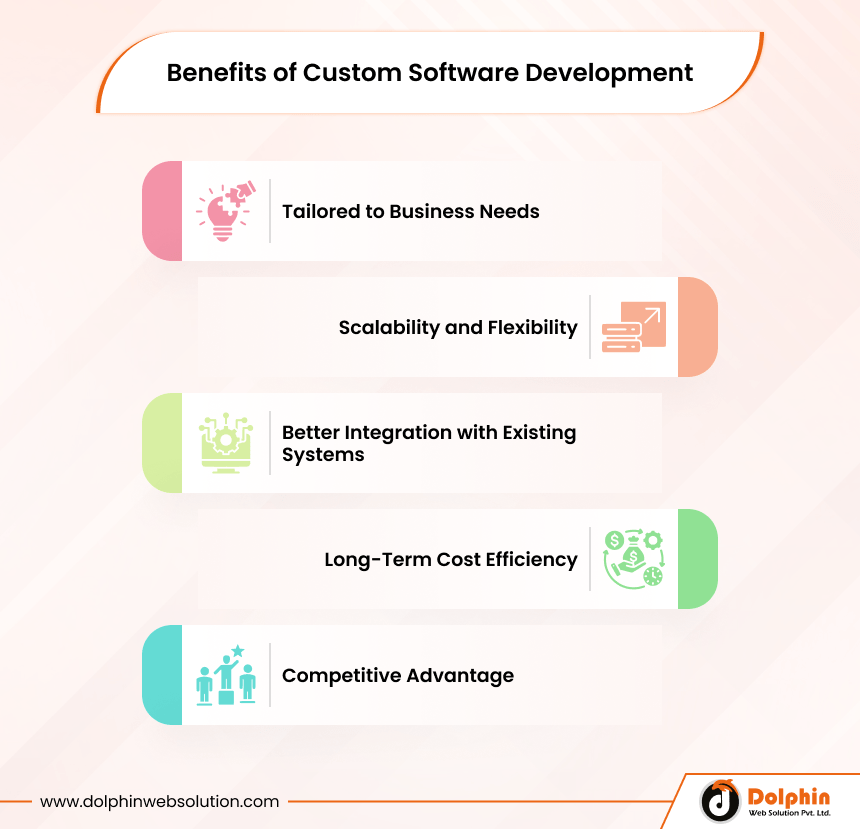
1. Tailored to Business Needs
Off the shelf tools might be bloated with features you never use, or missing essentials you desperately need. Custom-built software is designed with your specific challenges and targets in mind. As a result, processes flow smoother and performance improves.
2. Scalability and Flexibility
As your company grows or changes direction, you want your technology to keep up. Custom solutions are easy to scale, upgrade, or adapt because you control the roadmap. Adding new features or connecting new departments is much easier than asking a vendor for support.
3. Better Integration with Existing Systems
If your team uses unique databases, third-party software, or legacy tools, integration is critical. Custom software is built to “talk” to the other systems you rely on, automating workflows and reducing manual data entry.
4. Long-Term Cost Efficiency
While you pay more up front, custom solutions typically save money in the long run. You avoid expensive subscriptions, forced upgrades, or licensing restrictions. Instead, you own the code and can support and extend the platform as you see fit.
5. Competitive Advantage
A truly unique process or customer experience is your edge in the marketplace. Custom software can turn your intellectual property or novel business model into daily practice, making it tough for competitors to copy your playbook.
The Custom Software Development Process
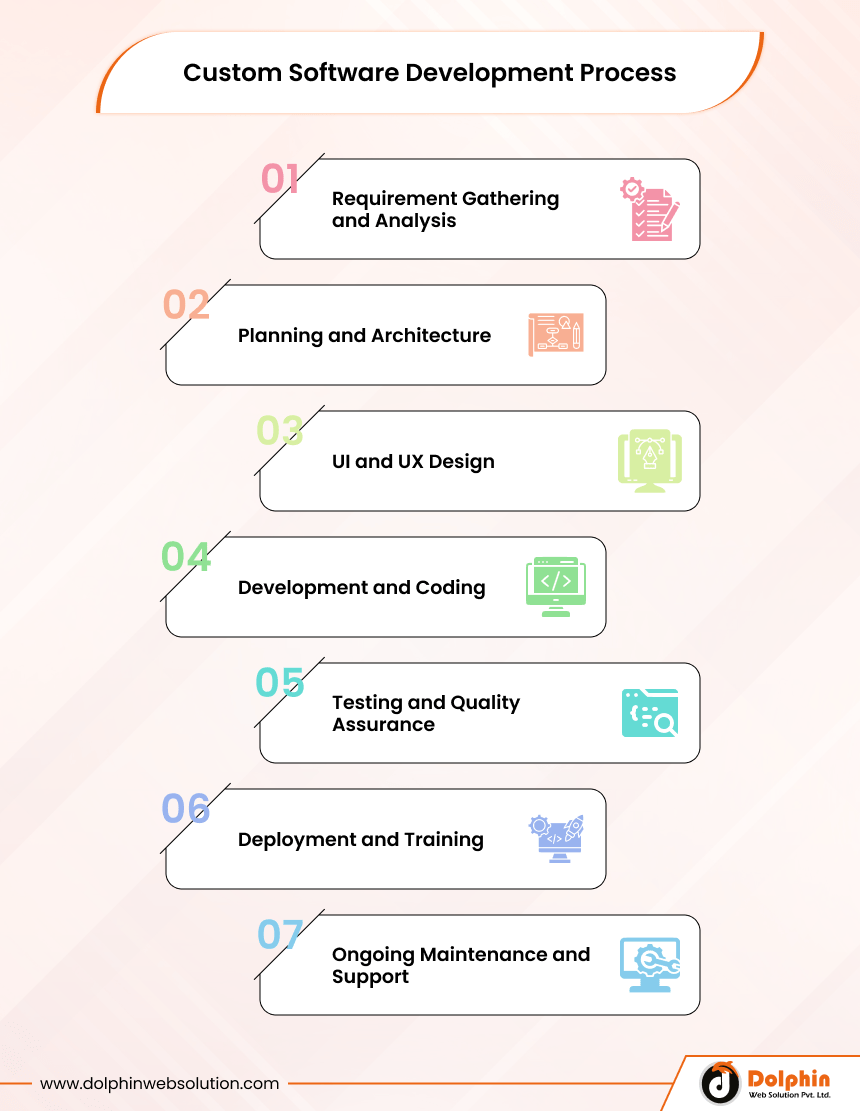
Custom software projects succeed with the right process. Here’s what it usually looks like:
Step 1: Requirement Gathering and Analysis
This initial phase is about listening and learning. Developers will hold workshops and interviews to map out your workflows, pain points, and big picture goals. They will define what success looks like for your business and document how users want to interact with the new system.
Step 2: Planning and Architecture
With the requirements clear, technical experts design the high-level structure. They select the best programming languages, frameworks, and database solutions. A roadmap is created that spells out timelines, milestones, and resources required.
Step 3: UI and UX Design
Experienced designers create wireframes and interactive prototypes. This stage ensures that the new interface is both visually appealing and easy for users to adopt. Early feedback loops with your team allow for tweaks before any code is written.
Step 4 : Development and Coding
Using agile methods, the development team delivers working features in small, regular increments. You get to review the progress, provide feedback, and adjust priorities if needed. This transparent approach reduces surprises and ensures you always know what is being delivered.
Step 5: Testing and Quality Assurance
Before launch, your software is thoroughly tested. This includes fixing bugs, checking functions, verifying performance under heavy traffic, and making sure the solution is secure. Manual and automated testing ensure robust, reliable operation.
Step 6: Deployment and Training
Once the system is ready, it is deployed to your live environment. Training sessions help your staff become comfortable with the new platform, and documentation is provided so everyone can get up to speed quickly.
Step 7: Ongoing Maintenance and Support
Business never stands still. Your partner should provide support for troubleshooting, updates, and adding new features as your needs evolve. This ensures your investment remains future-proof.
Custom Software vs Ready-Made Solutions
A direct comparison can help you see which route is right for you.
| Key Factors | Custom Software | Off the Shelf |
|---|---|---|
| Upfront Cost | Higher | Lower |
| Deployment Time | Months | Ready in days |
| Features | Fully customizable | Generic and fixed |
| Flexibility | Unlimited | Restricted by vendor |
Choose Custom Software When:
- Your workflows, data, or service delivery are unlike your competitors
- Integration, advanced security, or compliance is critical
- You want to innovate, automate, or scale up without being held back by generic tools
- Long-term value and owning your own technology is important
Choose Off the Shelf Software When:
- Your requirements are simple or mainstream
- You have budget constraints or an immediate need
- Built-in support for your industry is already included
Cost Factors in Custom Software Development
1. Complexity and Features: More screens, integrations, or advanced features result in higher costs
2. Technology Stack: Cutting-edge tools or rare programming languages can demand higher developer rates
3. Design Requirements: Unique branding, specialized user experiences, or accessibility features all require more time and expertise
4. Maintenance and Upgrades: Ongoing support, cloud hosting, and feature updates should be included in the overall budget
Software Development Cost
Understanding the cost of software development is essential for planning your project and making informed decisions. Costs can vary widely depending on project complexity, features, team location, and much more.
1. Average Software Development Cost
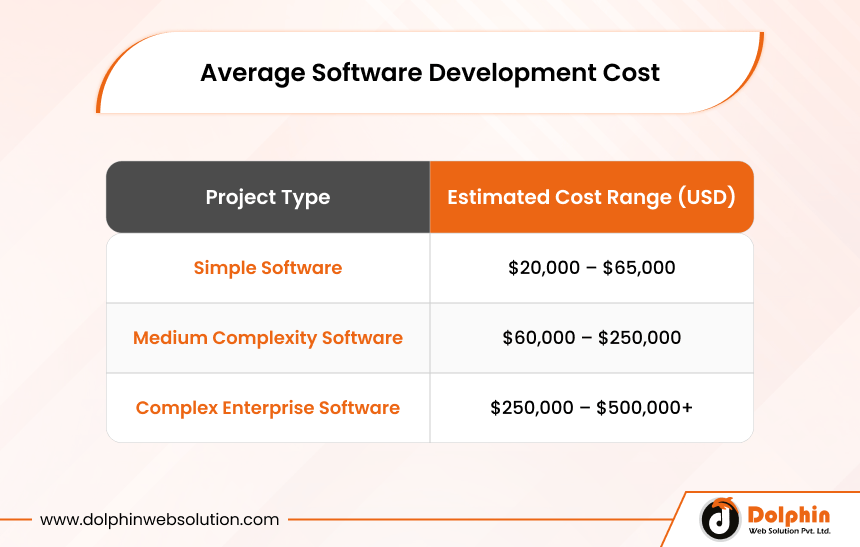
Some projects may go beyond these ranges, with enterprise solutions reaching $1 million or more in rare cases.
Hourly rates in 2025 vary depending on company size and geography:
- Freelance/Offshore: $27–$82 per hour
- Small Firms: $30–$50 per hour
- Mid-Market Firms: $40–$70 per hour
- Enterprise-Class Firms: $100+ per hour
2. Cost by Complexity: Example Breakdown
| Complexity | Features Included | Estimated Cost (USD) | Timeline |
|---|---|---|---|
| Basic | Simple UI, core functionality, no integrations | $20,000 – $50,000 | 2–3 months |
| Medium | Payment integration, chatbots, custom UI/UX | $50,000 – $80,000 | 4–6 months |
| Highly Complex | Advanced security, big data, APIs, scalability | $90,000 – $250,000 | 6+ months |
| Enterprise | Multi-system integrations, vast features, global | $250,000 – $500,000+ | 9+ months |
Trends in Custom Software Development for 2025 and Beyond
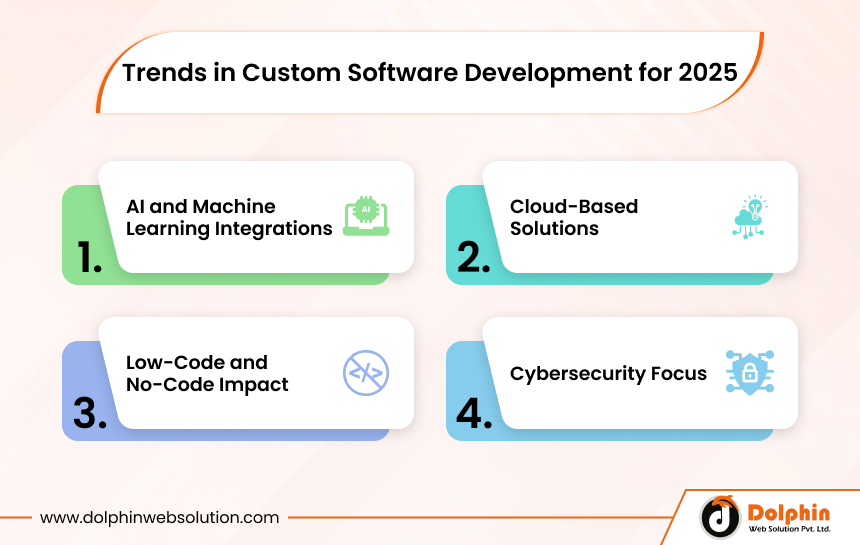
1. AI and Machine Learning Integrations
Artificial intelligence is transforming how businesses operate. Predictive analytics, smart automation, natural language processing, and dynamic personalization are now achievable. Including these features in custom software sets your business up for future growth.
2. Cloud-Based Solutions
Most new software is being built for the cloud, enabling flexible remote work, easy scalability, and higher data reliability. Businesses large and small benefit from secure, accessible platforms that update automatically and integrate across geographies.
3. Low-Code and No-Code Impact
These platforms empower business users and IT teams to rapidly assemble applications without deep programming skills. For many companies, combining low-code building blocks with custom integrations delivers results faster and at lower cost.
4. Cybersecurity Focus
With cyber threats growing each year, data protection is now central to every software project. Today’s custom apps must follow best practices for encryption, identity, access control, and compliance with standards like GDPR or HIPAA.
How to Choose the Right Custom Software Development Company
Selecting a development partner is a crucial decision. Ask these questions to choose wisely:
- Does the company have experience in your industry?
- Can they show you recent case studies similar to your challenge?
- What does their process look like, from idea to launch and support?
- How do they handle communication and transparent project updates?
- What is included in post-launch support?
Conclusion
Custom software development is not a luxury reserved for giants. It is a practical route to sustainable growth, powerful digital transformation, and future-proofing your business against evolving challenges. Rather than bending your processes to fit generic tools, you can put technology to work for you—on your terms.
Ready to unlock the advantage of custom software? Let Dolphin Web Solution turn your vision into reality. Get in touch with us to discuss your custom software needs today.

Frequently Asked Questions (FAQs)
How long does it take to build custom software?
Timelines vary depending on project complexity. Simple applications can be delivered in two to three months. More advanced systems can take six months or longer. A discovery phase and detailed requirements analysis will lead to a realistic timeline.
Is custom software secure?
Absolutely, as long as you work with experienced teams who embed security best practices and comply with regulations. At Dolphin Web Solution, data protection is a cornerstone of every project.
Can custom software integrate with my existing tools?
Yes. One of the biggest advantages of going custom is making sure your new solution works side by side with your current CRM, ERP, email systems, or databases. Seamless integration eliminates data silos and double entry.
Nimesh Patel


Nimesh Patel is the Managing Director of Dolphin Web Solution, a global eCommerce, AI, and software development company helping businesses accelerate digital growth. With over 15 years of experience in technology consulting and product development, he has successfully guided startups, SMBs, and enterprise organizations in building scalable digital solutions. Nimesh specializes in eCommerce development, custom software solutions, mobile application development, and digital transformation strategies. Throughout his career, he has worked closely with businesses across retail, healthcare, automotive, manufacturing, and technology sectors, helping them leverage modern technologies to improve operational efficiency and customer experiences. As a business leader, Nimesh is passionate about innovation, entrepreneurship, and helping organizations turn ideas into successful digital products. His insights focus on eCommerce growth, AI adoption, software development trends, and business transformation through technology.

We can help you with
- Dedicated Team
- Setup Extended Team
- Product Development
- Custom App Development
Our Offices

AHMEDABAD (INDIA)
B- 203-206, Empire Business Hub, Science City Road, Sola, Ahmedabad – 380060

BERLIN (GERMANY)
Badensche Str. 28, 10715 Berlin, Germany

CALIFORNIA (USA)
9601 Reseda Blvd, Apt#223, Northridge CA-91324, USA

ALBERTA (CANADA)
302 Skyview Ranch Drive NE, Calgary, Alberta, Canada T3N0P5





Hello!
Click one of our contacts below to chat on WhatsApp