How Much Does It Cost to Build an AI Agent for Your Business?

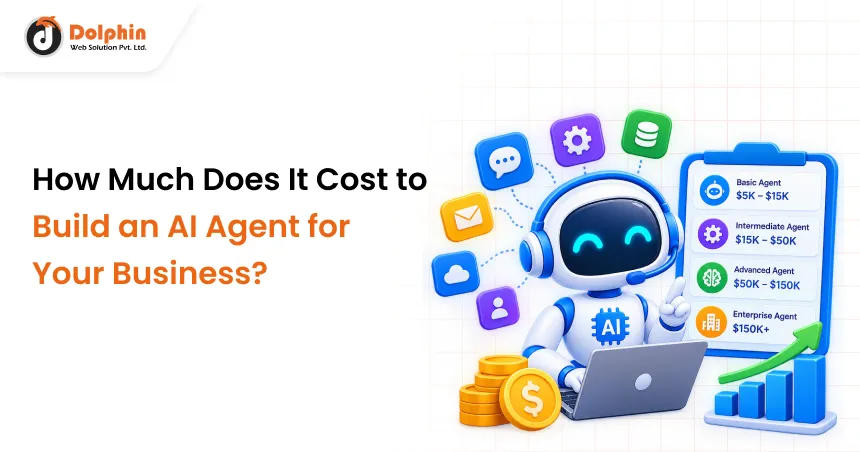

Table of Contents
 Show

- 1 What Is an AI Agent and Why Does Its Cost Vary So Much?
- 2 Average Cost to Build an AI Agent
- 3 Key Factors That Affect AI Agent Development Cost
- 4 Cost Breakdown by Development Stage
- 5 Ongoing Costs After Launch
- 6 Hidden Costs Businesses Often Overlook
- 7 Build, Buy, or Hybrid: Which Is Cheaper?
- 8 How to Reduce AI Agent Development Cost Without Hurting Quality
- 9 How to Estimate the Return on Investment
- 10 Why Partner with an Experienced Development Team at Dolphin Web Solution
- 11 Conclusion

Summary :
Building an AI agent can cost anywhere from $5,000 for a simple assistant to over $150,000 for an enterprise system. This guide explains what drives that range, from scope and data readiness to integrations and ongoing maintenance. It also covers hidden costs, build versus buy decisions, ways to control your budget, and how to estimate ROI before you commit.
Every business leader asks the same question before starting an AI project: what is this going to cost? The honest answer is that it depends, but "it depends" is not helpful when you are building a budget.
In practice, most AI agent projects fall between $5,000 and $150,000 or more. A simple support assistant sits at the low end. A multi system agent that reads documents, makes decisions, and acts inside your software sits at the high end.
This guide explains where that range comes from, what you pay for at each stage, and how to avoid surprises. If you are still deciding whether to move ahead, our AI Agent Development team can help you map your use case to a realistic budget.
What Is an AI Agent and Why Does Its Cost Vary So Much?
An AI agent is software that understands a goal, decides what steps to take, and uses tools or data to complete the task with limited human input. Unlike a basic chatbot that only answers questions, an agent can check inventory, update a CRM record, draft a reply, and escalate to a human when needed.
That flexibility is exactly why pricing varies. Two agents can both be called "AI agents" while one handles a single repetitive task and the other coordinates dozens of workflows across several systems. The more decisions, data sources, and integrations involved, the more design, testing, and engineering effort the project needs.
Average Cost to Build an AI Agent
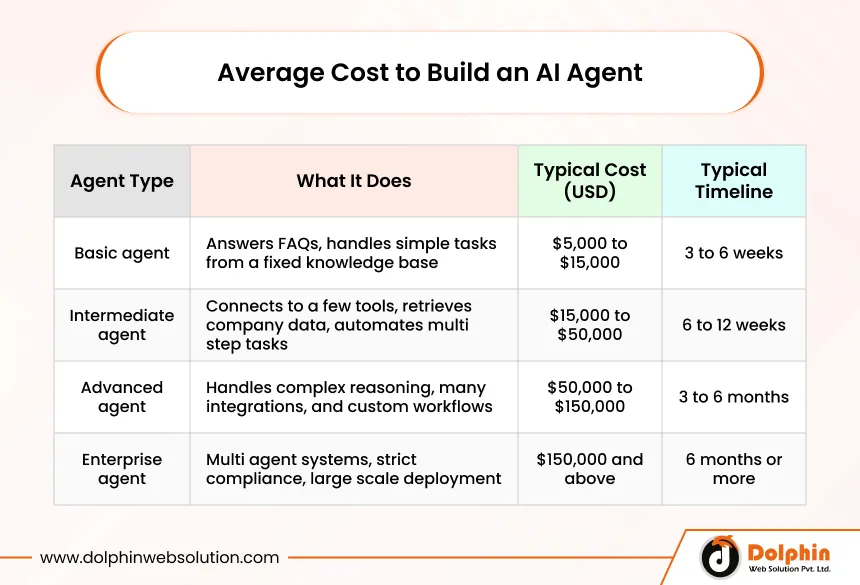
The table above shows typical ranges based on complexity. Treat these as planning estimates, since your exact quote depends on scope.
What You Get at Each Level
Each level suits a different stage of AI adoption. A basic agent is fast to launch and ideal for testing whether AI fits your process, since it relies on a fixed knowledge base and a hosted model. An intermediate agent is the most common choice for growing businesses, connecting to a few tools such as a CRM or helpdesk to handle multi step tasks that would otherwise take your team hours each week.
Advanced agents suit operations where accuracy, speed, and deep system access matter, and they need thorough testing to behave reliably in real situations. Enterprise agents are built for organizations with security reviews, audit trails, and high traffic demands, often using several agents together under strict compliance controls and dedicated monitoring.

Key Factors That Affect AI Agent Development Cost
1. Scope and Complexity of Tasks
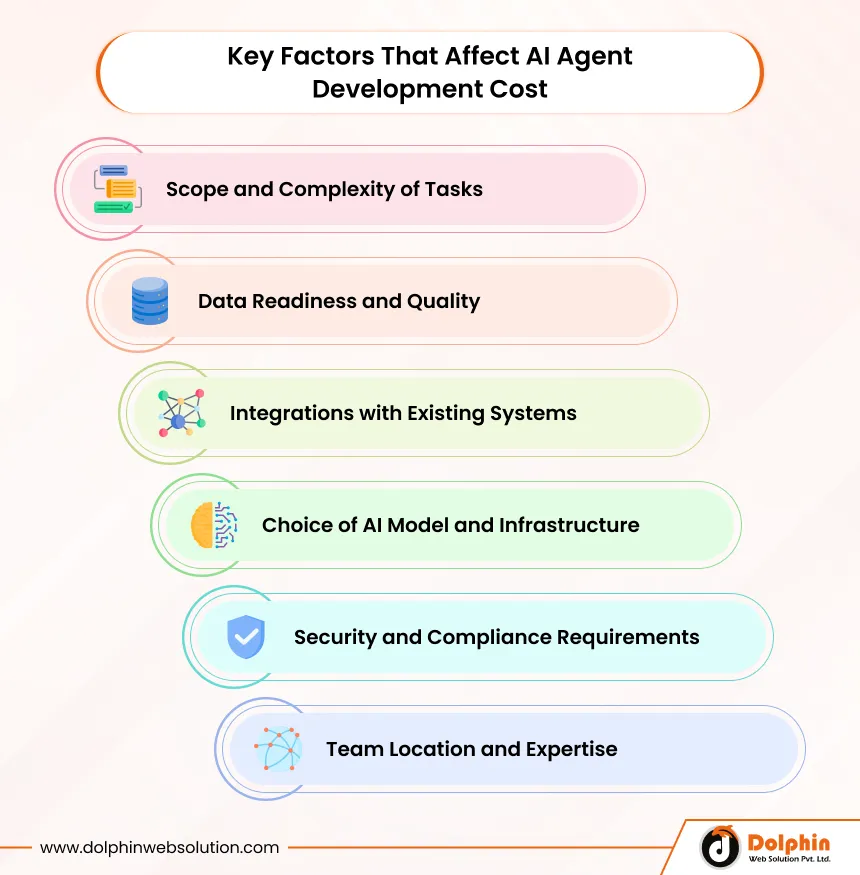
The number of tasks the agent performs, and how much judgment each one needs, is the single biggest cost driver. An agent that routes support tickets is far simpler than one that negotiates refunds, checks policy, and updates three systems.
2. Data Readiness and Quality
Agents are only as good as the information they can access. If your data is scattered across spreadsheets, old databases, and email threads, a portion of your budget will go to cleaning and organizing it before any AI work begins.
3. Integrations with Existing Systems
Each connection to your CRM, ERP, ecommerce platform, payment gateway, or helpdesk adds development and testing time. Older systems without modern APIs cost more to connect.
4. Choice of AI Model and Infrastructure
Using a hosted large language model through an API is faster and cheaper to start. Fine tuning a model or hosting one privately raises upfront and running costs but can improve accuracy and data control.
5. Security and Compliance Requirements
Industries such as healthcare, finance, and insurance need extra safeguards, encryption, access controls, and documentation. These requirements add effort but protect you from far larger risks.
6. Team Location and Expertise
Rates vary widely by region and experience level. A lower hourly rate does not always mean a lower total cost, especially if rework is needed. Reviewing the Best AI Agent Development Companies can help you compare delivery quality, experience, and pricing before you shortlist a partner.
Cost Breakdown by Development Stage
Knowing where the money goes makes budgeting easier. Here is a typical split for a mid sized project.
| Stage | Share of Budget | What Happens |
|---|---|---|
| Discovery and planning | 10% to 15% | Defining goals, use cases, data needs, and success metrics |
| Design and architecture | 10% to 15% | Planning the agent logic, tools, and system structure |
| Development and integration | 40% to 50% | Building the agent, connecting systems, writing prompts and workflows |
| Testing and refinement | 15% to 20% | Checking accuracy, edge cases, safety, and performance |
| Deployment and training | 5% to 10% | Launching, documentation, and team onboarding |
Skipping discovery to save money is one of the most common mistakes. A few days of planning often prevents weeks of rework later.
Ongoing Costs After Launch
An AI agent is not a one time purchase. Plan for recurring expenses such as:
- Model usage fees: Charges per token or per request that grow with traffic. A busy support agent handling thousands of conversations each month can cost far more to run than a lightly used internal tool, so estimate your expected volume early.
- Cloud hosting and infrastructure: Servers, databases, and monitoring tools that keep the agent available around the clock. Costs rise with storage needs, response speed targets, and the number of systems the agent stays connected to.
- Maintenance and updates: Fixing issues, adjusting prompts, and keeping integrations working as the tools around the agent change. Software updates and API changes from third parties often need quick attention to avoid breakages.
- Performance monitoring: Tracking accuracy, response quality, and failure rates so problems are caught before customers notice them. Regular reviews also show where the agent can be improved or given new responsibilities.
- Retraining and improvement: Updating the agent as your business, products, and policies change. New product lines, pricing updates, or revised workflows all need to be reflected so the agent keeps giving correct answers.
A practical rule is to budget roughly 15% to 25% of the initial build cost per year for upkeep, though high usage agents may need more.
Hidden Costs Businesses Often Overlook
Some expenses do not appear in the first quote. Watch for these:
- Data preparation: Cleaning, labeling, and organizing existing information so the agent can use it. Duplicate records, outdated documents, and inconsistent formats can quietly consume a large share of the project hours.
- Change management: Training staff and updating processes so the agent is actually used. Even a well built agent delivers little value if your team does not trust it or does not know when to hand work over to it.
- Human review time: Early versions need people to check outputs and correct mistakes. This review period is essential for improving accuracy, but it adds labor costs that are easy to leave out of the original budget.
- Third party licenses: Paid APIs, vector databases, or specialized tools that the agent depends on. These subscriptions often scale with usage, so a small monthly fee at launch can grow noticeably over time.
- Scope changes: New feature requests added mid project. Each addition affects design, testing, and timelines, which is why a clear scope document and a change approval process protect your budget.
Asking your development partner to list these items upfront keeps your budget honest.
Build, Buy, or Hybrid: Which Is Cheaper?
| Approach | Upfront Cost | Flexibility | Best For |
|---|---|---|---|
| Buy a ready made tool | Low | Limited | Common tasks with standard workflows |
| Build a custom agent | Higher | Very high | Unique processes and competitive advantage |
| Hybrid approach | Moderate | High | Starting with existing tools and customizing key parts |
Ready-made tools are quick, but they rarely fit complex business logic. Custom builds cost more initially yet often deliver better returns when the agent touches core operations. If you are unsure which path suits you, our AI Consulting Services can assess your workflows and recommend the most sensible route before you commit budget.

How to Reduce AI Agent Development Cost Without Hurting Quality
You can control your budget with a few smart decisions:
- Start with one focused use case. Prove value first, then expand. Choosing a single process, such as order status queries or lead qualification, keeps the build simple and gives you clear results to learn from.
- Launch an MVP. A smaller version gives real feedback before you invest heavily. Real users reveal gaps and priorities that no planning document can predict, which saves you from building features nobody needs.
- Use existing models and APIs instead of training from scratch. Modern hosted models already handle language well, so your budget can go toward integrations, workflows, and testing rather than expensive model training.
- Prepare your data early. Organized information cuts development hours. Gathering your documents, FAQs, and product details before the project starts lets the team move faster and avoid paid cleanup work later.
- Define clear success metrics. This prevents endless adjustments. When everyone agrees on targets such as response accuracy or resolution time, it is easier to know when the agent is ready to launch.
- Plan phases. Spreading the build across stages makes cash flow easier. Each phase delivers something usable, so you can review progress, adjust direction, and release funds only as value is proven.
How to Estimate the Return on Investment
Cost matters less than the value an agent creates. To estimate ROI, compare your investment against measurable gains:
Start with time saved, the simplest and most reliable measure. Multiply the hours the agent saves each week by the hourly cost of the staff involved, and repetitive work becomes a clear monthly saving. Then look at customer facing gains, since faster response times often lead to better reviews, fewer abandoned carts, and stronger loyalty, all of which you can track through your existing support data.
Next, count the cost of errors and the value of growth. Mistakes in data entry, order handling, or ticket routing carry real costs, so a drop in error rates is a direct financial gain. An agent that responds to leads within seconds and suggests relevant products can also lift conversions, while handling more conversations with the same team lets you grow without raising payroll at the same pace.
For example, an agent that saves 80 hours of work each month can pay for itself within a year even at a mid range budget. Tracking these numbers from day one also helps you decide where to expand next.
Why Partner with an Experienced Development Team at Dolphin Web Solution
Choosing the right partner affects both your cost and your results. A team with genuine depth in AI and software development changes how a project goes in practical ways:
- Honest Guidance on AI Fit: An experienced team can tell you honestly when AI is not the right fit for your problem. Sometimes a simple automation or a software update solves the issue at a lower cost, and that honesty can save you thousands.
- Strong Software Architecture: Strong software architecture keeps AI features stable, secure, and maintainable. Clean integrations, proper access controls, and well structured code mean your agent keeps working as your systems and traffic grow.
- Production Ready Experience: A team that has shipped real projects understands the gap between a working demo and a production ready system. Handling edge cases, failures, and security reviews is what separates a prototype from something you can trust with customers.
- Transparent Estimates: Transparent estimates reduce the risk of surprise costs halfway through the build. A detailed scope, a clear list of assumptions, and regular progress updates keep your budget predictable from the first week.
- Long Term Support: Long standing client relationships mean ongoing support, not a one time handoff. After launch, you have a team that knows your systems and can monitor, improve, and expand the agent as your needs change.
Dolphin Web Solution has spent more than 15 years building ecommerce platforms, custom software, and now AI powered features for businesses across industries. That combination of software engineering discipline and applied AI experience is often exactly what is missing when AI projects fail to move past the prototype stage.
Conclusion
The cost of building an AI agent depends on scope, data, integrations, security needs, and the team you choose. Simple agents can start near $5,000, while complex enterprise systems can pass $150,000. The smartest approach is to start small, measure results, and grow based on proven value rather than assumptions.
Plan for ongoing costs, ask about hidden expenses, and choose a partner who is open about trade offs. With the right strategy, an AI agent becomes an investment that saves time, improves customer experience, and supports long term growth.
Frequently Asked Questions
1. How much does it cost to build a simple AI agent?
A basic AI agent that answers questions or handles one repetitive task typically costs between $5,000 and $15,000. The final price depends on the data sources, the AI model used, and how many tools it connects to.
2. How long does it take to develop an AI agent?
Simple agents can be ready in 3 to 6 weeks. Intermediate projects usually take 6 to 12 weeks, while advanced or enterprise systems can take several months because of integrations, testing, and security reviews.
3. What are the monthly costs of running an AI agent?
Monthly costs usually include model usage fees, cloud hosting, monitoring, and maintenance. Depending on traffic and complexity, many businesses spend from a few hundred to several thousand dollars per month.
4. Is it cheaper to buy an AI tool than to build a custom agent?
Buying a ready made tool costs less upfront and works well for standard tasks. A custom agent costs more initially but fits your exact workflows, integrates deeply with your systems, and often delivers better long term value.
5. Can a small business afford an AI agent?
Yes. Small businesses can start with a focused MVP, use existing AI models, and expand in phases. This keeps the initial investment manageable while still delivering measurable time savings.
6. How can I make sure my AI agent project stays within budget?
Define clear goals, start with one use case, prepare your data early, and agree on a phased plan with your development partner. Regular reviews and a transparent estimate help prevent scope creep and unexpected costs.
Nimesh Patel


Nimesh Patel is the Managing Director of Dolphin Web Solution, a global eCommerce, AI, and software development company helping businesses accelerate digital growth. With over 15 years of experience in technology consulting and product development, he has successfully guided startups, SMBs, and enterprise organizations in building scalable digital solutions. Nimesh specializes in eCommerce development, custom software solutions, mobile application development, and digital transformation strategies. Throughout his career, he has worked closely with businesses across retail, healthcare, automotive, manufacturing, and technology sectors, helping them leverage modern technologies to improve operational efficiency and customer experiences. As a business leader, Nimesh is passionate about innovation, entrepreneurship, and helping organizations turn ideas into successful digital products. His insights focus on eCommerce growth, AI adoption, software development trends, and business transformation through technology.

We can help you with
- Dedicated Team
- Setup Extended Team
- Product Development
- Custom App Development
Our Offices

AHMEDABAD (INDIA)
B- 203-206, Empire Business Hub, Science City Road, Sola, Ahmedabad – 380060

BERLIN (GERMANY)
Badensche Str. 28, 10715 Berlin, Germany

CALIFORNIA (USA)
9601 Reseda Blvd, Apt#223, Northridge CA-91324, USA

ALBERTA (CANADA)
302 Skyview Ranch Drive NE, Calgary, Alberta, Canada T3N0P5


Hello!
Click one of our contacts below to chat on WhatsApp