
AI Shopping Agents: How AI Is Changing the Future of Ecommerce


Table of Contents
 Show
Show
- 1 What Are AI Shopping Agents?
- 2 How AI Shopping Agents Work
- 3 How AI Shopping Agents Are Changing the Future of Ecommerce
- 4 Benefits of AI Shopping Agents for Ecommerce Businesses
- 5 Challenges and Risks to Plan For
- 6 How to Prepare Your Online Store for AI Shopping Agents
- 7 Platform Channels or a Custom AI Agent: Which Path Fits?
- 8 Why Partner with an Experienced Development Team of Dolphin Web Solution
- 9 Conclusion

Summary :
AI shopping agents are software assistants that find, compare, and in some cases purchase products for shoppers. This guide explains how they work, which protocols and platforms support them today, and what ecommerce businesses should do to prepare. It also covers the benefits, the risks, and when a custom AI agent makes sense.
Online shopping used to mean typing a keyword, opening ten tabs, and comparing prices by hand. AI shopping agents are changing that routine. Instead of searching, shoppers describe what they need, and an AI system finds products, compares options, and in some cases helps complete the purchase.
For ecommerce businesses, this is a shift in where customers first meet your brand, not just another feature. This guide explains what AI shopping agents are, how they work, what is actually live today, and how to prepare your store. The space is moving quickly, so the facts below are current as of October 2026 and worth rechecking before you make major decisions.
What Are AI Shopping Agents?
An AI shopping agent is software that acts on behalf of a shopper. It understands a request in plain language, searches product data, compares options against the shopper’s needs, and then either recommends a product or moves toward a purchase. Examples of where shoppers meet these agents include ChatGPT, Google’s AI Mode and Gemini app, and Microsoft Copilot.
A shopper might say, “I need waterproof running shoes under a set budget that work for wide feet.” A traditional search box returns links. An AI shopping agent returns a short list with reasons, and may help the shopper act on it.
How AI Shopping Agents Differ from Chatbots and Recommendation Engines
These tools are often confused, so a direct comparison helps.
| Feature | Support chatbot | Recommendation engine | AI shopping agent |
|---|---|---|---|
| Main job | Answer common questions | Suggest related products | Understand a goal and help reach a purchase decision |
| Understands open requests | Limited | No | Yes |
| Compares products across sellers | No | Usually within one store | Often, depending on the platform |
| Can take action for the shopper | Rarely | No | Sometimes, such as building a cart or starting checkout |
| Where it lives | Your website | Your website or emails | Your website, or on AI platforms outside your site |
One important caution: not every product sold as a shopping agent can complete a purchase. Many today focus on discovery and then send the shopper to the merchant’s own checkout.
How AI Shopping Agents Work
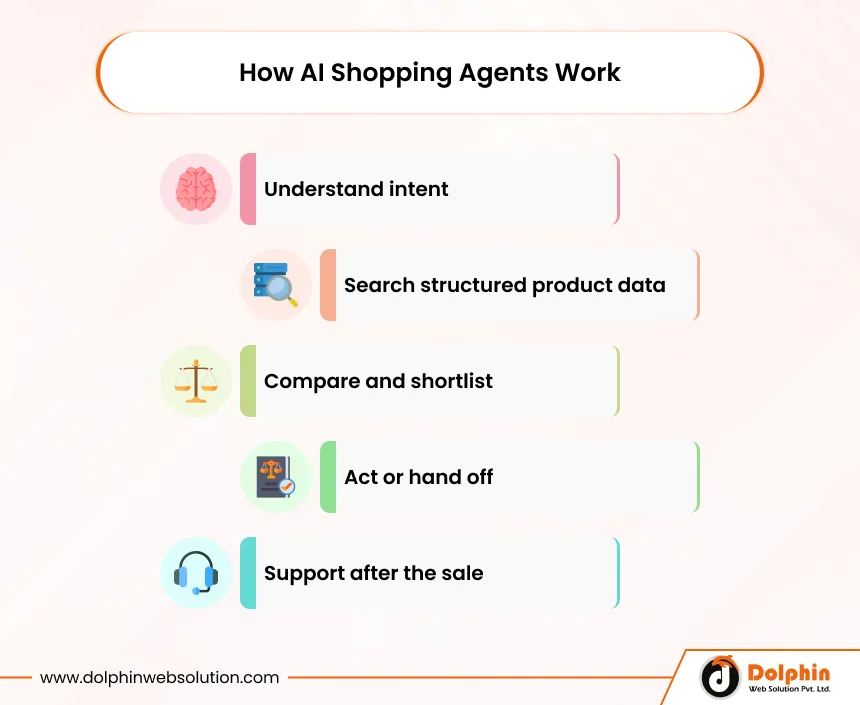
The exact design differs by platform, but most agents follow the same basic flow:
- Understand intent: The agent reads the request and works out budget, preferences, and constraints. It also picks up softer signals, such as the occasion, a preferred style, or a need for fast delivery. If the request is vague, a good agent asks a follow up question instead of guessing, which is why clear intent is the foundation for every step that follows.
- Search structured product data: It pulls details such as price, availability, variants, and descriptions from product feeds or store catalogs. This is where structured data matters most, because the agent relies on fields like size, material, stock status, and product identifiers rather than on marketing copy alone. Missing or outdated fields can quietly remove a product from consideration.
- Compare and shortlist: It weighs options against the shopper’s needs and explains its picks. A strong agent compares products on the factors the shopper cares about, such as price, features, reviews, and delivery time, and shows why each option made the shortlist. Honest, specific product information gives your listing a better chance of being chosen for the right reasons.
- Act or hand off: Depending on the platform, it builds a cart, starts a checkout, or sends the shopper to the merchant’s store. Some platforms support checkout inside the AI experience for select merchants, while others simply pass the shopper to the merchant’s own site to finish the purchase. In most cases the shopper still reviews and confirms the order before payment.
- Support after the sale: Order status, returns, and questions still need to be handled by the merchant’s systems. Shoppers expect tracking updates, easy returns, and quick answers no matter where the sale began, so your order, inventory, and support tools need to work smoothly across every sales channe
The quality of step 2 decides whether your products are even considered. An agent can only recommend what it can read clearly.
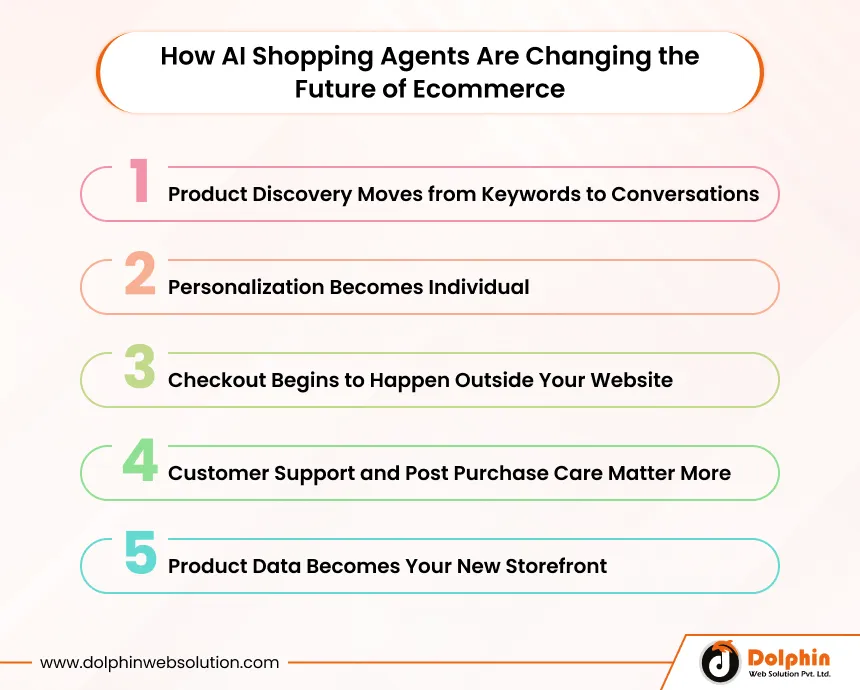
How AI Shopping Agents Are Changing the Future of Ecommerce
The changes below combine confirmed platform moves with our own reading of where they point. Where we are giving an interpretation rather than a confirmed fact, we say so.
1. Product Discovery Moves from Keywords to Conversations
Shoppers are starting to describe full requirements instead of typing short keywords. That favors stores with detailed, accurate product information. A listing that says only “blue jacket” gives an agent very little to work with, while one that covers material, fit, use case, and care gives it plenty.
2. Personalization Becomes Individual
Agents can weigh a shopper’s stated budget, preferences, and past choices when they shortlist products. For merchants, this means generic merchandising matters less than clear, honest product data that lets the right product match the right person.
3. Checkout Begins to Happen Outside Your Website
Google’s Universal Commerce Protocol can power checkout directly inside AI Mode and the Gemini app for select eligible merchants, and industry coverage indicates the merchant stays the seller of record. Shopify has also said that merchants on its platform stay merchant of record when selling through AI channels, and that orders arrive in the Shopify admin with referral attribution. In our view, this makes it more important to keep your order, inventory, and returns systems tightly connected.
4. Customer Support and Post Purchase Care Matter More
When a shopper buys through an agent, they still expect the same delivery tracking, easy returns, and fast answers. Support that feels disconnected from the original conversation is likely to hurt trust, so these flows need to work no matter where the sale started.
5. Product Data Becomes Your New Storefront
If agents choose which products to show, then your catalog quality, pricing accuracy, and stock status act like a shop window you do not see. This is our interpretation, but it matches how platforms describe their requirements: Google, for example, expects specific product attributes in Merchant Center for its checkout feature.

Benefits of AI Shopping Agents for Ecommerce Businesses
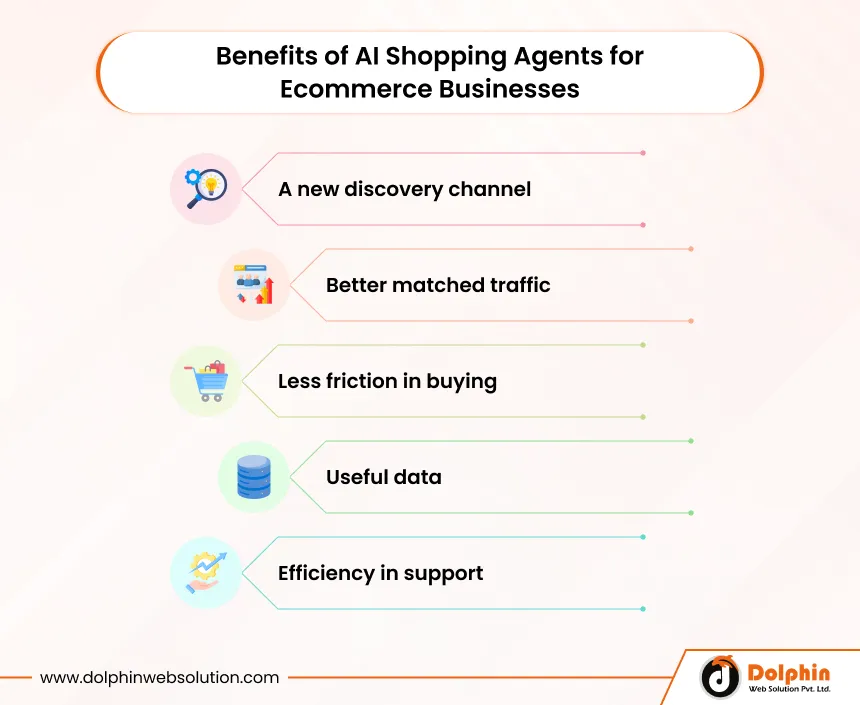
When your catalog and systems are in good shape, agents can open useful opportunities:
- A new discovery channel: Your products can be found by shoppers who never typed your brand name. Agents recommend based on what the shopper needs, which gives smaller or newer brands a chance to appear next to established names when their product data is strong. This extends your reach beyond search engines and ads, though visibility is never guaranteed.
- Better matched traffic: Shoppers arrive with a clearer idea of what they want, because the agent has already narrowed the options. That can mean fewer casual browsers and more people who are ready to check final details. We have not seen a verified figure that proves higher conversion across the industry, so please treat this as a possibility to measure on your own store.
- Less friction in buying: Where checkout is supported, fewer steps between interest and purchase can mean fewer abandoned carts. Saved payment details and prefilled shipping information remove the typing that often makes mobile shoppers give up. Support for this varies by platform and region, so check what applies to your store.
- Useful data: Referral attribution can show which AI channel sent each order. Shopify, for example, says orders from ChatGPT arrive in the Shopify admin with referral attribution. This helps you see which channels bring real revenue and decide where to invest your time and budget.
- Efficiency in support: Agents on your own site can handle routine questions, freeing your team for complex cases. Common requests such as sizing help, delivery times, order status, and return policies can be answered at any hour. Your support team can then focus on conversations that need judgment and empathy.
Challenges and Risks to Plan For
AI shopping is still early, and honest planning means looking at the downsides too.
| Challenge | Why it matters | What to do |
|---|---|---|
| Poor product data | Agents skip or misrepresent products they cannot read clearly | Audit titles, attributes, images, GTINs, and stock accuracy |
| Loss of direct contact | The first conversation may happen on a platform you do not control | Keep your brand voice in product content and capture customers at order time |
| Uneven adoption | Features can launch, expand, or be withdrawn, as Instant Checkout showed | Build on open standards and your own systems, not on one feature |
| Payment trust and security | Shoppers must feel safe letting software act for them | Use established payment providers and clear confirmation steps |
| Fragmented orders and returns | A sale from an AI channel still needs the same fulfillment flow | Connect all channels to one order and inventory system |
| Fast changing rules | Platform requirements keep evolving | Assign someone to review platform updates regularly |
How to Prepare Your Online Store for AI Shopping Agents
You do not need to rebuild your store to get started. Most of the work is about clarity and reliability.
1. Clean Up Your Product Data First
This is the highest value step for almost every store. Check that each product has:
- A specific, descriptive title and a full description
- Complete attributes such as size, color, material, and compatibility
- Accurate price, availability, and shipping information
- Clear images and valid product identifiers like GTIN where they apply
- Plain language return and warranty policies
2. Make Sure Your Platform Supports Agent Channels
Shopify says its Agentic Storefronts connect merchant catalogs to AI channels including ChatGPT, Microsoft Copilot, AI Mode in Google Search, and the Gemini app, with eligibility and availability varying by market. If your store runs on Shopify, a reliable theme, clean catalog structure, and tidy integrations make the most of this. Our Shopify Development team helps stores set up catalogs, checkout flows, and integrations so they stay stable as these channels evolve. Please check Shopify’s current documentation for what is available in your region.
3. Keep Orders, Inventory, and Returns in Sync
An order that starts in an AI chat should look like any other order inside your back office. Connect your inventory, payment, shipping, and returns systems so there is one source of truth.
4. Consider Building Your Own Shopping Agent
Platform channels put you in front of shoppers on other people’s surfaces. A shopping assistant on your own site lets you control the experience, the data, and the tone. If you are weighing that option, our AI Agent Development services cover planning, building, and connecting agents to your catalog and order systems.
Platform Channels or a Custom AI Agent: Which Path Fits?
There is no single right answer. The best path depends on your size, platform, and goals.
| Option | Best for | Strengths | Limits |
|---|---|---|---|
| Use platform channels such as Shopify’s AI channels | Stores that want visibility with little setup | Low effort, fast start, referral tracking | You depend on the platform’s rules and availability |
| Optimize product data and feeds for AI discovery | Any store, on any platform | Helps every channel at once, low cost | Does not give you your own agent experience |
| Add an AI assistant to your own site | Stores with large or complex catalogs | Full control over tone, data, and journey | Needs design, integration, and ongoing tuning |
| Build a custom AI shopping agent | Businesses with unique workflows or B2B ordering | Tailored to your products, rules, and systems | Highest investment, needs strong engineering |
Most businesses should start with the second row, since clean data helps everywhere. If you later decide to build, choosing the right partner matters. Our guide to the Best AI Agent Development Companies in India can help you compare options and know what to look for before you shortlist anyone.
Why Partner with an Experienced Development Team of Dolphin Web Solution
Preparing for AI shopping agents is easier when you work with a team that has real depth in both ecommerce and software development. Experience matters here in practical ways:
- An experienced team can tell you honestly when an AI agent is not the right fit, and when cleaning up your product data will deliver more value first.
- Strong ecommerce architecture keeps AI features stable, secure, and maintainable as platforms and protocols change.
- A team that has shipped real projects understands the gap between a working demo and a production ready system.
- Long standing client relationships mean ongoing support, not a one time handoff.
- Clear communication about what is confirmed, what is experimental, and what is still uncertain helps you avoid costly bets.
Dolphin Web Solution has spent more than 15 years building ecommerce platforms, custom software, and now AI powered features for businesses across industries. That combination of software engineering discipline and applied AI experience is often exactly what is missing when AI projects fail to move past the prototype stage.
Conclusion
AI shopping agents are changing how people find and buy products, but the story is still being written. Some early features have been scaled back, while others are expanding through open standards and platforms like Google and Shopify. The safest strategy is not to bet on one feature. It is to make your products easy for any agent to understand, keep your orders and inventory connected, and build your own AI capabilities where they add clear value.
Start with your product data, review your platform options, and test how your store appears when shoppers ask AI tools for recommendations. Then decide, with honest numbers from your own store, how far to go.

Frequently Asked Questions
1. What is an AI shopping agent?
It is software that understands a shopper's request in plain language, searches product data, compares options, and then recommends products or helps move toward a purchase. Some agents only recommend, while others can also build a cart or start checkout, depending on the platform.
2. Can AI shopping agents buy products on their own?
It depends on the platform and the merchant. Google's Universal Commerce Protocol supports checkout inside AI Mode and the Gemini app for select eligible merchants, while OpenAI scaled back ChatGPT's Instant Checkout in March 2026 and now focuses on discovery. In most cases the shopper still confirms the purchase. Features change often, so please verify the current status for your region.
3. Will AI shopping agents replace online stores?
We cannot predict that with certainty. Current platform approaches, such as Shopify's, keep the merchant as the seller of record and send orders into the merchant's own systems, which suggests stores remain important. Agents appear to be an additional channel for now, not a replacement.
4. How can a small ecommerce business get ready?
Start with product data: complete titles, descriptions, attributes, accurate prices, and stock status. Then check what your ecommerce platform already offers for AI channels, and make sure your orders, inventory, and returns work smoothly across every sales channel.
5. Do I need a custom AI shopping agent, or are platform channels enough?
For many stores, clean product data and platform channels are a sensible first step. A custom agent makes more sense for large or complex catalogs, specialized buying rules, or businesses that want full control over the shopping experience on their own site.
6. Is it safe to let an AI agent pay for purchases?
Security depends on how the payment flow is designed. Protocols such as Google's AP2 are designed to keep payments within limits the shopper sets, and established payment providers add their own protections. No system is risk free, so look for clear confirmation steps, spending limits, and trusted payment partners.Write a blog for our company, "Dolphin Web Solution," as per my recommendations.The title for the blog is "AI Shopping Agents: How AI Is Changing the Future of Ecommerce"Also, I want to write a slug, a meta title, a meta description, and a blog summary. Do not use hyphens in the article. I want to add my services and blog pages links as internal links with given anchor text in brackets.Service Page link: https://dolphinwebsolution.com/ai-agent-development-services/ anchor text for this link is (AI Agent Development)Service Page link: https://dolphinwebsolution.com/shopify-development/ anchor text for this link is (Shopify Development)Blog page link: https://dolphinwebsolution.com/blog/best-ai-agent-development-companies-in-india/Anchor text for this link is (Best AI Agent Development Companies in India)Set all internal links with relevant anchor text.Do not set the same link 2 times.Also, we include 2 CTA images in our blog, so write 2 different CTA contents.Also, write according to these details: "You are the senior content strategist and SEO copywriter for Dolphin Web Solution, a leading e-commerce and software development company with over 15 years of experience. Your responsibility is to write high-quality, human-written, EEAT-focused blogs that rank on Google while generating qualified leads. Every article should educate first and sell second."Write 5 to 6 FAQs at the end.Use bullet points and tables wherever they are relevant to the outline and help present the information more clearly. Add them naturally when the content requires a structured comparison, list, process, or set of key points. Do not force them into every section; include them naturally when they improve readability, make comparisons clearer, or help organize important information.Add EEAT focused content right before the conclusion. I want to write like this “Why Partner with an Experienced Development Team of Dolphin Web SolutionChoosing between AI development and software development is easier when you work with a team that has genuine depth in both. Experience matters here in practical ways:An experienced team can tell you honestly when AI is not the right fit for your problemStrong software architecture keeps AI features stable, secure, and maintainableA team that has shipped real projects understands the gap between a working demo and a production ready systemLong standing client relationships mean ongoing support, not a one time handoffDolphin Web Solution has spent more than 15 years building ecommerce platforms, custom software, and now AI powered features for businesses across industries. That combination of software engineering discipline and applied AI experience is often exactly what’s missing when AI projects fail to move past the prototype stage.” You can use bullet points also here. You can use bullet points also here.Use appropriate H2 and H3 headings for each outline section based on the topic and content structure. Ensure the heading hierarchy is clear and logical, with H2 for main sections and H3 for relevant subtopics.
Nimesh Patel


Nimesh Patel is the Managing Director of Dolphin Web Solution, a global eCommerce, AI, and software development company helping businesses accelerate digital growth. With over 15 years of experience in technology consulting and product development, he has successfully guided startups, SMBs, and enterprise organizations in building scalable digital solutions. Nimesh specializes in eCommerce development, custom software solutions, mobile application development, and digital transformation strategies. Throughout his career, he has worked closely with businesses across retail, healthcare, automotive, manufacturing, and technology sectors, helping them leverage modern technologies to improve operational efficiency and customer experiences. As a business leader, Nimesh is passionate about innovation, entrepreneurship, and helping organizations turn ideas into successful digital products. His insights focus on eCommerce growth, AI adoption, software development trends, and business transformation through technology.

We can help you with
- Dedicated Team
- Setup Extended Team
- Product Development
- Custom App Development
Our Offices

AHMEDABAD (INDIA)
B- 203-206, Empire Business Hub, Science City Road, Sola, Ahmedabad – 380060

BERLIN (GERMANY)
Badensche Str. 28, 10715 Berlin, Germany

CALIFORNIA (USA)
9601 Reseda Blvd, Apt#223, Northridge CA-91324, USA

ALBERTA (CANADA)
302 Skyview Ranch Drive NE, Calgary, Alberta, Canada T3N0P5





Hello!
Click one of our contacts below to chat on WhatsApp