
Best AI Agent Development Companies in India (2026)


Table of Contents
 Show
Show

Summary :
AI agents are quickly becoming the most in demand AI capability businesses want built, but not every development company has real experience shipping agents that work reliably in production. This guide rounds up the top AI agent development companies in India for 2026, what sets a genuinely capable agent development partner apart from one that just knows the buzzwords, and the key factors to weigh, such as technical depth, industry experience, and post launch support, before choosing who builds your next AI agent.
AI agents have moved past the experimental stage. Businesses are no longer just asking whether to use them, they are asking which company can actually build one that works reliably in production. India has become one of the most active markets for this kind of work, driven by a large pool of engineering talent, deep experience in enterprise software delivery, and a growing number of companies that have moved beyond chatbots into genuinely autonomous, task completing agents.
That growth also makes the market harder to navigate. A long list of companies now claim AI agent expertise, and not all of them have real, production grade experience behind that claim. This guide breaks down what actually separates a capable AI agent development company from one that has simply rebranded a chatbot offering, profiles some of the most established players building agentic AI in India today, and covers what to look for and what to budget before choosing a partner.
What Makes a Great AI Agent Development Company?
Before comparing specific companies, it helps to know what actually matters when evaluating one. The strongest AI agent development partners consistently share a few traits.
- Real experience with agent frameworks: Not just general purpose generative AI. Building a system that can plan, use tools, and complete multi step tasks autonomously requires different expertise than building a single purpose chatbot.
- Proven enterprise delivery: A company that has shipped software into large, complex organizations understands the integration, security, and reliability demands that agentic AI introduces at scale.
- Industry specific experience: An agent built for a regulated industry like finance or healthcare needs a very different approach to governance and risk than one built for a retail use case.
- A real portfolio: Not just marketing claims. Look for case studies with specific, measurable outcomes rather than vague statements about innovation.
- Support after launch: Agents need ongoing monitoring and refinement once deployed, since their performance can drift as the systems and data around them change.
Our own AI Agent Development Services team is built around these same principles, treating agent development as a discipline distinct from general AI development rather than a variation of it.

Top AI Agent Development Companies in India
1. Dolphin Web Solution
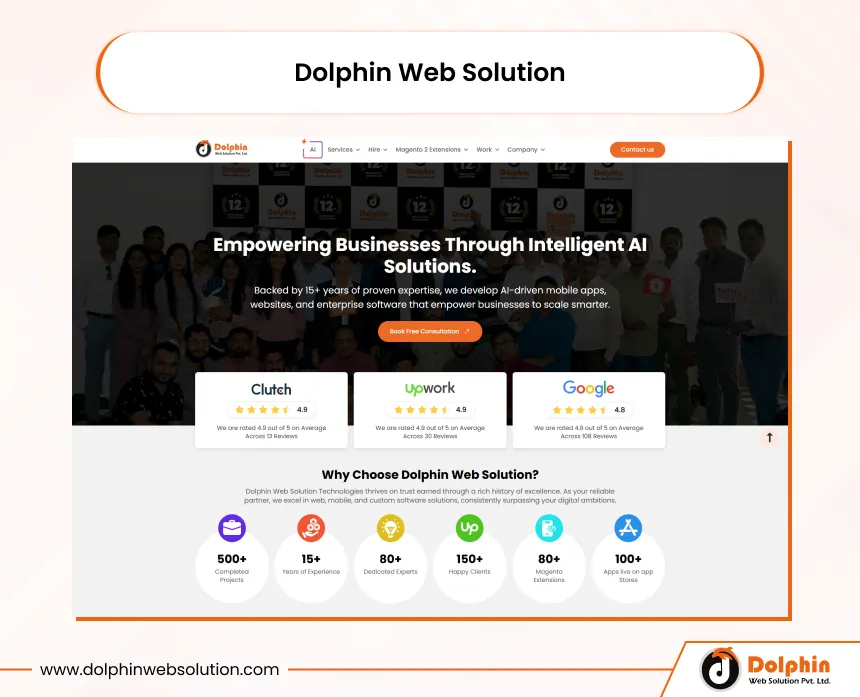
Dolphin Web Solution has spent over 15 years building software and ecommerce solutions for businesses across industries, and AI agent development has become a core part of that work. Rather than treating agents as an add on to existing AI offerings, our team approaches each engagement by first understanding the specific business process an agent needs to support, then building around that, whether the use case involves customer support, internal workflow automation, or task completion across multiple connected systems. Our broader AI App Development Services give clients a single partner for everything from initial strategy through agent deployment and ongoing support.
2. Tata Consultancy Services (TCS)
TCS is one of India's largest IT services companies and has built out AI agent capabilities as part of its broader enterprise AI portfolio, serving large, complex organizations across banking, retail, manufacturing, and other sectors. Its scale makes it well suited to businesses that need an agent development partner capable of supporting global, multi region deployments.
3. Infosys
Infosys has invested heavily in agentic AI through its Infosys Topaz platform, which includes Agentic Foundry, a set of tools built specifically to help enterprises discover, build, deploy, and monitor AI agents at scale. Infosys has publicly detailed deployments spanning finance, healthcare, retail, and IT operations, with agents designed to handle tasks such as fraud detection, financial analysis, and internal service requests. This makes Infosys a strong option for large enterprises looking for a partner with a mature, purpose built agent platform rather than a custom build from scratch.
4. Wipro
Wipro brings decades of enterprise IT experience to its AI and automation practice, with agentic AI positioned as an extension of its existing digital transformation and intelligent automation services. Businesses already working with Wipro on broader technology initiatives often find it a natural extension to bring agent development into the same relationship.
5. HCLTech
HCLTech has built AI and automation into its engineering and IT services offerings, with agent development typically positioned within larger digital transformation engagements. Its scale and engineering depth make it a common choice for enterprises with complex, multi system environments.
6. Accenture
Accenture operates a significant AI and agentic AI practice in India as part of its global consulting and technology services business, often working with large enterprises undergoing broader AI transformation rather than single, narrowly scoped agent projects. Its strength lies in combining strategy consulting with technical delivery under one engagement.
7. Tech Mahindra
Tech Mahindra has expanded its AI and automation capabilities to include agentic AI, often applied within its existing strengths in telecom, manufacturing, and enterprise IT services. Businesses in those specific sectors may find its industry specific experience particularly valuable.
8. Persistent Systems
Persistent Systems has a strong engineering focused reputation and has extended that into AI and agent development work, often for clients who need deep technical execution rather than broad consulting led engagements. This makes it a common choice for businesses with a clearly defined technical scope already in hand.
9. IBM
IBM brings its long standing enterprise AI and automation expertise, including its watsonx platform, into agent development work delivered through its India teams. Its focus tends to be on large enterprises with strict governance, security, and compliance requirements around how autonomous systems are allowed to operate.
How to Choose the Right AI Agent Development Partner
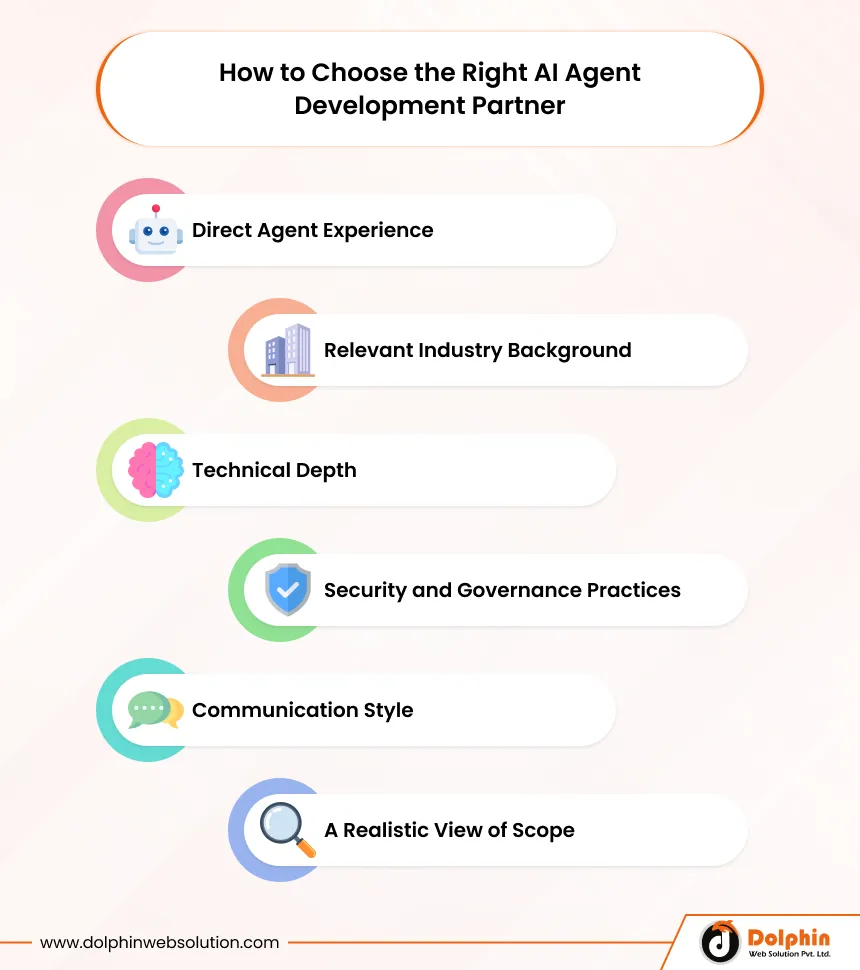
Once you have a shortlist, evaluate each company against the same core criteria.
1. Direct Agent Experience
Ask for real examples of agents the company has actually built and deployed, verified through specifics rather than general AI marketing language. A partner who can walk you through how a previous agent handled a tricky edge case, or where an earlier version fell short before being improved, has genuine hands on experience. Vague claims about being an AI first company are not the same thing as having shipped a working agent into production.
2. Relevant Industry Background
Look for experience in your specific sector and its constraints, since the right approach to an AI agent in a regulated industry like finance or healthcare looks very different from one built for retail or logistics. A partner who already understands your industry's compliance requirements and typical data structures will need far less ramp up time than one starting from scratch.
3. Technical Depth
Evaluate depth in areas like tool use, multi agent orchestration, and retrieval based reasoning, not just the ability to prompt a language model well. A capable agent development team should be able to explain how they handle failure cases, how the agent decides when to hand off to a human, and how they manage context across a multi step task, not just what model they plan to use.
4. Security and Governance Practices
This matters most when the agent will operate with access to sensitive systems or data. Ask specifically how the partner handles access control, audit logging, and limits on what actions an agent is allowed to take autonomously. A partner who cannot answer these questions clearly is not ready to build something that touches production systems.
5. Communication Style
Agent projects often involve ambiguity that gets resolved through honest, ongoing conversation rather than a fixed spec written once at the start. Pay attention to how a potential partner communicates during early conversations, since a team that pushes back with thoughtful questions early on is far more likely to flag problems before they become expensive, rather than after.
6. A Realistic View of Scope
Be cautious of a partner who promises a fully autonomous agent for every use case, since that is usually overselling what is currently practical. The strongest partners are willing to recommend a narrower, more reliable scope for a first version, even if it is a less exciting pitch, because a working agent with limited scope delivers more real value than an ambitious one that cannot be trusted in production.
Cost Considerations for AI Agent Development
Cost is one of the most common questions businesses have before starting an agent project, and it varies significantly based on how many tasks the agent needs to handle autonomously, how many systems it needs to connect to, and how reliable it needs to be for production use.
1. Task Autonomy
The biggest cost driver is autonomy. An agent that performs one narrow, well defined task costs far less to build than one expected to plan across multiple steps, make judgment calls, and hand off to a human only when genuinely necessary.
2. System Integrations
Every additional system the agent needs to connect to, whether that is a CRM, an internal database, or a third party API, adds integration work and increases the overall cost of the build.
3. Reliability Requirements
Every layer of reliability the business requires, such as fallback behavior when the agent is uncertain, adds engineering time and testing that a simple demo does not need.
4. Pricing by Complexity
A single purpose agent handling a narrow, repetitive task typically sits at the lower end of the pricing spectrum. A multi step agent coordinating several tasks and tools costs meaningfully more, and fully autonomous agents operating with minimal human oversight, particularly in regulated environments, sit at the top of the range.
5. Ongoing Costs
The upfront development cost is only part of the picture. Agents typically carry ongoing costs for model usage, infrastructure, and continuous monitoring to catch performance drift before it affects users, so it is worth budgeting for these from the start rather than treating them as an afterthought.
Rather than guessing at a budget, our detailed breakdown of AI Agent Development Cost walks through typical pricing ranges and the specific factors that drive them.

Conclusion
The AI agent development market in India has matured quickly, and businesses now have a genuine range of options, from large global IT services firms to specialized teams like Dolphin Web Solution. The right choice depends less on company size and more on real, verifiable experience building agents that actually work in production, industry specific familiarity, and a partner willing to be honest about what is realistic for your specific use case.
Before committing to a partner, take the time to evaluate them against the criteria in this guide rather than choosing based on name recognition alone. The businesses getting real value from AI agents are consistently the ones that matched their project to a partner with genuine, demonstrable expertise in this specific area.
Frequently Asked Questions
What should I look for in an AI agent development company?
Look for direct, verifiable experience building agents rather than general AI development, relevant industry background, technical depth in agent frameworks, strong security practices, and support after deployment.
Are large IT services companies better than specialized AI agent firms?
Not necessarily. Large firms offer scale and broad enterprise experience, while specialized firms often bring deeper, more focused agent expertise. The right choice depends on your project's complexity and your organization's existing relationships.
How much does AI agent development typically cost?
Cost depends heavily on the number of tasks the agent needs to perform, the systems it connects to, and reliability requirements. Our guide to AI agent development cost breaks down typical ranges in more detail.
Can AI agents integrate with existing business systems?
Yes, most AI agents are built to integrate with systems such as a CRM, ERP, or internal databases, though the complexity of that integration depends on how accessible and well structured the existing systems are.
How long does it take to build and deploy an AI agent?
Timelines vary based on scope, but most projects move through discovery, design, development, testing, and deployment over a period of several weeks to a few months.
Is AI agent development suitable for small and mid sized businesses?
Yes, particularly when scoped around a single, well defined task rather than broad, open ended autonomy. Starting narrow allows smaller businesses to validate value before expanding an agent's responsibilities.
Nimesh Patel


Nimesh Patel is the Managing Director of Dolphin Web Solution, a global eCommerce, AI, and software development company helping businesses accelerate digital growth. With over 15 years of experience in technology consulting and product development, he has successfully guided startups, SMBs, and enterprise organizations in building scalable digital solutions. Nimesh specializes in eCommerce development, custom software solutions, mobile application development, and digital transformation strategies. Throughout his career, he has worked closely with businesses across retail, healthcare, automotive, manufacturing, and technology sectors, helping them leverage modern technologies to improve operational efficiency and customer experiences. As a business leader, Nimesh is passionate about innovation, entrepreneurship, and helping organizations turn ideas into successful digital products. His insights focus on eCommerce growth, AI adoption, software development trends, and business transformation through technology.

We can help you with
- Dedicated Team
- Setup Extended Team
- Product Development
- Custom App Development
Our Offices

AHMEDABAD (INDIA)
B- 203-206, Empire Business Hub, Science City Road, Sola, Ahmedabad – 380060

BERLIN (GERMANY)
Badensche Str. 28, 10715 Berlin, Germany

CALIFORNIA (USA)
9601 Reseda Blvd, Apt#223, Northridge CA-91324, USA

ALBERTA (CANADA)
302 Skyview Ranch Drive NE, Calgary, Alberta, Canada T3N0P5





Hello!
Click one of our contacts below to chat on WhatsApp