
-
Dolphin Web SolutionArtificial IntelligenceAI Agent Development Cost: A Complete Guide
 15 Min Read
AI Agent Development Cost: A Complete Guide


Table of Contents
 Show
Show
- 1 Introduction
- 2 What Is an AI Agent? Explained Simply
- 3 Types of AI Agents
- 4 Real World Examples
- 5 Factors That Affect AI Agent Development Cost
- 6 Average AI Agent Development Cost in 2026
- 7 Cost Comparison Table
- 8 Hidden or Additional Cost Components
- 9 How To Reduce AI Agent Development Cost
- 10 When Should a Business Invest in an AI Agent
- 11 AI Agent Development Timeline
- 12 Choosing the Right AI Development Partner
- 13 Conclusion

Summary :
AI agents are intelligent software systems that automate tasks and make decisions independently. This guide explores the complete cost breakdown of developing AI agents in 2026 covering everything from basic chatbots to advanced autonomous systems, helping businesses understand pricing models and make informed investment decisions.
Introduction
Artificial intelligence is no longer just a buzzword for tech companies. Today, businesses across industries are turning to AI agents to streamline operations, improve customer experiences, and boost revenue. But one question keeps coming up: How much does it actually cost to build an AI agent?
The answer isn’t straightforward because development costs vary dramatically based on what you’re building, how complex it needs to be, and what features you want. A simple chatbot might cost a few thousand dollars, while a sophisticated autonomous agent could run into hundreds of thousands. Understanding these costs upfront helps you make smarter investment decisions and plan your AI strategy effectively.
In this guide, we’ll break down everything that influences AI agent development costs, show you realistic pricing for 2026, and help you figure out whether investing in an AI agent makes sense for your business.
What Is an AI Agent? Explained Simply
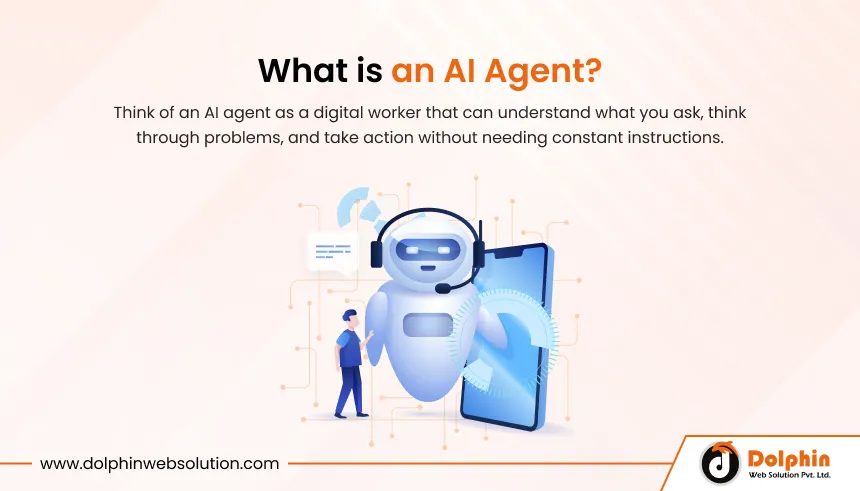
Think of an AI agent as a digital worker that can understand what you ask, think through problems, and take action without needing constant instructions. Unlike traditional software that follows rigid rules, AI agents learn from data and adapt their behavior based on situations.
Here’s the easiest way to understand it: If a regular chatbot is like a lookup table where you search for answers, an AI agent is like talking to a knowledgeable person who understands context, remembers past conversations, and can make decisions on their own.
Types of AI Agents
Different AI agents are built for different purposes. Let’s explore the main categories:
Reactive Agents are the simplest type. They respond to what users ask without remembering previous conversations. Think of them as one shot responders. They’re fast and efficient but limited in capability.
Conversational Agents are what most people think of as chatbots. They understand natural language, can handle back and forth dialogue, and often remember what was discussed earlier in the conversation. These are common in customer support.
Task Automation Agents focus on getting specific jobs done. They might fill out forms, schedule meetings, process orders, or extract information from documents. They’re designed for efficiency and accuracy.
Multimodal AI Agents can handle text, images, voice, and video. They’re the most advanced type and can understand complex real world scenarios through multiple input types.
Real World Examples
Let’s look at practical applications you might recognize:
Customer Support Bots handle incoming customer questions, troubleshoot common issues, and escalate complex problems to human agents. A company like an ecommerce store might use one to handle thousands of customer inquiries daily.
AI Sales Agents reach out to prospects, answer questions about products, qualify leads, and even negotiate deals. Some companies use these to follow up with abandoned carts or suggest products based on browsing history.
Workflow Automation Agents handle internal business processes. They might process expense reports, schedule team meetings, organize documents, or pull data from multiple systems for analysis.
AI Powered Recommendation Agents analyze customer behavior and suggest products, content, or services. Streaming platforms, ecommerce stores, and SaaS companies use these to increase engagement and revenue.
Factors That Affect AI Agent Development Cost
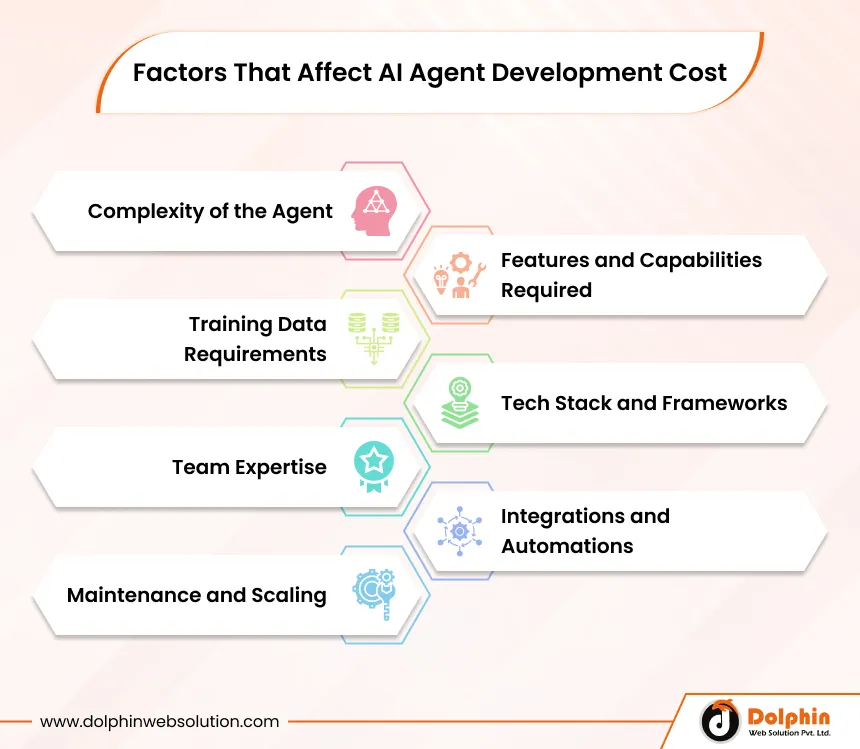
Not all AI agents cost the same. Several factors determine the final price tag. Understanding these helps you plan your budget accurately.
1. Complexity of the Agent
The first major cost driver is complexity. Rule based agents are simpler and cheaper. They follow predetermined logic: “If the customer asks about returns, show the returns policy.” They’re straightforward to build but limited in capability.
Autonomous agents are far more complex. They analyze situations, make decisions without explicit instructions, and learn from outcomes. Building one requires sophisticated AI models, extensive testing, and ongoing refinement.
Consider the difference between a basic FAQ bot for a website (rule based) versus an autonomous sales agent that qualifies leads, suggests products, negotiates pricing, and closes deals (autonomous). The autonomous version might cost 10 times more because it requires deeper AI capabilities.
2. Features and Capabilities Required
Beyond complexity, the specific features you want dramatically impact cost. Here’s what typically adds to the expense:
Natural Language Processing (NLP) lets the agent understand what customers really mean, not just the exact words they use. This is essential for conversational quality but adds development time and costs.
Voice Integration lets users talk to the agent instead of typing. This requires speech recognition and synthesis technology, which adds another $15,000 to $50,000 to development.
Multilanguage Support means the agent can communicate in multiple languages. Each language requires training, testing, and refinement. Supporting five languages might add $10,000 to $30,000 to your budget.
Integrations connect your agent to other systems. Connecting to Shopify (ecommerce), Salesforce (CRM), WordPress (your website), WhatsApp, email, and custom APIs all take developer time. Each integration adds $5,000 to $15,000.
Real Time Analytics gives you insights into agent performance, user behavior, and system health. This requires building dashboards and data pipelines.
Memory and Personalization let the agent remember customer preferences and past interactions. This requires database architecture and algorithmic refinement.
3. Training Data Requirements
AI agents need data to learn. This is often the hidden cost that surprises businesses.
Labeled datasets are pre organized training data where humans have tagged information correctly. If you need thousands of customer conversations labeled to train your agent, that’s expensive manual work. Depending on volume and quality requirements, this could cost $10,000 to $100,000.
Custom data training means teaching the model specifically how your business operates. A healthcare AI agent needs different training than an ecommerce agent. This customization takes time and expertise.
Pretrained versus custom models is a critical decision. Using a pretrained model (like OpenAI’s GPT) is faster and cheaper upfront but less specialized. Building a custom model from scratch offers better accuracy for your specific use case but costs significantly more.
4. Tech Stack and Frameworks
Your technology choices impact cost in several ways.
Large Language Models (LLMs) power most modern AI agents. OpenAI’s models (like GPT 4), Google’s Gemini, Meta’s Llama, and others each have different pricing, capabilities, and integration complexity. Using OpenAI’s APIs might add $1,000 to $5,000 monthly depending on usage, while Llama (open source) might reduce that cost to near zero but require more engineering.
Frameworks and libraries like LangChain, Rasa, and Python libraries accelerate development. Using established frameworks saves money and time compared to building from scratch.
Cloud infrastructure on AWS, Google Cloud Platform (GCP), or Microsoft Azure handles hosting, storage, and processing. Initial setup might cost $2,000 to $10,000, with monthly operating costs ranging from $500 to $10,000 depending on agent traffic.
5. Team Expertise
Building an AI agent requires skilled professionals, and salaries vary significantly by location.
An AI Engineer specialized in machine learning might cost $80 to $150 per hour. An ML Specialist focused on model training could be $100 to $200 per hour. A Backend Developer to build the system infrastructure might be $60 to $120 per hour. UI/UX designers ensure the interface is user friendly at $50 to $100 per hour.
Developer costs differ significantly across regions. European developers typically cost more than North American developers. UK and Canadian talent usually falls between US and European rates. The Gulf region shows competitive rates for senior talent. All these variations affect your total project cost.
6. Integrations and Automations
Every system you connect to adds complexity and cost.
Website integration embeds your agent into your website, usually through a chat widget. This takes $5,000 to $15,000 depending on complexity.
Mobile app integration lets users access the agent through an app, adding another $10,000 to $25,000 for full development.
API connectors to external services (payment processors, data providers, etc.) add $3,000 to $8,000 each depending on complexity.
Third party tools and services create additional monthly costs. API usage fees from your LLM provider, subscription services the agent uses, and other ongoing expenses add up.
7. Maintenance and Scaling
Building the agent is just the beginning. Keeping it running and improving it costs money too.
Ongoing updates to fix bugs and add features typically cost 20 to 40 percent of initial development annually.
AI retraining happens when performance degrades or you want to improve capabilities. This might be quarterly or annually, costing $5,000 to $30,000 per session depending on complexity.
Cloud usage grows as your user base grows. What costs $500 monthly with 100 users might cost $5,000 monthly with 10,000 users.
Security requires monitoring, updates, and compliance work, especially if handling sensitive data. Budget $3,000 to $10,000 annually for security maintenance.
Average AI Agent Development Cost in 2026
Let’s get specific about pricing. These ranges are based on 2026 market rates for development in North America, UK, Europe, and Gulf regions.
1. Basic AI Agent
A basic AI agent is simple, focused, and rule based. It answers common questions without deep learning or personalization.
What it does: Handles FAQ questions, provides product information, collects contact details from visitors.
No deep training required: Uses simple matching logic, not complex AI models.
Typical use case: Small business website chatbot, basic customer inquiry handler.
Development cost range: $15,000 – $40,000
Timeline: 1 to 2 weeks
This tier is ideal for businesses starting their AI journey or testing the waters. You get a functioning agent that handles routine queries but requires human intervention for complex issues.
2. Standard AI Agent
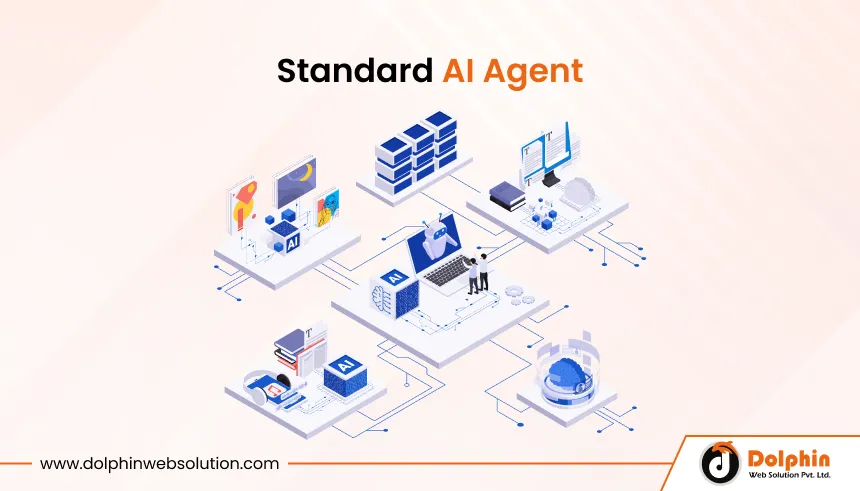
A standard AI agent has conversational ability, integrates with key business systems, and remembers context.
Capabilities include:
- Natural language processing so it understands customer intent, not just keywords.
- Integration with CRM systems to access customer history and personalize responses.
- Connection to ecommerce platforms like Shopify to check inventory and process orders.
- Memory based replies that reference previous conversation points.
- Multi turn conversations that feel natural and human like.
- Good for: SaaS companies handling customer onboarding, ecommerce stores managing customer service, service based businesses qualifying leads.
Development cost range: $50,000 – $150,000
Timeline: 3 to 6 weeks
Monthly operational cost: $2,000 – $8,000 (including API usage, cloud hosting, and infrastructure)
This tier represents the sweet spot for most businesses. You get sophisticated capabilities without enterprise level complexity.
3. Advanced AI Agent
An advanced AI agent is autonomous, handles complex workflows, and continuously improves itself.
Advanced capabilities:
- Multimodal inputs including text, voice, images, and video understanding.
- Autonomous decision making without human approval on routine tasks.
- Full workflow automation that handles multi step business processes.
- Custom model training specific to your industry and use cases.
- High scalability to handle millions of interactions.
- Real time learning and adaptation.
- Sophisticated analytics and performance monitoring.
- Good for: Enterprise companies needing sophisticated automation, AI driven product differentiation, mission critical processes.
Development cost range: $200,000 – $800,000+
Timeline: 3 to 6 months
Monthly operational cost: $10,000 – $50,000+ depending on scale and complexity
Custom model training cost: $50,000 – $200,000+
Advanced agents are for companies willing to invest significantly for competitive advantage and operational transformation.
Cost Comparison Table
| Agent Type | Development Cost | Timeline | Monthly Operations | Best For |
|---|---|---|---|---|
| Basic | $15,000 – $40,000 | 1 – 2 weeks | $500 – $2,000 | Startups, testing, FAQ bots |
| Standard | $50,000 – $150,000 | 3 – 6 weeks | $2,000 – $8,000 | SaaS, ecommerce, service businesses |
| Advanced | $200,000 – $800,000+ | 3 – 6 months | $10,000 – $50,000+ | Enterprise, complex automation |
Hidden or Additional Cost Components
Beyond the main development cost, several hidden expenses catch businesses off guard.
API Usage Costs depend on how much your agent operates. If your AI agent handles 10,000 chats per month at an average 500 tokens per chat, you might spend $3,000 to $5,000 monthly on API calls alone. A highly active agent handling 100,000 interactions could cost $30,000 to $50,000 monthly.
Cloud Hosting includes servers, storage, and data transfer. A basic setup might cost $500 to $1,000 monthly. As you scale, expect $3,000 to $10,000 monthly for moderate usage or $10,000 to $50,000 for enterprise scale.
Data Storage for conversation logs, customer data, and training datasets adds $1,000 to $5,000 monthly depending on volume.
Integration Maintenance ensures your agent stays connected to other systems. APIs change, updates happen, and compatibility issues arise. Budget $3,000 to $8,000 quarterly for ongoing integration support.
UI/UX Updates and Refinement keep your agent feeling modern and responsive. Budget $2,000 to $5,000 monthly for continuous improvements.
Monitoring and Alerting Tools track agent performance and alert you to problems. These tools typically cost $500 to $2,000 monthly.
Security Audits and Compliance are increasingly important, especially if handling sensitive data. Annual security audits cost $5,000 to $20,000 depending on scope.
Real world example: A mid size ecommerce company launches a standard AI agent. Initial development costs $100,000. They budget as follows: API usage ($4,000 monthly), cloud hosting ($3,000 monthly), monitoring tools ($800 monthly), UI improvements ($3,000 monthly), security and updates ($2,000 monthly). That’s $12,800 monthly in ongoing costs, or about $154,000 annually.
How To Reduce AI Agent Development Cost
Budget constraints are real. Here are practical ways to lower development costs without sacrificing quality.
Use Pretrained Large Language Models instead of building custom models. OpenAI’s GPT 4 is ready to use and costs less than training your own model from scratch. This approach saves $100,000 to $500,000.
Build an MVP First (Minimum Viable Product). Launch with core features only, get user feedback, then expand. This lets you validate the concept for $20,000 to $50,000 before committing to advanced features.
Use Open Source Options like Llama, Mistral, or Rasa. These are free or low cost compared to proprietary solutions. Your trade off is more engineering work, but the licensing costs drop dramatically.
Use Templates and Workflow Builders instead of custom development. Many platforms offer AI agent templates you can customize. This reduces development time from weeks to days and costs from $50,000 to $10,000.
Choose an Efficient Tech Stack that balances cost and capability. Python with LangChain and an open source LLM might be cheaper than a custom solution, though it requires skilled engineers.
Use Managed Services like AWS Bedrock or Google Vertex AI instead of managing infrastructure yourself. You pay per use but avoid managing servers.
Start with Fewer Integrations and add more later. Each integration adds cost and complexity. Begin with your most critical system and expand afterward.
When Should a Business Invest in an AI Agent
Not every business needs an AI agent right now, but certain situations make it a smart investment.
Customer Support is the most common use case. If you’re overwhelmed with support tickets, an AI agent handling first line support saves money and improves response time. This works well for SaaS companies, ecommerce stores, and travel businesses.
Lead Qualification becomes valuable when you have many inbound leads but limited sales staff. An AI agent qualifies prospects, gathers information, and hands warm leads to sales teams. Real estate, education, and healthcare benefit here.
Recommendations drive revenue in ecommerce and digital platforms. An AI agent that suggests products, courses, or services increases average order value and customer satisfaction.
Internal Workflows for document processing, data entry, or routine tasks save significant time. Healthcare practices, law firms, and financial services companies see ROI quickly here.
Content Creation assistance helps agencies and publishers produce content faster. An AI agent can draft, research, and structure content, leaving refinement to humans.
Appointment Booking reduces administrative overhead. Healthcare, consulting, salons, and professional services love this use case.
Industry Specific Examples
Ecommerce: An AI agent answers product questions, handles returns, recommends items, and captures abandoned cart recovery. Development cost of $80,000 recovers through increased conversions and reduced support costs within months.
Healthcare: A scheduling and intake agent books appointments, collects patient information, and handles follow up calls. This frees up staff for higher value work and improves patient experience.
Real Estate: An AI agent qualifies leads, answers property questions, schedules viewings, and follows up. Given high commission values, even a 2 percent improvement in conversion rates justifies the investment.
Education: An AI tutor answers student questions, provides personalized learning paths, and helps with homework. This enhances student outcomes while reducing instructor burden.
Travel: An AI travel assistant handles bookings, answers destination questions, suggests itineraries, and manages cancellations. The 24/7 availability and cost savings justify investment quickly.
AI Agent Development Timeline
How long does building an AI agent actually take? It depends on complexity, but here’s what to expect.
Simple Agent: 1 week to 10 days
A basic FAQ or rule based bot with no integrations. Useful for getting started quickly but limited in capability.
Medium Complexity Agent: 2 to 5 weeks
A conversational agent with one or two integrations, basic NLP, and memory. This is where most businesses start.
Complex Agent: 2 to 3 months
An advanced agent with multiple integrations, custom model training, multimodal capabilities, and autonomous features. Full development and testing cycles take significant time.
Development Stages
Every AI agent development follows similar phases:
Planning: Define requirements, scope features, and plan architecture. This takes 3 to 5 days for simple agents, 1 to 2 weeks for complex ones.
Development: Build the core agent, integrate systems, and implement features. This is the longest phase.
Training: Prepare data, train models, and refine performance. Depending on complexity, this takes days to weeks.
Testing: Rigorous testing across different scenarios, edge cases, and user interactions. Quality testing prevents embarrassing failures in production.
Deployment: Set up production environment, migrate systems, train staff, and launch. This phase includes monitoring and bug fixes.
These timelines assume dedicated teams and clear requirements. Vague specifications or changing requirements extend timelines significantly.
Choosing the Right AI Development Partner
Finding the right developer or agency matters enormously. Here’s what to look for.
Experience with Large Language Models is non-negotiable. They should have shipped multiple AI agent projects, not just toy examples. Ask about their experience with OpenAI, Gemini, Llama, or other LLMs.
Industry Knowledge specific to your business is valuable. A development partner who’s built agents for ecommerce understands your challenges differently than someone with banking experience.
Transparent Pricing means no hidden fees or surprise costs. A good partner breaks down costs clearly: development, infrastructure, integrations, and support. Red flags include vague hourly rates or fixed quotes with unclear scope.
Ongoing Support matters more than you think. After launch, you’ll need updates, bug fixes, and improvements. Partners who offer reasonable support plans are better than those who disappear.
Security Practices are essential, especially if handling customer data. Ask about data encryption, access controls, compliance certifications, and security audits.
Case Studies and References prove capability. Ask to see previous projects, metrics achieved, and client feedback. Any reputable partner has real examples they can share.
Communication and Project Management determine whether the project stays on track. Regular updates, clear documentation, and responsive communication prevent misunderstandings.
Conclusion
AI agents represent one of the most transformative technologies for business today. They’re not just hype. Companies using AI agents are handling more customer inquiries with fewer staff, qualifying leads more efficiently, and improving customer satisfaction dramatically with support from AI App Development Services.
The cost to build an AI agent varies tremendously. A basic agent costs as little as $15,000 and takes a week. A sophisticated enterprise agent might cost $500,000+ and take months. Understanding these costs upfront helps you make smart decisions aligned with your business goals and budget.
Remember that development cost is just the beginning. Ongoing expenses for hosting, API usage, maintenance, and improvements continue indefinitely. However, the ROI often justifies the investment. A company reducing customer support costs by 30 percent or increasing sales conversion by 10 percent through AI agents recovers their investment in months.
The key is starting smart. Build an MVP with core functionality, measure results, then expand. This approach manages risk and lets you validate the business case before major investment.
Ready to transform your business with AI agents? Dolphin Web Solution specializes in developing custom AI agents tailored to your specific business needs. Whether you need a customer support bot, lead qualification agent, or workflow automation system, our experienced team delivers solutions that drive real results. Contact us today for a consultation and discover how AI agents can revolutionize your operations. Let’s build your competitive advantage together.

Rohit Prajapati


Rohit Prajapati is the Chief Executive Officer of Dolphin Web Solution and a recognized expert in eCommerce technologies, digital commerce strategy, and product development. With over 15 years of experience in the technology industry, he helps businesses build high-performing online stores, scalable digital platforms, and innovative customer experiences. As a certified Adobe Commerce Business Practitioner (Magento Solution Specialist), Rohit possesses deep expertise in Shopify, Magento, Shopware, Hyvä, and enterprise eCommerce ecosystems. He has successfully consulted businesses worldwide on platform selection, digital transformation, migration strategies, and growth-focused commerce solutions. Rohit regularly shares insights on eCommerce trends, AI-driven commerce, online business growth, and emerging technologies. His mission is to help organizations create future-ready digital experiences that drive measurable business outcomes and long-term success.

We can help you with
- Dedicated Team
- Setup Extended Team
- Product Development
- Custom App Development
Our Offices

AHMEDABAD (INDIA)
B- 203-206, Empire Business Hub, Science City Road, Sola, Ahmedabad – 380060

BERLIN (GERMANY)
Badensche Str. 28, 10715 Berlin, Germany

CALIFORNIA (USA)
9601 Reseda Blvd, Apt#223, Northridge CA-91324, USA

ALBERTA (CANADA)
302 Skyview Ranch Drive NE, Calgary, Alberta, Canada T3N0P5





Hello!
Click one of our contacts below to chat on WhatsApp