
-
Dolphin Web SolutionArtificial IntelligenceThe Agentic Commerce Revolution: AI Agents Driving Ecommerce Growth
 15 Min Read
The Agentic Commerce Revolution: AI Agents Driving Ecommerce Growth


Table of Contents
 Show
Show

Summary :
The Agentic Commerce Revolution is reshaping ecommerce by using intelligent AI agents that automate tasks, personalize shopping, and improve customer journeys. These agents enhance efficiency, reduce manual work, and drive higher conversions for brands. This shift marks a new era of smarter, self-operating online commerce.
The ecommerce landscape is experiencing a seismic shift in 2026, driven by the emergence of agentic AI—intelligent systems that don’t just respond to commands but actively think, decide, and execute tasks autonomously. These AI agents are transforming online retail from passive browsing experiences into dynamic, conversational shopping journeys where technology anticipates customer needs and acts on their behalf. For ecommerce brands looking to stay competitive, understanding and leveraging AI agents isn’t just an advantage—it’s becoming essential.
What Are AI Agents?
AI agents, also known as intelligent agents, are specialized artificial intelligence systems designed to operate independently to achieve specific goals without constant human intervention. Unlike traditional AI tools or chatbots that require prompts and step-by-step guidance, AI agents possess three game-changing capabilities that set them apart:
Autonomous decision-making allows these systems to perceive their environment, interpret complex data patterns, and make informed choices without waiting for human input. Continuous learning enables them to refine their performance over time by analyzing outcomes and adapting their strategies based on real-world feedback. Contextual understanding empowers AI agents to maintain conversation history, remember customer preferences, and deliver personalized experiences that evolve with each interaction.
The key distinction lies in their level of independence—while traditional AI chatbots excel at answering specific questions, AI agents can manage entire workflows from product research and comparison to completing purchases autonomously. OpenAI’s Operator, launched in January 2026 and integrated into ChatGPT, exemplifies this evolution by helping users automate complex tasks like booking travel and completing online purchases without manual navigation.
Why AI Agents Matter for Ecommerce in 2026
The year 2026 marks a pivotal moment in digital commerce as consumer expectations reach unprecedented heights and competition intensifies across all retail sectors. AI agents are revolutionizing four critical areas: product discovery through intelligent search that understands natural language queries, customer engagement via conversational interfaces that build relationships, marketing automation by dynamically personalizing campaigns at scale, and support operations that resolve queries instantly without human intervention.
Traffic to US retail sites from GenAI browsers and chat services skyrocketed 4,700% year-over-year in July 2026, according to Adobe, with these users spending 32% more time on sites, browsing 10% more pages, and showing a 27% lower bounce rate. More than half of consumers anticipate using AI assistants for shopping by the end of 2026, signaling a fundamental shift in how people interact with ecommerce platforms.
At Dolphin Web Solution, we help ecommerce brands navigate this transformation by integrating cutting-edge AI agent technologies seamlessly into their digital storefronts, ensuring they capitalize on these trends while maintaining brand identity and customer trust.
Key Benefits of AI Agents in Ecommerce
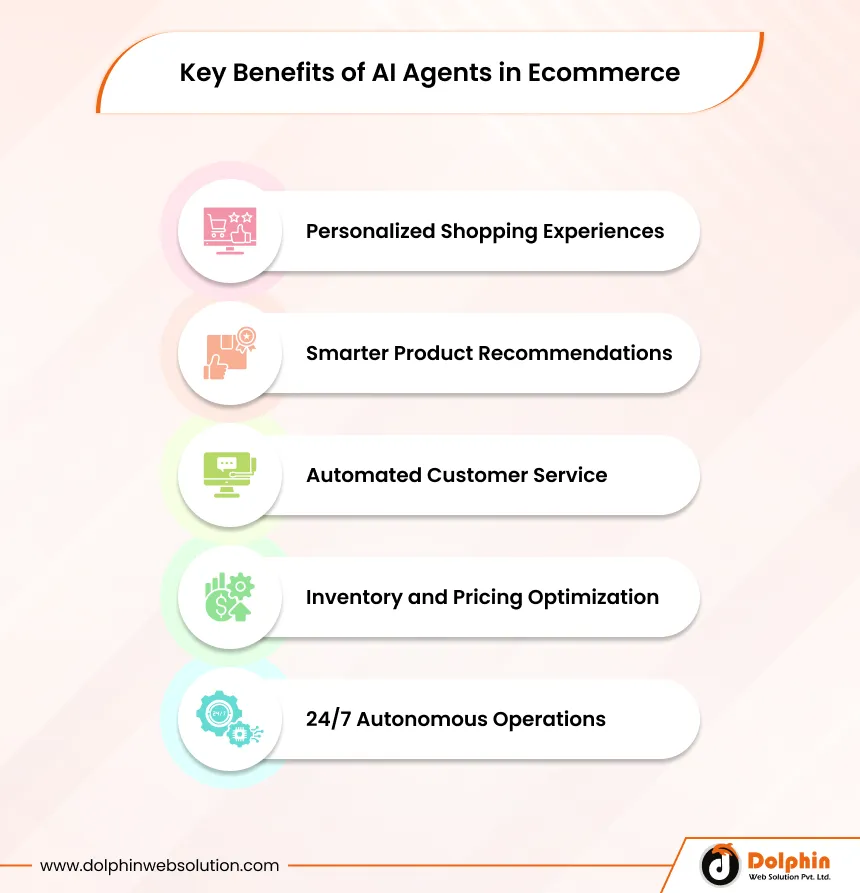
1. Personalized Shopping Experiences
AI-powered online stores leverage agents that analyze browsing history, past purchases, demographics, and real-time behavior to deliver hyper-personalized recommendations that resonate with individual shoppers. Unlike traditional segmentation that groups customers into broad categories, AI agents create unique experiences for each visitor by understanding their specific preferences and anticipating their needs before they even express them.
2. Smarter Product Recommendations
Ecommerce automation powered by AI agents goes beyond simple “customers also bought” suggestions. These intelligent systems analyze vast contextual data including search terms, click patterns, and cart actions to guide users toward conversion paths that align with their evolving intent. Instacart’s “Ask Instacart” feature exemplifies this capability—shoppers can describe what they need in natural language like “I’m hosting a taco night” and instantly receive a tailored grocery list.
3. Automated Customer Service
AI agents in ecommerce function as 24/7 customer service teams capable of handling thousands of queries simultaneously. H&M uses AI-powered chatbots to help customers find products, check stock, and track orders, freeing their human support team to focus on complex issues while maintaining instant response times. This reduces customer wait times to seconds rather than minutes or hours, directly improving satisfaction and reducing cart abandonment.
4. Inventory and Pricing Optimization
AI agents continuously monitor inventory levels, customer preferences, and competitor movements to execute intelligent merchandising strategies automatically. They can adjust product placements, create promotional bundles based on sales trends, and implement dynamic pricing that responds to real-time demand fluctuations, maximizing revenue while maintaining competitiveness.
5. 24/7 Autonomous Operations
The always-on nature of AI agents transforms ecommerce operations from resource-constrained to infinitely scalable. These systems never sleep, never take breaks, and maintain consistent performance quality regardless of traffic volume, enabling small businesses to deliver enterprise-level customer experiences without proportional staffing costs.
Real-World Use Cases
1. Virtual Shopping Assistants
AI shopping assistants have become integral to ecommerce in 2026, offering tailored recommendations, real-time support, and streamlined purchasing processes. These agents understand user preferences, answer questions in seconds, and suggest relevant products based on behaviors and predicted actions. The ideal AI shopping assistant leverages accurate data and is purpose-built to address key challenges in online shopping and product discovery.
2. Conversational Commerce
Agentic commerce represents the next evolution where AI agents act as intelligent personal shoppers that actively browse, compare, and complete purchases on customers’ behalf. Major platforms like ChatGPT introduced “Instant Checkout” in 2026, enabling customers to complete purchases directly within chat windows—starting with Etsy merchants and expanding to Shopify stores. Perplexity launched “Buy with Pro” allowing one-click purchases from select merchants, while Google expanded its AI Mode shopping interface to track prices and confirm purchases via Google Pay.
3. AI-Driven Upselling and Cross-Selling
Personalized upselling and cross-selling strategies powered by AI agents significantly increase average order value and customer lifetime value by suggesting items that fit individual buying patterns. Salesforce’s State of the Connected Customer report found that 66% of customers expect companies to understand their unique needs, yet only 34% believe they actually do—AI agents help bridge this expectation gap.
4. Supply Chain Automation
AI agents optimize entire supply chains by predicting demand fluctuations with greater accuracy, helping retailers optimize inventory levels, reduce waste, and prevent stockouts. They also streamline logistics by identifying the most efficient delivery routes and managing real-time adjustments to unexpected disruptions.
5. Predictive Analytics for Consumer Behavior
By processing vast amounts of behavioral data, AI agents identify patterns and predict future customer actions with remarkable accuracy. This enables proactive marketing strategies, inventory planning, and personalized engagement campaigns that reach customers at precisely the right moment with the right message.
How to Implement AI Agents in Ecommerce (with Expert Help from Dolphin Web Solution)
1. Steps for Integration
Successful AI agent implementation begins with choosing the right tools that align with your business goals and technical infrastructure. This requires evaluating specialized platforms like Rebuy, Lily AI, and Vue.ai that offer AI-driven features for hyper-personalized recommendations and automated merchandising. The next critical step involves setting up data pipelines that unify customer information across touchpoints, enabling AI agents to access comprehensive behavioral histories and deliver consistent experiences.
Testing and optimization form the final phase, where businesses must continuously monitor AI agent performance, collect feedback from interactions, and refine models to improve accuracy and personalization. AI shopping assistants get smarter over time—if a customer frequently browses eco-friendly products, the assistant learns to prioritize sustainable options in future recommendations.
2. End-to-End Ecommerce AI Solutions from Dolphin Web Solution
At Dolphin Web Solution, we provide comprehensive ecommerce AI solutions that span from initial strategy development through deployment and ongoing optimization. Our team specializes in integrating AI agents into platforms like Shopify, Magento, and custom-built solutions, ensuring seamless connectivity with your existing technology stack. We handle the technical complexity of data integration, model training, and user experience design, allowing you to focus on your core business while we transform your digital storefront into an intelligent, autonomous selling machine.
Our approach prioritizes scalability and future-readiness, implementing AI architectures that evolve with your business and adapt to emerging technologies as the AI in the ecommerce landscape continues advancing.
Challenges & Considerations
1. Data Privacy and Ethical AI Use
AI agents rely on vast amounts of customer data to deliver personalized experiences, raising significant concerns about data privacy and regulatory compliance. Businesses must adhere to regulations like GDPR and CCPA, implementing end-to-end encryption, secure authentication mechanisms, and anonymization techniques to protect customer identities. Unauthorized access or data breaches can lead to severe legal consequences and reputational damage that may take years to recover from.
2. Cost and Technical Infrastructure
High implementation costs represent a significant barrier for many ecommerce businesses considering AI agent adoption. Beyond initial development expenses, maintaining sophisticated AI systems requires ongoing investment in computing resources, data storage, and specialized talent. Technical challenges increase exponentially with ecosystem complexity, creating substantial implementation hurdles particularly for businesses with legacy systems.
3. Partnering with Experienced Teams
The complexity of AI agent implementation makes partnering with an experienced ecommerce technology team essential for success. Dolphin Web Solution brings deep expertise in navigating technical challenges, ensuring regulatory compliance, and designing AI systems that align with your business objectives while protecting customer trust. Our proven methodologies reduce implementation risks and accelerate time-to-value, transforming potential pitfalls into competitive advantages.
Conclusion
AI agents represent the next major evolution in ecommerce, fundamentally transforming how brands interact with customers and operate their digital storefronts. From autonomous shopping assistants that browse and purchase on behalf of consumers to intelligent systems that optimize pricing, inventory, and marketing in real time, these technologies are no longer futuristic concepts—they’re reshaping retail today. As consumer adoption accelerates and major platforms integrate agentic capabilities, businesses that embrace AI agents and strong eCommerce Development strategies position themselves at the forefront of digital commerce innovation.
If you’re ready to build an AI powered ecommerce store that delivers personalized experiences, maximizes conversions, and operates with unprecedented efficiency, connect with Dolphin Web Solution—your trusted technology partner to hire ecommerce developers and navigate the AI revolution in online retail.

Nimesh Patel


Nimesh Patel is the Managing Director of Dolphin Web Solution, a global eCommerce, AI, and software development company helping businesses accelerate digital growth. With over 15 years of experience in technology consulting and product development, he has successfully guided startups, SMBs, and enterprise organizations in building scalable digital solutions. Nimesh specializes in eCommerce development, custom software solutions, mobile application development, and digital transformation strategies. Throughout his career, he has worked closely with businesses across retail, healthcare, automotive, manufacturing, and technology sectors, helping them leverage modern technologies to improve operational efficiency and customer experiences. As a business leader, Nimesh is passionate about innovation, entrepreneurship, and helping organizations turn ideas into successful digital products. His insights focus on eCommerce growth, AI adoption, software development trends, and business transformation through technology.

We can help you with
- Dedicated Team
- Setup Extended Team
- Product Development
- Custom App Development
Our Offices

AHMEDABAD (INDIA)
B- 203-206, Empire Business Hub, Science City Road, Sola, Ahmedabad – 380060

BERLIN (GERMANY)
Badensche Str. 28, 10715 Berlin, Germany

CALIFORNIA (USA)
9601 Reseda Blvd, Apt#223, Northridge CA-91324, USA

ALBERTA (CANADA)
302 Skyview Ranch Drive NE, Calgary, Alberta, Canada T3N0P5





Hello!
Click one of our contacts below to chat on WhatsApp