
-
Dolphin Web SolutionEcommerceAI Agents: The Future of Customer Engagement for eCommerce
 15 Min Read
AI Agents: The Future of Customer Engagement for eCommerce


Table of Contents
 Show
Show

Summary :
AI agents are transforming customer engagement in eCommerce by offering personalized, instant support. These smart digital assistants give shoppers real-time help 24/7, recommend products uniquely suited to each person, and make shopping smoother than ever. By handling customer questions quickly and proactively (even on holidays or late at night), AI agents create seamless experiences that boost loyalty and sales.
Introduction
Customer engagement is critical to eCommerce success. Today’s online shoppers expect quick answers, customized recommendations, and a smooth experience every time they visit a store. If a customer hits “add to cart” or sends a message at midnight, they want an immediate response. Brands that keep people waiting or ignore personal touches risk losing sales and loyalty.
Over recent years, customer expectations have shifted dramatically toward real-time support and personalization. Shoppers now compare experiences with the best brands (like how instantly Amazon or Netflix respond to them) and expect every store to keep up. This means no more slow email replies or tedious FAQs. Instead, people want fast chat replies, tailored product suggestions, and even voice-based help.
This is where AI agents come in as the future of eCommerce customer experience. Think of an AI agent as a smart virtual assistant for your online store. It uses artificial intelligence to understand customer questions, suggest products, and solve problems immediately. These AI assistants are essentially the new face of customer support – always awake and learning – ensuring that every shopper feels personally attended to, no matter when or how they shop.
What are AI Agents in eCommerce?
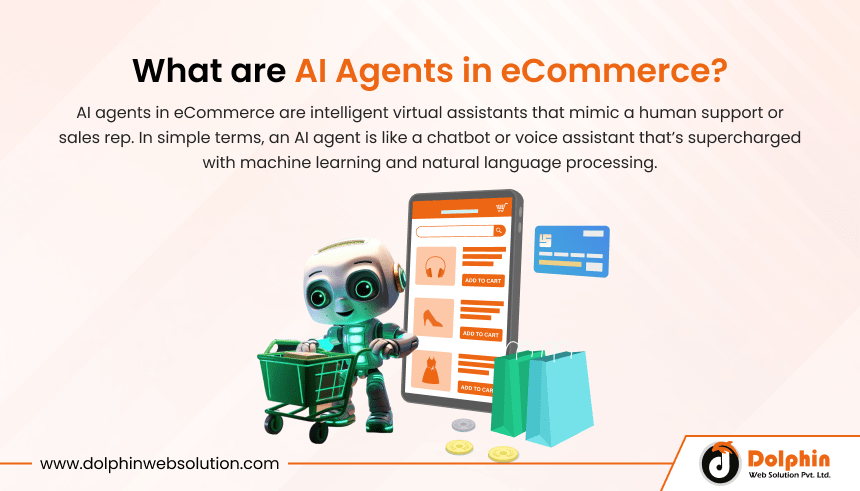
AI agents in eCommerce are intelligent virtual assistants that mimic a human support or sales rep. In simple terms, an AI agent is like a chatbot or voice assistant that’s supercharged with machine learning and natural language processing. It can read a customer’s questions or requests, understand their meaning, and respond in a helpful way. AI agents act like digital concierges for shoppers, answering queries, guiding choices, and even completing tasks on their behalf.
Imagine a shopper who’s unsure which smartphone to buy. Instead of spending hours browsing, they type a question to the AI agent: “Show me the best budget-friendly smartphones under $300.” The AI agent quickly understands the request, searches all products, and returns a shortlist of top-rated phones that fit the criteria. This is AI agents at work: instant, intelligent assistance.
These AI assistants can also handle entire conversations. For example, a customer who buys a dress might ask the agent, “Which shoes match this dress?” In real time, the AI agent will browse the inventory and reply, “These sandals and heels pair great with that style.” The shopper gets personalized help immediately, exactly like having a knowledgeable sales associate online.
How AI Agents Improve Customer Engagement
AI agents boost customer engagement in several key ways:
- 24/7 availability for customer queries. AI chatbots never sleep or go offline. They can answer questions any time of day or night, on weekends or holidays. This means a customer who shops late at night or in another time zone still gets an immediate response. Instant answers around the clock keep customers interested and prevent frustration.
- Personalized product recommendations. AI agents analyze customer data (browsing history, past purchases, and preferences) to suggest products each shopper is likely to love. For example, if a customer often buys running gear, the AI agent might proactively recommend new running shoes or accessories just for them. This one-on-one personalization makes customers feel understood and increases the chance they’ll buy more.
- Proactive support (reminders for abandoned carts). AI agents can follow up with customers who leave items in their shopping cart. Suppose someone adds headphones to their cart but doesn’t check out. The AI agent notices and can send a reminder message: “Hey, you left something behind! Would you like a 10% off coupon for those headphones?” These helpful nudges turn abandoned carts into completed sales and make shoppers feel cared for.
- Multichannel engagement across chat, email, and voice. AI agents work everywhere customers do. They can chat on your website, answer questions via email, respond on social media chat, and even take voice commands on smart speakers. For instance, a customer can start a conversation on a phone and continue it later by voice at home. This seamless, omni-channel support (as shown above) makes the shopping journey fluid. Customers get consistent help whether they’re on a laptop, using a mobile app, or talking to a virtual assistant.
- Faster resolution of customer issues. With instant access to product info, order history, and FAQs, AI agents resolve common customer issues in seconds. Questions like “Where is my order?” or “How do I return this?” get answered immediately by the AI. Instead of waiting on hold or for an email reply, shoppers get quick solutions. Fast support makes customers happier and more likely to buy again.
Benefits of AI Agents for eCommerce Businesses
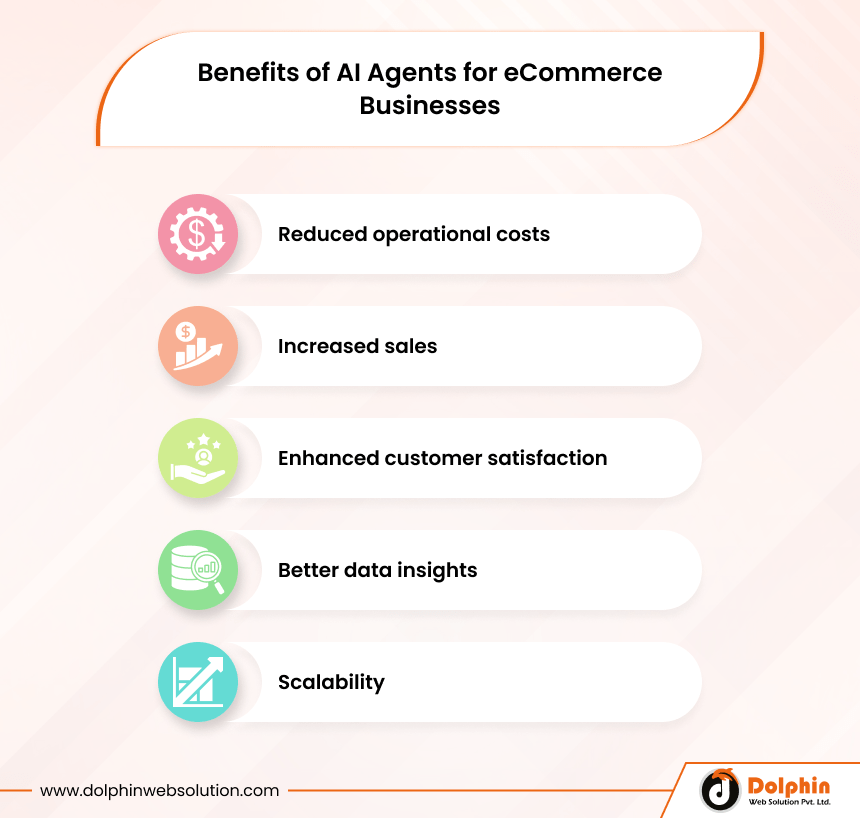
AI agents aren’t just good for customers – they bring big advantages for businesses too:
- Reduced operational costs by automating repetitive tasks. Since AI agents handle routine customer questions automatically, companies need fewer staff to answer basic queries. This cuts support costs. Human agents are freed up to tackle complex issues instead of repeating the same answers. Over time, automating FAQs, basic troubleshooting, and order updates can save a lot on labor.
- Increased sales through upselling and cross-selling suggestions. AI agents don’t just respond to inquiries; they also look for sales opportunities. The agent can suggest related or higher-value products during a conversation. For example, if a customer orders a camera, the AI agent might offer a bundled lens kit or a protective case. These timely upsells and cross-sells feel helpful (like a smart salesperson) and boost average order values.
- Enhanced customer satisfaction with faster responses. Customers get answers instantly instead of waiting. This speed greatly increases satisfaction and trust. When buyers see that their needs are understood and addressed quickly, they are happier and more loyal. High satisfaction also means positive reviews and recommendations, further growing the business.
- Better data insights into customer behavior. Every AI interaction generates data. AI agents track what customers ask for, which products they browse, and how they respond to offers. Businesses can analyze this data to learn customer trends and preferences. For instance, if many people ask for a product that’s out of stock, the retailer can notice this gap. Better insights help companies improve inventory decisions, marketing, and personalized experiences over time.
- Scalability during high traffic events like sales or festive seasons. AI agents can easily scale up to handle thousands of customers at once. During big sales events (like Black Friday) or holidays, human teams can be overwhelmed by questions and orders. In contrast, AI agents manage spikes smoothly – they instantly handle massive traffic without breaking a sweat. This means every customer gets help even during rush hour, keeping the store’s reputation strong and sales flowing.
When shopping excitement peaks (for example, a big sale is live), AI agents shine by connecting with customers on any device or channel. They can chat on a website while a customer is on their phone, send follow-up emails, or even respond to voice commands on a smart speaker. This multi-platform presence ensures that no matter how customers choose to engage, they always get quick, personalized support.
Real World Applications of AI Agents in eCommerce
AI agents are not just theoretical – they are already working in stores and apps you use every day. Here are some relatable examples of how businesses use AI agents:
-
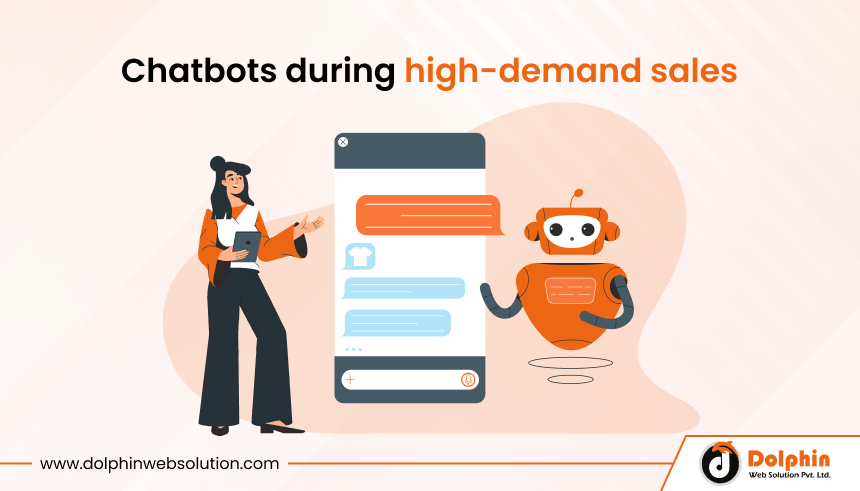
Chatbots during high-demand sales:
Imagine it’s Black Friday and thousands of customers flood an online store. A retailer’s AI chatbot steps in to handle the chaos. It quickly answers FAQs (“Is this jacket still in stock?” or “When will my order ship?”) and guides customers to deals. Instead of long queues or unanswered emails, shoppers get instant help. This keeps customers happy during the rush and allows the company to serve more buyers without hiring extra staff. -
Personalized upselling with product recommendations:
Suppose you just bought a new dress online. An AI agent might immediately pop up and suggest matching shoes or accessories. For example, a shopper finds a red dress and the AI says, “These black heels and gold necklace would look great with that dress!” It feels like having a personal stylist available 24/7. This real-time suggestion increases the sale (you get more items) and makes your shopping experience fun and relevant. -
Voice-based shopping assistants:
AI agents can also live in your smart speaker or phone’s voice assistant. Picture this: You’re cooking dinner and realize you need more cooking oil. You simply say, “Alexa, add olive oil to my shopping cart.” The voice assistant, acting as an AI agent, adds the item and may even suggest related items (“Would you like to reorder the pasta sauce you bought last time?”). Customers love this hands-free convenience. It’s like talking to a helpful store clerk who’s always listening and eager to assist.
These examples show AI agents making shopping feel easy and personal. The image above (a shopping cart against a cityscape) symbolizes how AI support is integrated into modern eCommerce – seamlessly connecting a busy online marketplace with the perfect help and products customers need.
Challenges of Using AI Agents
While AI agents offer many benefits, businesses should be aware of some challenges to use them wisely:
-
Over-reliance on automation (less human touch):
If a store relies only on AI, customers might feel something is missing. Some buyers prefer talking to a human, especially for complex or sensitive issues. AI agents can sometimes misunderstand nuanced questions or lack empathy. To address this, companies should ensure customers can still reach a human agent when needed. A balanced mix – bots for routine tasks and humans for personalized care – works best. -
Training required for complex queries:
AI agents learn from data and need good training. They handle standard questions great, but unusual or very complicated queries can stump them. Setting up the AI initially (feeding it product details and FAQs) and regularly updating it (teaching it new information) takes effort. Retailers must invest time in refining their AI agents so they become smarter and more accurate over time. -
Data security and privacy concerns:
AI agents often handle sensitive customer information (purchase histories, personal preferences, even payment details). This raises security issues. Businesses must ensure data is stored safely and used responsibly. Protecting customer privacy and complying with regulations (like GDPR) is crucial. Customers must trust that using the AI agent won’t expose their private data.
Also Read:
How Much Does AI App Development Cost?The Future of AI Agents in Customer Engagement
AI agents are getting smarter every day. In the near future, we’ll see even more amazing advancements:
-
Even more human-like conversations (NLP advances):
AI language technology is rapidly improving. Future AI agents will understand context, slang, and even emotions better. They will chat almost indistinguishably from a human. Customers will be surprised at how naturally the agent talks. This evolution means AI agents will not just answer questions, but truly engage in meaningful conversations (asking follow-up questions or understanding frustration cues). -
Integration with AR/VR for immersive shopping:
The next frontier is combining AI with augmented and virtual reality. Imagine wearing AR glasses and seeing virtual product information pop up as you browse a store. An AI agent (perhaps appearing as a friendly avatar) could guide you through a virtual showroom or let you “try on” clothes digitally. These immersive experiences will make online shopping feel like visiting a futuristic store. -
Hyper-personalization using big data:
AI agents will leverage huge amounts of data to treat each customer completely individually. They’ll use your past purchases, browsing behavior, social media, location, and even current trends (like weather or events) to customize every suggestion. For example, an AI agent might say, “It looks like rain in your area this weekend. How about a waterproof jacket from our new collection?” The shopping experience will feel like having a personal shopper who knows you inside and out.
Overall, these trends mean that AI agents for ecommerce will only grow more powerful. They will become essential customer engagement solutions that blend the convenience of technology with a personal touch. Retailers who embrace AI in ecommerce customer support now will be well ahead in delivering the cutting-edge experiences customers crave.
Conclusion
AI agents are undeniably the future of eCommerce customer engagement and eCommerce development. They bridge the gap between instant service and personal touch, giving online stores the ability to support shoppers like never before. By providing real-time answers, tailored recommendations, and proactive help, AI agents help businesses exceed customer expectations and stay competitive. For any ecommerce retailer, integrating AI-powered assistants is no longer optional – it’s a key strategy to reduce costs, increase sales, and build loyal customers. Staying ahead means adopting AI agents for ecommerce today and using innovative customer engagement solutions. Companies that leverage AI in ecommerce development and customer support will delight customers with fast, smart service and will outperform competitors who fall behind.
Ready to transform your online store’s customer experience with AI? Connect with Dolphin Web Solution and let our experts implement cutting-edge AI-powered eCommerce solutions for you. Whether you’re looking to hire eCommerce developers for custom integration or need end-to-end automation, we’ll help you add intelligent chatbots and virtual assistants to your store, improving customer engagement and boosting sales. Reach out to Dolphin Web Solution today to take your customer support to the next level and stay ahead in the eCommerce game!

Nimesh Patel


Nimesh Patel is the Managing Director of Dolphin Web Solution, a global eCommerce, AI, and software development company helping businesses accelerate digital growth. With over 15 years of experience in technology consulting and product development, he has successfully guided startups, SMBs, and enterprise organizations in building scalable digital solutions. Nimesh specializes in eCommerce development, custom software solutions, mobile application development, and digital transformation strategies. Throughout his career, he has worked closely with businesses across retail, healthcare, automotive, manufacturing, and technology sectors, helping them leverage modern technologies to improve operational efficiency and customer experiences. As a business leader, Nimesh is passionate about innovation, entrepreneurship, and helping organizations turn ideas into successful digital products. His insights focus on eCommerce growth, AI adoption, software development trends, and business transformation through technology.

We can help you with
- Dedicated Team
- Setup Extended Team
- Product Development
- Custom App Development
Our Offices

AHMEDABAD (INDIA)
B- 203-206, Empire Business Hub, Science City Road, Sola, Ahmedabad – 380060

BERLIN (GERMANY)
Badensche Str. 28, 10715 Berlin, Germany

CALIFORNIA (USA)
9601 Reseda Blvd, Apt#223, Northridge CA-91324, USA

ALBERTA (CANADA)
302 Skyview Ranch Drive NE, Calgary, Alberta, Canada T3N0P5





Hello!
Click one of our contacts below to chat on WhatsApp