
-
Dolphin Web SolutionEcommerceThe Role of Artificial Intelligence in Shaping Quick Commerce
 15 Min Read
The Role of Artificial Intelligence in Shaping Quick Commerce


Table of Contents
 Show
Show

Summary :
AI revolutionizes quick commerce through demand forecasting, smart inventory management, route optimization, and personalized customer experiences. Implementation delivers 20-30% cost reductions, faster deliveries, and improved satisfaction. Success requires a phased approach, avoiding common pitfalls like treating AI as a magic solution. Strategic AI adoption essential for competitive advantage.
In today’s hyperconnected world, waiting is no longer an option. Consumers expect their groceries delivered in 10 minutes, meals in 20, and essentials within the hour. This seismic shift in consumer behavior has given birth to quick commerce—a delivery model that promises instant gratification at unprecedented speeds.
The numbers tell a compelling story. The global quick commerce market reached $45 billion in 2023 and is projected to grow at a CAGR of 28% through 2030. In urban markets, 67% of consumers now expect same-day delivery as standard, while 42% are willing to pay premium prices for ultra-fast delivery. But here’s the challenge: meeting these expectations while maintaining profitability requires more than just faster vehicles and more warehouses. It demands smart logistics, advanced eCommerce development, and seamless digital ecosystems that can handle real-time inventory, personalized experiences, and predictive analytics.
Enter Artificial Intelligence—the technological backbone that’s making quick commerce not just possible, but profitable and sustainable.
What is Quick Commerce?
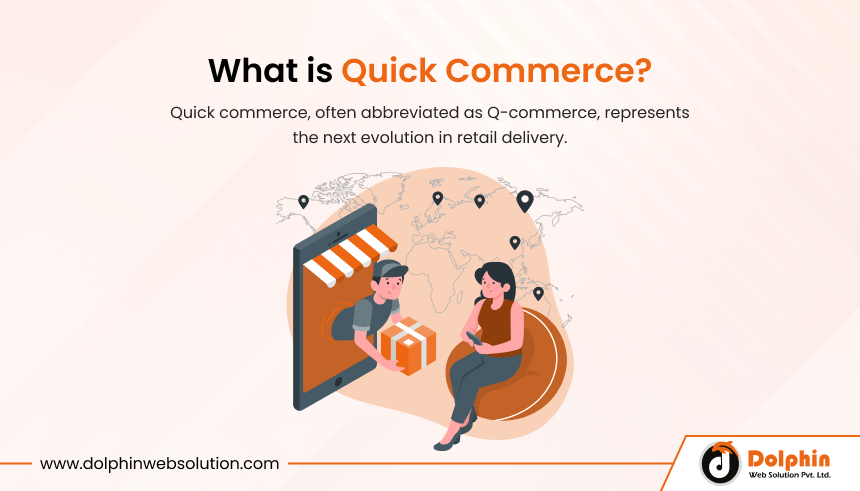
Quick commerce, often abbreviated as Q-commerce, represents the next evolution in retail delivery. Unlike traditional e-commerce where delivery windows span days, quick commerce promises delivery within 10 to 60 minutes of order placement.
Key Differentiators:
- Speed: Delivery measured in minutes, not days
- Micro-fulfillment: Dark stores and micro-warehouses positioned strategically in urban centers
- Limited SKU Selection: Focused inventory of high-demand products
- Hyperlocal Operations: Dense network of fulfillment nodes serving small geographic areas
- Real-time Coordination: Immediate inventory allocation and dispatch
The critical difference lies not just in delivery speed, but in the operational complexity required. Every minute counts, and every decision—from inventory placement to route selection—must be optimized in real-time. This is where human decision-making reaches its limits, and AI becomes essential.
Challenges in Quick Commerce Without AI
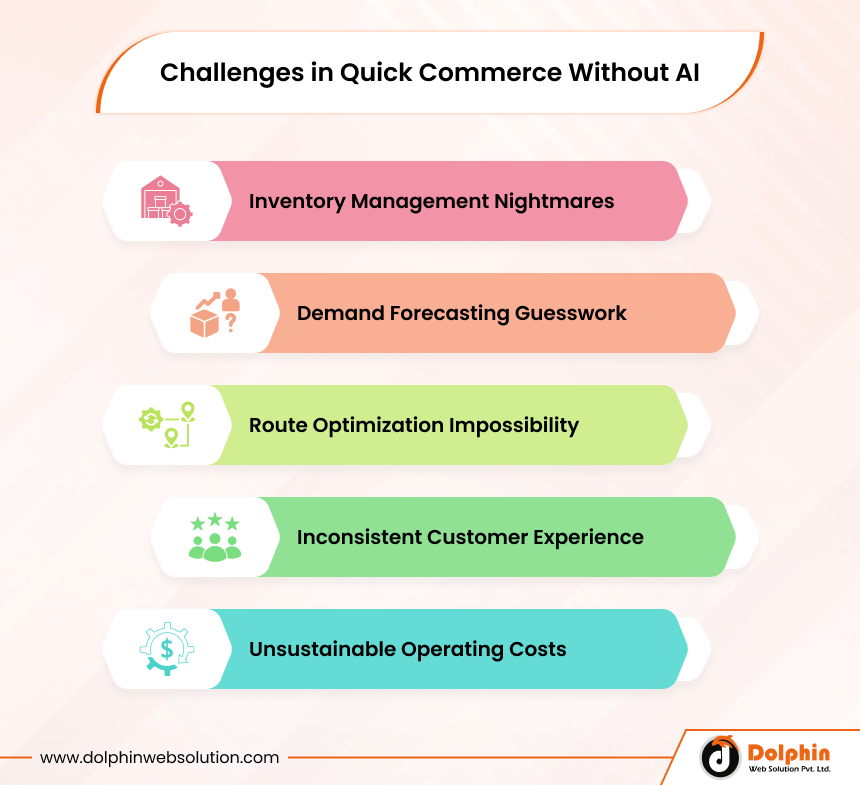
Operating a quick commerce business without AI is like navigating a maze blindfolded. Here are the critical pain points:
1. Inventory Management Nightmares
In quick commerce, stockouts mean lost customers forever. With inventory spread across dozens of micro-warehouses, maintaining optimal stock levels becomes exponentially complex.
Traditional inventory systems that work for weekly restocking cycles fail spectacularly when you need real-time visibility across 50 locations.
A study by IHL Group found that retailers lose $1.77 trillion annually due to inventory distortion—overstocks and out-of-stocks. In quick commerce, where margins are razor-thin and delivery windows are measured in minutes, these losses can be catastrophic.
2. Demand Forecasting Guesswork
Consumer demand in quick commerce fluctuates wildly based on weather, events, time of day, holidays, and countless other variables. Traditional forecasting models that analyze monthly or weekly patterns are useless when you need to predict demand for the next two hours in a specific 2-kilometer radius.
3. Route Optimization Impossibility
When you’re juggling 200 orders per hour across 15 delivery personnel in traffic-congested urban areas, finding optimal routes manually is impossible. Even a few minutes of inefficiency per delivery can destroy profitability and customer satisfaction.
4. Inconsistent Customer Experience
Without AI-driven personalization, every customer gets the same generic experience. You miss opportunities to recommend complementary products, predict reorder timing, or customize communication—all critical for customer retention in a competitive market.
5. Unsustainable Operating Costs
Manual operations mean more staff, more errors, more waste, and ultimately, unsustainable cost structures. Many quick commerce startups have failed not because of lack of demand, but because their operational costs exceeded revenue.
How AI is Revolutionizing Quick Commerce
AI isn’t just improving quick commerce—it’s making it viable. Here’s how:
1. AI-Driven Demand Forecasting
Modern AI algorithms analyze thousands of variables simultaneously—historical sales data, weather patterns, local events, social media trends, traffic conditions, and even TV programming schedules—to predict demand with remarkable accuracy.
Real-world Impact: Leading quick commerce platforms using AI demand forecasting have achieved 92-95% forecast accuracy at the SKU-location-hour level, compared to 70-75% with traditional methods. This translates directly to reduced waste and fewer stockouts.
Machine learning models continuously learn and adapt, improving predictions over time. They can identify subtle patterns invisible to human analysts, like how rainfall increases ice cream orders (yes, really—comfort eating is a thing) or how sports events drive specific beverage purchases.
2. Smart Inventory Management
AI-powered inventory systems dynamically allocate stock across micro-warehouses based on predicted demand, ensuring products are positioned closest to likely buyers before orders even arrive.
Key Capabilities:
- Predictive Restocking: AI predicts when specific items will stock out and triggers automatic replenishment
- Dynamic Allocation: Products are moved between locations based on real-time demand patterns
- Shelf-Life Optimization: AI prioritizes distribution of perishables based on expiry dates and demand forecasts
- Safety Stock Optimization: Maintains minimum viable inventory levels while minimizing stockout risk
The result? Inventory turnover rates increase by 30-40% while stockouts decrease by up to 60%.
3. Intelligent Route Optimization
AI algorithms process real-time data—traffic conditions, order locations, delivery personnel positions, time windows, and capacity constraints—to generate optimal delivery routes in seconds.
Unlike static route planning, AI systems continuously optimize routes as new orders arrive and conditions change. They consider factors like:
- Real-time traffic and road conditions
- Delivery time windows and order priorities
- Driver efficiency patterns and capabilities
- Weather impacts on delivery speed
- Historical delivery success rates by area
Business Impact: Companies implementing AI route optimization report 25-30% reduction in delivery times and 20-25% fuel cost savings.
4. Hyper-Personalized Customer Experience
AI analyzes individual customer behavior to create personalized experiences that drive loyalty and increase order values.
Personalization Strategies:
- Predictive Recommendations: AI suggests products based on purchase history, browsing behavior, and similar customer patterns
- Smart Reorder Reminders: Predicts when customers will need refills and sends timely notifications
- Dynamic Pricing: Offers personalized promotions based on price sensitivity and purchase patterns
- Communication Optimization: Determines preferred channels and timing for customer communications
Personalization can increase repeat purchase rates by 35-40% and average order values by 15-20%.
5. Operational Automation
AI automates hundreds of micro-decisions that would otherwise require human intervention:
- Automatic order assignment to optimal fulfillment centers
- Real-time capacity management and order throttling during peak times
- Automated quality checks and fraud detection
- Dynamic pricing and promotion management
- Predictive maintenance for delivery vehicles and equipment
This automation doesn’t just reduce costs—it eliminates human error and enables operations to scale without proportional increases in management overhead.
Business Benefits: The AI Advantage
1. Faster Delivery Times
AI optimization reduces average delivery times by 20-30%, directly improving customer satisfaction and competitive positioning. When every minute matters, this advantage is crucial.
2. Reduced Operating Costs
By optimizing inventory, routes, and staffing, AI reduces operational costs by 25-35%. A typical quick commerce operation can save $2-4 per delivery through AI optimization—which at scale translates to millions in savings.
3. Real-Time Business Intelligence
AI-powered analytics provide executives with real-time insights into operations, customer behavior, and market trends. Decision-makers can identify issues and opportunities instantly rather than waiting for weekly reports.
4. Improved Customer Satisfaction
With faster deliveries, fewer stockouts, and personalized experiences, customer satisfaction scores typically increase by 30-40%. More importantly, customer lifetime value increases as AI-driven personalization builds loyalty.
5. Scalability Without Proportional Cost Increases
Perhaps the most significant benefit: AI enables businesses to scale operations without proportional increases in complexity or cost. You can expand to new markets or double order volumes without doubling management staff.
Implementation Strategies: Getting AI Right
1. Start with Data Foundation
Before implementing AI, ensure you have robust data collection and storage systems. AI is only as good as the data it learns from. Focus on capturing:
- Complete transactional data
- Customer behavior and interaction data
- Operational metrics and performance data
- External data sources (weather, traffic, events)
Phased Implementation Approach
Don’t try to implement everything at once. A recommended phased approach:
Phase 1 (Months 1-3): Implement AI demand forecasting and basic inventory optimization.
Phase 2 (Months 4-6): Add route optimization and delivery personnel assignment.
Phase 3 (Months 7-9): Implement customer personalization and recommendation engines.
Phase 4 (Months 10-12): Full automation and advanced analytics.
2. Invest in Integration
AI systems must integrate seamlessly with existing platforms—order management, warehouse management, customer relationship management, and last-mile delivery systems. Prioritize integration capabilities when selecting AI solutions.
3. Build AI Literacy in Your Team
Your team needs to understand AI capabilities and limitations. Invest in training programs that help staff work alongside AI systems effectively.
4. Establish Feedback Loops
Create mechanisms for continuous learning and improvement. AI systems should be monitored, evaluated, and refined based on real-world performance.
5. Partner with Experts
Quick commerce AI implementation is complex. Partner with experienced technology providers who understand both AI and quick commerce operations.
Common Pitfalls and How to Avoid Them
Pitfall 1: Treating AI as a Magic Solution
The Mistake: Expecting AI to solve all problems instantly without proper implementation and change management.
How to Avoid: Set realistic expectations. Understand that AI requires time to learn, data to train on, and human oversight to succeed. Focus on specific use cases with measurable outcomes.
Pitfall 2: Ignoring Change Management
The Mistake: Implementing AI without preparing your team for new workflows and processes.
How to Avoid: Invest heavily in change management. Communicate clearly about how AI will augment (not replace) human decision-making. Provide comprehensive training and support.
Pitfall 3: Data Quality Neglect
The Mistake: Feeding AI systems with incomplete or inaccurate data.
How to Avoid: Establish data quality standards and governance processes. Regularly audit data accuracy. Remember: garbage in, garbage out.
Pitfall 4: Lack of Integration
The Mistake: Implementing AI as a standalone tool disconnected from core operations.
How to Avoid: Ensure comprehensive integration with existing systems. AI insights should flow automatically into operational workflows.
Pitfall 5: Insufficient Governance and Ethics
The Mistake: Implementing AI without proper governance frameworks or consideration of ethical implications.
How to Avoid: Establish clear governance policies. Consider privacy, fairness, and transparency in all AI implementations. Ensure compliance with relevant regulations.
Conclusion: The AI-Powered Future of Quick Commerce
Quick commerce isn’t a trend—it’s the new standard for retail delivery. But succeeding in this space requires more than speed; it requires intelligence.
Artificial Intelligence transforms quick commerce from a logistical nightmare into a competitive advantage. It enables businesses to predict demand, optimize operations, personalize experiences, and scale efficiently—all while maintaining profitability. To fully leverage these capabilities, many businesses now hire eCommerce developers who can integrate AI-driven solutions, streamline digital infrastructure, and enhance user experience across platforms.
The question isn’t whether to implement AI in your quick commerce operations, but how quickly you can get started. Every day of delay represents lost opportunities, dissatisfied customers, and competitive ground surrendered to more agile competitors.

Frequently Asked Questions
How long does it take to implement AI in quick commerce operations?
Implementation timelines vary based on business size and complexity, but most organizations see initial results within 3-4 months. A phased approach allows you to realize benefits progressively while building toward comprehensive AI integration over 9-12 months.
What's the typical ROI for AI in quick commerce?
Most businesses achieve ROI within 6-9 months. Typical benefits include 25-35% reduction in operational costs, 30-40% improvement in delivery efficiency, and 20-25% increase in customer retention—all contributing to rapid payback of AI investments.
Do we need to replace our existing systems to implement AI?
No. Modern AI solutions integrate with existing platforms through APIs and data connections. The goal is to enhance your current technology stack, not replace it entirely. However, some legacy systems may require upgrades to support effective integration.
How does AI handle unexpected disruptions like weather events or traffic incidents
AI systems excel at handling disruptions because they process real-time data and can rapidly reoptimize operations. When unexpected events occur, AI immediately adjusts demand forecasts, reroutes deliveries, and reallocates inventory based on changing conditions—much faster and more effectively than human operators could manage.
What data do we need to get started with AI in quick commerce?
Essential data includes historical order data, inventory levels, delivery performance metrics, customer information, and operational costs. Even if your data isn't perfect, AI can start providing value and improve as data quality improves. The key is starting with what you have and building data capabilities progressively.
Jigar Shah


Jigar Shah serves as the Chief Operating Officer of Dolphin Web Solution, overseeing business operations, project delivery, client success, and organizational growth initiatives. With more than 15 years of experience in the IT and digital services industry, he plays a vital role in ensuring operational excellence and delivering exceptional outcomes for global clients. His expertise spans strategic planning, project management, process optimization, resource management, and technology operations. Jigar has successfully managed complex eCommerce, AI, web, and mobile application projects while building scalable processes that support sustainable business growth. Passionate about leadership and continuous improvement, Jigar focuses on creating efficient systems, empowering teams, and maintaining the highest standards of quality. He frequently shares perspectives on digital transformation, project execution, operational efficiency, and business growth strategies.

We can help you with
- Dedicated Team
- Setup Extended Team
- Product Development
- Custom App Development
Our Offices

AHMEDABAD (INDIA)
B- 203-206, Empire Business Hub, Science City Road, Sola, Ahmedabad – 380060

BERLIN (GERMANY)
Badensche Str. 28, 10715 Berlin, Germany

CALIFORNIA (USA)
9601 Reseda Blvd, Apt#223, Northridge CA-91324, USA

ALBERTA (CANADA)
302 Skyview Ranch Drive NE, Calgary, Alberta, Canada T3N0P5





Hello!
Click one of our contacts below to chat on WhatsApp