
-
Dolphin Web SolutionArtificial IntelligenceArtificial Intelligence in Automotive: Benefits, Challenges, and Trends
 15 Min Read
Artificial Intelligence in Automotive: Benefits, Challenges, and Trends


Table of Contents
 Show
Show

Summary :
Artificial intelligence is reshaping the automotive industry with smarter safety features, automation, and improved efficiency. Though challenges like high costs and data security remain, AI continues to drive major trends such as autonomous driving and smart mobility, shaping the future of transportation.
The automotive industry is experiencing a technological revolution unlike anything seen since the invention of the assembly line. At the heart of this transformation lies Artificial Intelligence (AI)—a powerful force reshaping how vehicles are designed, manufactured, operated, and experienced. From self-driving cars navigating city streets to predictive maintenance systems that prevent breakdowns before they happen, AI in the automotive industry is no longer a futuristic concept—it’s today’s reality.
AI encompasses machine learning algorithms, neural networks, computer vision, natural language processing, and deep learning technologies that enable vehicles and manufacturing systems to learn, adapt, and make intelligent decisions. This game-changing technology is revolutionizing every aspect of the automotive ecosystem: streamlining production lines, enhancing vehicle safety, personalizing driver experiences, and paving the way for fully autonomous vehicles. As we stand on the brink of a mobility revolution, understanding AI’s role in automotive is essential for businesses, consumers, and anyone invested in the future of transportation.
The Transformative Benefits of AI in Automotive
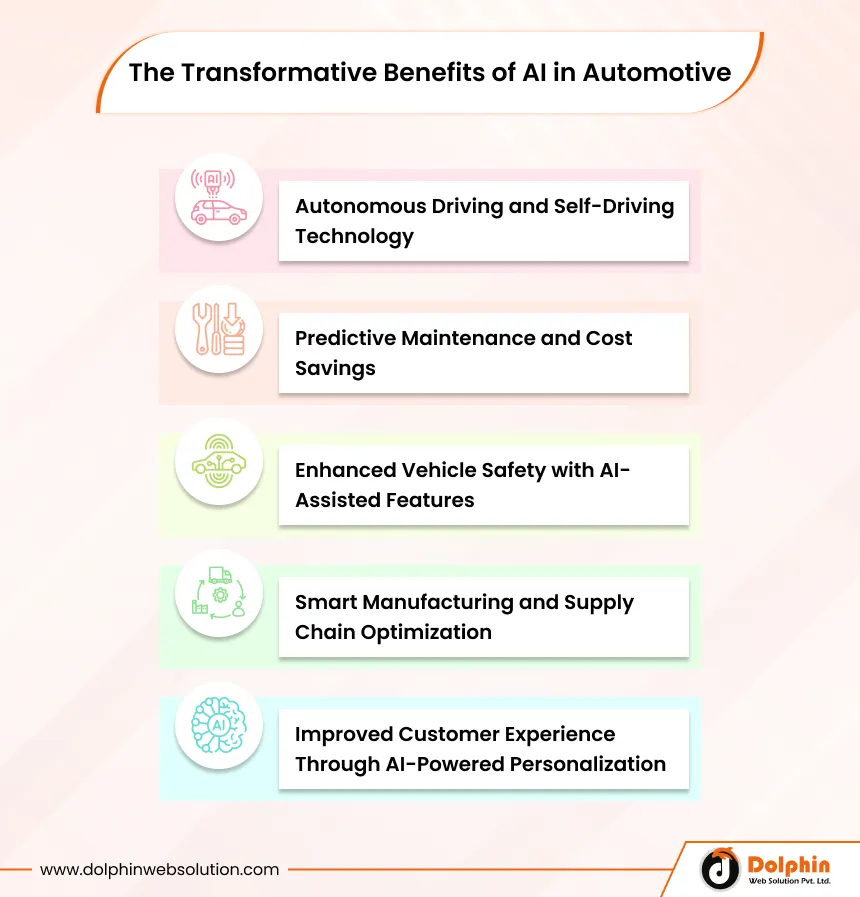
1. Autonomous Driving and Self-Driving Technology
Perhaps the most visible application of AI in automotive is autonomous driving. AI-powered automotive solutions utilize sophisticated sensor fusion, combining data from cameras, LiDAR, radar, and ultrasonic sensors to create a comprehensive understanding of the vehicle’s environment. Machine learning algorithms process this information in real-time, enabling vehicles to recognize objects, predict pedestrian behavior, navigate complex traffic scenarios, and make split-second decisions.
Companies like Waymo have logged over 20 million autonomous miles on public roads, while Tesla’s Autopilot system has accumulated billions of miles of real-world driving data. These systems continuously learn and improve, making autonomous vehicles increasingly capable. The benefits extend beyond convenience—autonomous vehicles promise to reduce the 94% of accidents caused by human error, potentially saving thousands of lives annually.
2. Predictive Maintenance and Cost Savings
AI-driven predictive analytics are transforming vehicle maintenance from reactive to proactive. Smart cars equipped with IoT sensors continuously monitor hundreds of parameters—engine performance, brake wear, tire pressure, battery health, and more. Machine learning algorithms analyze this data to predict component failures before they occur, alerting drivers and service centers to potential issues.
BMW’s ConnectedDrive system exemplifies this technology, providing real-time vehicle health monitoring and predictive maintenance alerts. This approach reduces unexpected breakdowns by up to 70%, minimizes repair costs, and extends vehicle lifespan. For fleet operators, predictive maintenance translates to significant operational savings—studies suggest companies can reduce maintenance costs by 25-30% while improving vehicle uptime by 20%.
3. Enhanced Vehicle Safety with AI-Assisted Features
AI is making vehicles safer than ever through advanced driver assistance systems (ADAS). These AI-powered features include:
- Automatic Emergency Braking: AI systems detect imminent collisions and apply brakes faster than human reflexes allow
- Lane Keeping Assistance: Computer vision monitors road markings and gently corrects steering to prevent unintended lane departures
- Blind Spot Detection: AI algorithms track vehicles in blind spots and warn drivers of potential hazards
- Adaptive Cruise Control: Machine learning adjusts vehicle speed based on traffic conditions, maintaining safe following distances
- Driver Drowsiness Detection: Facial recognition and behavioral analysis identify signs of fatigue and alert drivers
The Insurance Institute for Highway Safety reports that vehicles equipped with forward collision warning and automatic emergency braking reduce rear-end crashes by 50%. These technologies are saving lives today while paving the way for fully autonomous safety systems tomorrow.
4. Smart Manufacturing and Supply Chain Optimization
AI is revolutionizing automotive manufacturing through intelligent automation and optimization. Computer vision systems perform quality inspections with 99.9% accuracy, detecting defects invisible to human inspectors. AI-powered robots collaborate with human workers, handling repetitive or dangerous tasks while adapting to changes in real-time.
Beyond the factory floor, AI optimizes entire supply chains. Machine learning algorithms forecast demand, optimize inventory levels, and predict supply disruptions before they impact production. Ford uses AI to analyze data from over 100 manufacturing plants globally, reducing production delays and minimizing waste. This smart manufacturing approach increases efficiency by 20-40% while reducing operational costs significantly.
5. Improved Customer Experience Through AI-Powered Personalization
Connected vehicles are becoming personalized digital experiences. AI-powered infotainment systems learn driver preferences—favorite routes, preferred cabin temperature, entertainment choices, and more. Natural language processing enables voice assistants that understand context and conversational language, making vehicle interaction seamless and intuitive.
Mercedes-Benz’s MBUX system uses AI to create a personalized driving experience, learning from user behavior to anticipate needs. The system can suggest restaurants along your route, adjust climate settings based on time of day, and even recognize different drivers’ preferences. This personalization extends to insurance—usage-based insurance programs use AI to analyze driving behavior, rewarding safe drivers with lower premiums.
Navigating the Challenges of AI in Automotive
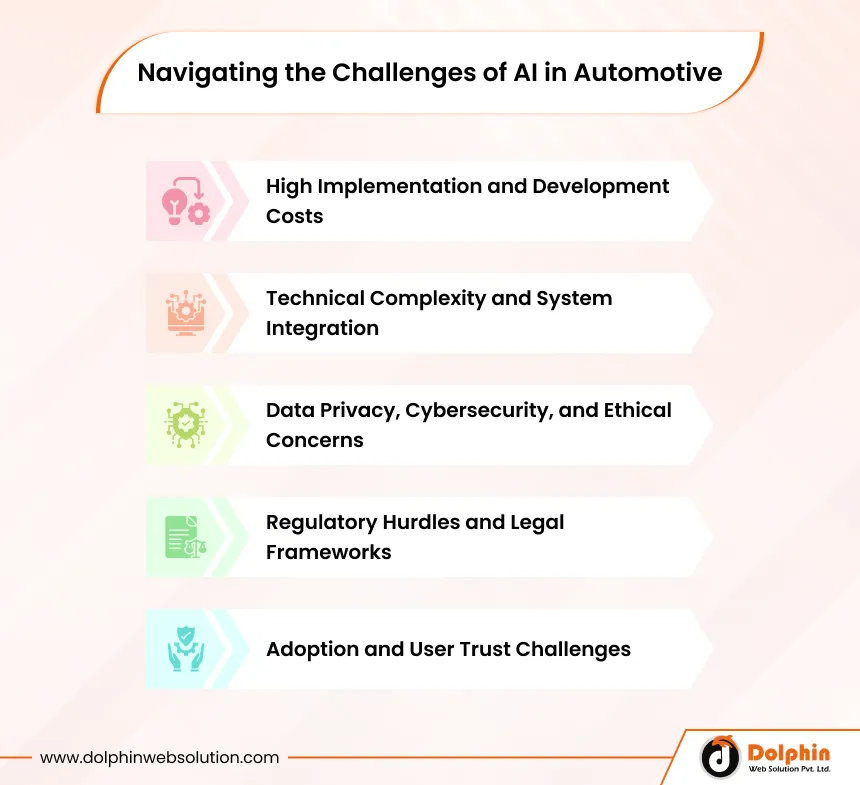
1. High Implementation and Development Costs
Developing AI-powered automotive solutions requires substantial investment. The technology stack includes expensive sensors (a single LiDAR unit can cost $75,000+), powerful computing hardware, extensive data infrastructure, and specialized talent. Research and development costs for autonomous vehicle programs can exceed billions of dollars, making AI adoption particularly challenging for smaller manufacturers.
Additionally, the infrastructure required to support AI systems—high-definition mapping, 5G connectivity, cloud computing resources—represents a significant ongoing expense. While costs are decreasing as technology matures, the initial investment barrier remains substantial for many companies in the automotive industry.
2. Technical Complexity and System Integration
Integrating AI into automotive systems presents formidable technical challenges. Autonomous vehicles must process terabytes of sensor data in real-time, requiring computing power equivalent to hundreds of high-end laptops—all while consuming minimal power and operating reliably in extreme temperatures.
Legacy automotive systems weren’t designed for AI integration, creating compatibility challenges. Manufacturers must balance innovation with reliability, ensuring AI systems perform flawlessly across millions of driving scenarios. The “edge cases”—rare but critical situations AI must handle correctly—are particularly challenging. A self-driving car might perform excellently in normal conditions but struggle with unusual scenarios like construction zones, hand signals from police officers, or severe weather conditions.
3. Data Privacy, Cybersecurity, and Ethical Concerns
Connected vehicles generate massive amounts of data—location history, driving patterns, personal preferences, and more. This raises significant privacy concerns. Who owns this data? How is it protected? Can it be sold to third parties? Consumers and regulators are increasingly scrutinizing data practices in the automotive industry.
Cybersecurity presents another critical challenge. As vehicles become more connected, they become potential targets for hackers. A compromised autonomous vehicle isn’t just a privacy breach—it’s a safety risk. The automotive industry must implement robust cybersecurity measures, but this remains an evolving challenge as attack methods become more sophisticated.
Ethical dilemmas also arise with AI decision-making. In an unavoidable accident scenario, how should an autonomous vehicle prioritize safety? These “trolley problem” scenarios require societal consensus and careful ethical frameworks that technology alone cannot resolve.
4. Regulatory Hurdles and Legal Frameworks
The regulatory landscape for AI in automotive is complex and fragmented. Different countries and regions have varying standards for autonomous vehicle testing, data collection, and safety requirements. This patchwork of regulations complicates global deployment and increases compliance costs.
Legal questions abound: Who is liable in an accident involving an autonomous vehicle—the manufacturer, the software developer, or the human occupant? How should insurance models adapt? Current legal frameworks weren’t designed for AI-driven vehicles, and regulatory bodies are struggling to keep pace with technological advancement. Until clear, harmonized regulations emerge, AI adoption in automotive will face significant friction.
5. Adoption and User Trust Challenges
Despite technological progress, many consumers remain skeptical of autonomous vehicles. Surveys indicate that 50-70% of drivers express discomfort with fully self-driving cars. High-profile accidents involving autonomous vehicles, though statistically rare, receive outsized media attention and erode public trust.
Building trust requires transparency, extensive real-world testing, and gradual introduction of AI capabilities. Manufacturers must educate consumers about AI benefits while acknowledging limitations. The transition to AI-powered automotive solutions will be evolutionary, not revolutionary, as trust is earned through consistent performance and safety records.
Current and Emerging Trends in AI Automotive Technology
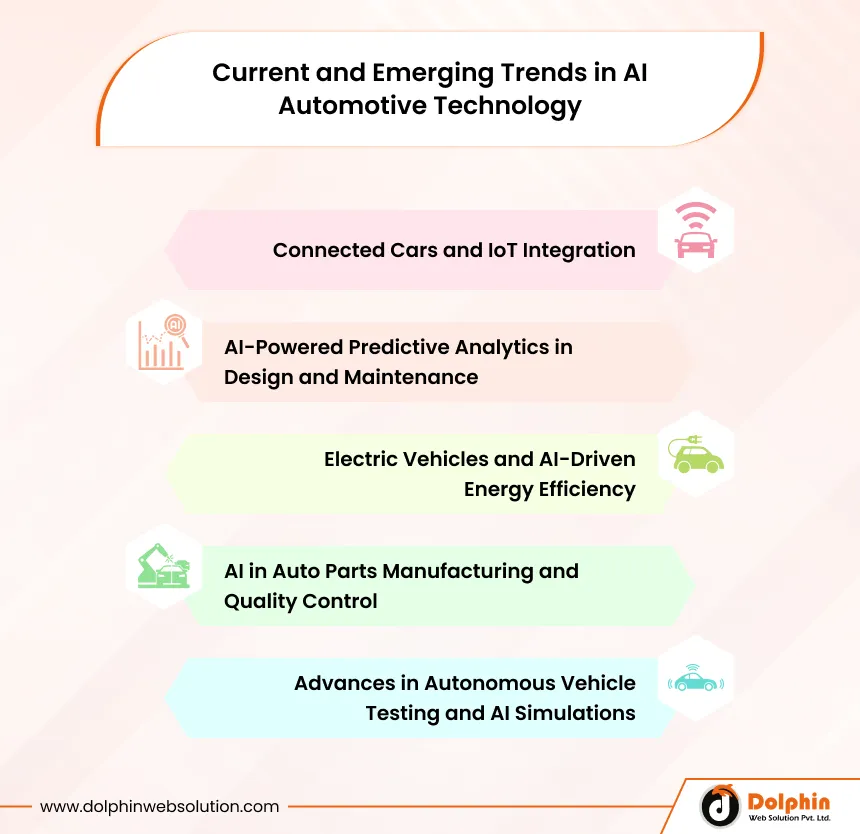
1. Connected Cars and IoT Integration
The future of automotive technology lies in connectivity. Modern vehicles are IoT devices on wheels, communicating with other vehicles (V2V), infrastructure (V2I), pedestrians (V2P), and cloud networks (V2C). This connectivity enables cooperative driving—vehicles sharing information about road conditions, traffic, and hazards to improve safety and efficiency.
5G networks are accelerating this trend, providing the low-latency, high-bandwidth connections necessary for real-time communication. By 2030, experts predict over 750 million connected vehicles will be on roads globally, creating unprecedented opportunities for AI-driven services and applications.
2. AI-Powered Predictive Analytics in Design and Maintenance
Generative AI is revolutionizing automotive design. Engineers use AI to explore thousands of design variations, optimizing for aerodynamics, weight reduction, and structural integrity. These AI-generated designs often surpass human-created alternatives, resulting in more efficient, safer vehicles.
In maintenance, AI analyzes warranty claims, service records, and sensor data across millions of vehicles to identify systemic issues and design improvements. This feedback loop accelerates innovation and improves quality across entire product lines.
3. Electric Vehicles and AI-Driven Energy Efficiency
AI and electric vehicles are natural partners. Machine learning algorithms optimize battery management, extending range by predicting optimal charging patterns, managing thermal systems, and adapting energy consumption based on driving conditions and route planning.
Tesla’s AI analyzes driving patterns to maximize efficiency, while systems like Audi’s predictive efficiency assistant use navigation data and traffic information to recommend optimal speeds and when to coast or regenerate energy. As EV adoption accelerates, AI will be crucial in addressing range anxiety and optimizing charging infrastructure.
4. AI in Auto Parts Manufacturing and Quality Control
AI is transforming auto parts manufacturing through intelligent quality control and process optimization. Computer vision systems inspect components with superhuman precision, while machine learning algorithms optimize production parameters in real-time to minimize defects.
Predictive maintenance in manufacturing equipment reduces downtime—AI analyzes vibration patterns, temperature data, and production metrics to predict equipment failures before they occur. This approach increases production efficiency by 20-25% while reducing waste and quality issues.
5. Advances in Autonomous Vehicle Testing and AI Simulations
Physical testing alone cannot cover the billions of scenarios autonomous vehicles must handle. AI-powered simulations enable virtual testing at unprecedented scale. Companies like Waymo conduct over 20 billion virtual miles annually, exposing AI systems to edge cases and dangerous scenarios impossible to safely replicate in real-world testing.
These simulations use AI to generate increasingly complex scenarios, accelerating development timelines and improving safety. Digital twins—virtual replicas of physical vehicles—allow engineers to test software updates and predict performance before deploying to actual vehicles.
Impact on Businesses and Consumers
1. Competitive Advantage Through AI Adoption
Automotive companies embracing AI are gaining significant competitive advantages. Tesla’s over-the-air updates and continuous learning capabilities have created a unique value proposition—vehicles that improve over time. Traditional manufacturers are responding aggressively, with companies like General Motors investing $35 billion in electric and autonomous vehicles through 2025.
AI enables manufacturers to differentiate through software and services rather than hardware alone. Subscription-based features, personalized experiences, and autonomous capabilities are becoming key selling points, fundamentally changing the automotive business model from one-time sales to ongoing customer relationships.
2. Benefits for Consumers: Safer, Smarter, More Personalized Vehicles
For consumers, AI translates to tangible benefits: vehicles that are safer, more convenient, and increasingly personalized. Commuters can reclaim time spent driving, productivity increases, and mobility becomes accessible to those unable to drive—elderly individuals, people with disabilities, and young people.
AI-powered features reduce stress, improve fuel efficiency, and lower ownership costs through predictive maintenance. As autonomous technology matures, the promise of eliminating traffic fatalities—which claim 1.35 million lives globally each year—comes closer to reality.
3. Industry Examples of AI Leadership
Several companies exemplify AI leadership in automotive:
- Tesla: Pioneering AI-driven autonomous capabilities and over-the-air updates, with over 400 million miles driven using Full Self-Driving beta
- Waymo: Operating commercial autonomous taxi services in multiple US cities, demonstrating real-world viability of self-driving technology
- BMW: Integrating AI across manufacturing, design, and vehicle features with their intelligent personal assistant
- Toyota: Investing heavily in AI research through the Toyota Research Institute, focusing on safety and human-machine collaboration
- Mercedes-Benz: Achieving Level 3 autonomous driving certification with their Drive Pilot system, a significant regulatory milestone
The Future Outlook: AI's Evolution in Automotive
1. The Next 5-10 Years: What to Expect
The coming decade will witness accelerating AI integration across automotive. By 2030, analysts project that Level 4 and Level 5 autonomous vehicles will comprise 15-20% of new vehicle sales in developed markets. AI-powered features will become standard rather than premium options, driving industry-wide transformation.
Edge computing will bring more AI processing directly into vehicles, reducing latency and enabling more sophisticated real-time decision-making. Quantum computing may eventually tackle the most complex optimization problems in autonomous driving and traffic management.
The automotive industry will increasingly resemble the technology sector, with software and AI capabilities determining competitive position. Traditional manufacturers partnering with tech companies will accelerate innovation, while new entrants with AI expertise will disrupt established players.
2. Shaping Mobility, Sustainability, and Urban Transportation
AI will fundamentally reshape urban mobility. Autonomous vehicle fleets—robotaxis and shared mobility services—will reduce the need for personal vehicle ownership, particularly in cities. This shift could reduce vehicles on roads by 60%, decreasing congestion, pollution, and parking requirements.
AI-optimized traffic management systems will communicate with connected vehicles to minimize congestion, reduce emissions by 20-30%, and improve urban air quality. Smart cities will integrate autonomous vehicles with public transportation, creating seamless multimodal transportation networks.
Sustainability benefits extend beyond emissions reduction. AI optimization of traffic flow reduces fuel consumption, while shared autonomous fleets maximize vehicle utilization—vehicles sitting idle 95% of the time today will be productive assets tomorrow. This efficiency could reduce the total number of vehicles needed globally while improving mobility access.
Conclusion: Embracing AI for Automotive Innovation
Artificial Intelligence is not simply another technological advancement in automotive—it represents a fundamental paradigm shift that will define mobility for generations to come. The benefits are compelling: dramatically safer roads, more efficient transportation, reduced environmental impact, and personalized experiences that enhance quality of life. While challenges around cost, regulation, cybersecurity, and trust remain significant, the trajectory is clear—AI-powered automotive solutions will become ubiquitous.
For businesses in the automotive ecosystem—manufacturers, suppliers, service providers, and technology companies—the imperative is clear: embrace AI or risk obsolescence. The competitive advantages of AI adoption are too significant to ignore, and early movers are establishing positions that will be difficult to challenge. Many companies are also exploring eCommerce Development Services and looking to hire ecommerce developer teams to support their digital transformation alongside AI. Investment in AI capabilities, partnerships with technology leaders, and a commitment to innovation are essential for long-term success.
For consumers and society, AI in automotive promises a future where transportation is safer, cleaner, more accessible, and more efficient. The road ahead requires careful navigation of technical, ethical, and regulatory challenges, but the destination—a transformed automotive industry that better serves humanity—is worth the journey.
The future of automotive technology is intelligent, connected, and autonomous. Those who recognize this reality and act decisively will lead the industry into its next era. The AI revolution in automotive has begun—the only question is how quickly we’ll accelerate toward this transformative future.

Rohit Prajapati


Rohit Prajapati is the Chief Executive Officer of Dolphin Web Solution and a recognized expert in eCommerce technologies, digital commerce strategy, and product development. With over 15 years of experience in the technology industry, he helps businesses build high-performing online stores, scalable digital platforms, and innovative customer experiences. As a certified Adobe Commerce Business Practitioner (Magento Solution Specialist), Rohit possesses deep expertise in Shopify, Magento, Shopware, Hyvä, and enterprise eCommerce ecosystems. He has successfully consulted businesses worldwide on platform selection, digital transformation, migration strategies, and growth-focused commerce solutions. Rohit regularly shares insights on eCommerce trends, AI-driven commerce, online business growth, and emerging technologies. His mission is to help organizations create future-ready digital experiences that drive measurable business outcomes and long-term success.

We can help you with
- Dedicated Team
- Setup Extended Team
- Product Development
- Custom App Development
Our Offices

AHMEDABAD (INDIA)
B- 203-206, Empire Business Hub, Science City Road, Sola, Ahmedabad – 380060

BERLIN (GERMANY)
Badensche Str. 28, 10715 Berlin, Germany

CALIFORNIA (USA)
9601 Reseda Blvd, Apt#223, Northridge CA-91324, USA

ALBERTA (CANADA)
302 Skyview Ranch Drive NE, Calgary, Alberta, Canada T3N0P5





Hello!
Click one of our contacts below to chat on WhatsApp