
-
Dolphin Web SolutionEcommerceAll You Need to Know About Auto Parts eCommerce Website Development
 15 Min Read
All You Need to Know About Auto Parts eCommerce Website Development


Table of Contents
 Show
Show

Summary :
Planning for auto parts eCommerce website development? This guide helps you explore some must-have features your website needs and its development cost so that you can plan and build a custom auto parts eCommerce website to stand out your brand.
Gone are the days when customers looked for auto parts in nearby brick-and-mortar stores. With today’s digitalization and online shopping convenience, customers prefer to order auto parts via websites at more affordable rates.
In fact, as per recent stats, online automotive parts and accessories sales are expected to reach $1,103.4 billion by 2030. It clearly shows why businesses invest in building their own auto parts website to stay competitive and accept new market changes.
Having an auto parts eCommerce website lets you sell parts to customers 24/7 around the world quickly and easily.
However, building an auto parts website isn’t as easy. It comes with various factors and complexities to consider. No worries!
If you plan to build an auto parts website, this guide is all you need.
This guide will help you understand everything about the auto parts changing market, key features your auto parts eCommerce website needs, challenges to resolve, and its estimated cost for development.
Understanding the Auto Parts Market
The auto parts market is a large and growing industry. It includes various parts and accessories that vehicles need for repair, replacement, or upgrade. Let’s break down the key areas:
1. Types of Auto Parts: OEM vs Aftermarket
There are two broad categories of parts, i.e., OEM and Aftermarket. Let’s get familiar with each other!
1. OEM Parts
These parts are produced by the same firm that made the original components in your vehicle. Replacing a part is like a brake pad with an OEM component; it will be identical to the one installed with your car.
2. Aftermarket Parts
Third-party businesses produce aftermarket parts. They are intended to be fitted in your car but are not made by the original manufacturer. They are potentially more affordable and provide greater range, e.g., upgrades and modifications.
2. B2B vs B2C in the Auto Parts Industry
The automobile parts industry operates in two main ways:
1. B2B (Business to Business)
In this B2B business model, companies like repair shops or car dealers buy car parts in bulk from car manufacturers or wholesalers. They integrate these parts into their services or resell them to clients.
2. B2C (Business to Consumer)
In the B2C model, car parts are sold directly to the end-users, normally from online stores or physical shops. These are the components that regular car owners buy to fix or enhance their vehicles.
3. Market Potential and Growth Trends
Let’s see what trends are occurring in emerging markets in the automobile sector:
- Electric and Hybrid Vehicles: More and more people are buying electric and hybrid vehicles, so there is more demand for parts like motors and batteries.
- Tech Advances: Technological advancements such as 3D printing produce and lower the price of automobile components.
- Aftermarket Expansion: With increasing numbers of people fixing and maintaining their vehicles, replacement parts become in demand.
- Customization: People want customized car parts, which offers new prospects for suppliers.
- Sustainability: Individuals increasingly insist on recycled and green parts; therefore, demand for sustainable alternatives increases.
- Changing Preferences: As the world becomes more electric and autonomous, the car parts needed are changing.
Key Features of an Auto Parts eCommerce Website
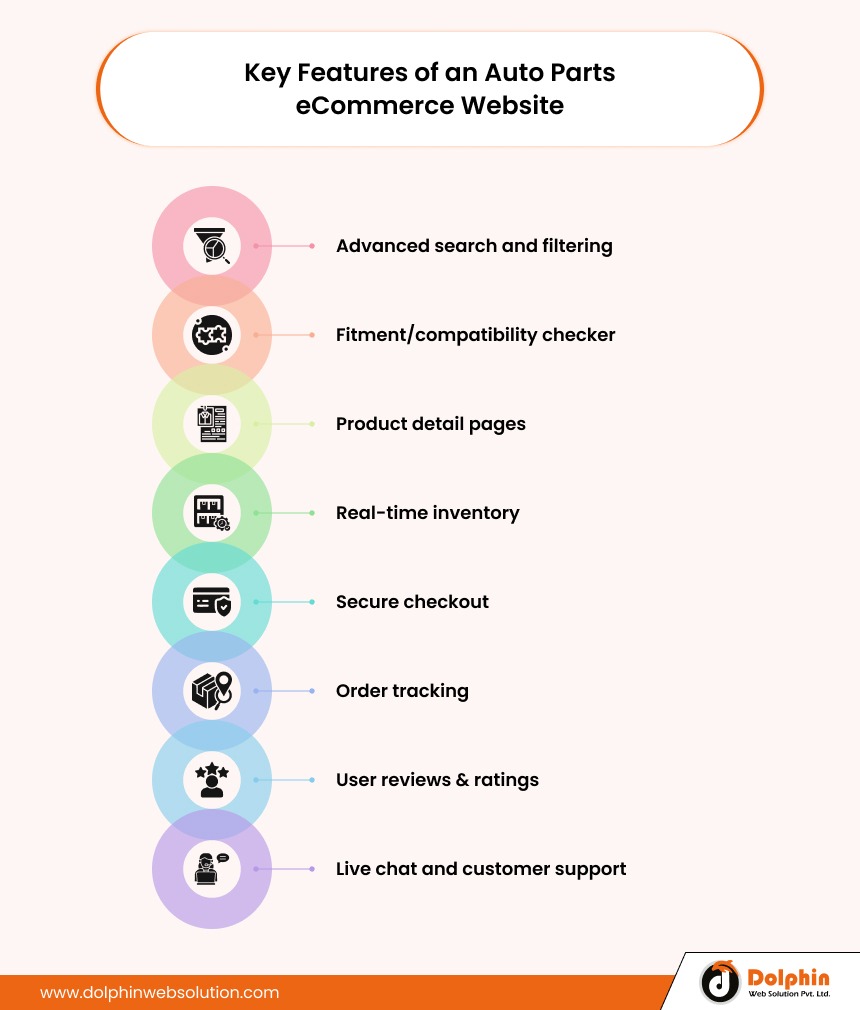
Following are some essential features of an auto parts eCommerce website:
1. Advanced search and filtering (by make, model, year)
An easy search function enables customers to find the parts they need quickly. They can enter their vehicle’s make, model, and year to rule out parts that will not fit. This is handy and saves them from buying the wrong part accidentally.
2. Fitment/compatibility checker
A fitment checker is similar to someone checking if the part would fit their vehicle. Customers can provide details such as the make and model of the car, and the website will inform them if the part fits.
3. Product detail pages with specs, diagrams, and guides
Clean product pages are crucial. Every detail should contain full information, including specs, images, and installation instructions. This informs customers what they are going to get.
4. Real-time inventory and stock updates
Real-time stock status shows if a part is in stock or not. The customers know the stock status before ordering, so it is no surprise. They will be informed if a part is out of stock.
5. Secure checkout & multiple payment gateways
A safe checkout is required to secure customer details. It also makes the customers feel more comfortable buying. Different payment options (like credit cards, PayPal, etc.) allow customers to choose how they pay.
6. Order tracking and customer history
Order tracking lets customers see where their package is and when it will arrive. It also allows them to see their previous orders so they can reorder easily.
7. User reviews & ratings
Other customers’ reviews and ratings are completely significant. They show how the product performs and how it fits. Good reviews encourage new buyers to feel more at ease with their purchase.
8. Live chat and customer support features
Good customer service creates trust and loyalty, so the company is concerned with meeting customers’ needs. Some ways of reaching support are live chat, email, or phone.
Choosing the Right Tech Stack
Here are some popular tech stack that helps your business grow online:
1. Magento (with Hyvä)
Magento is a strong platform for large corporations that require an individual site. It works wonderfully for lots of products, such as automobile accessories. Yet it’s not straightforward to set up, and you’ll have to hire high-end developers to create and administer it.
2. Shopify
Shopify is very easy to use. It’s ideal for small and medium businesses that need quick store setups with no technical issues. Shopify does everything for you, though; you can’t tailor it as you can with Magento.
3. WooCommerce
WooCommerce is a WordPress plugin that turns your website into an online store. It is a good use if you have already hosted your website on WordPress. It is free to install and is versatile.
4. BigCommerce
BigCommerce is like Shopify but with additional built-in functionality. It’s perfect for expanding businesses with many products and companies that require tools for improved inventory management, SEO, and selling across multiple channels (e.g., Amazon).
Custom Development vs. Ready-Made Platforms
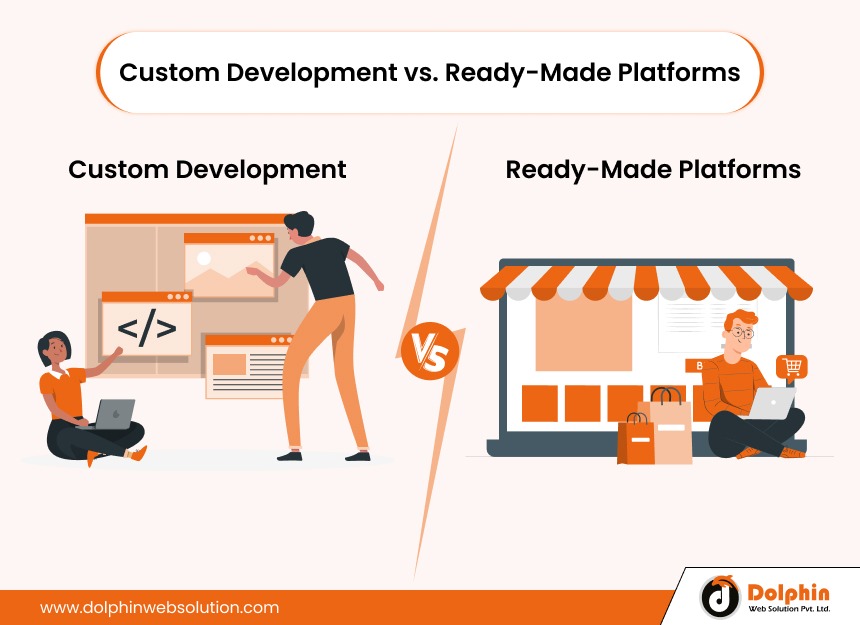
Let’s examine the differences to help you decide between custom vs template website development:
Custom Development is building your site from scratch to your specifications. You get to decide exactly what everything looks like and does. This is ideal if you require special functionality or have special needs.
Ready-made platforms (such as Shopify or WooCommerce) are pre-existing sites you can customize to suit your requirements. They are easy to install and significantly less expensive than custom development. Such sites, however, might have restricted features or design freedom.
Challenges and Solutions
Here are some key challenges and their solutions:
1. Handling Large and Complex Product Catalogs
Customers cannot find what they need when you have so many products.
Solution :To resolve this, group your catalog into concise categories and implement filters by make, model, and year. This way, customers can quickly locate the appropriate part for their car.
2. Managing Returns and Mismatched Parts
Customers sometimes purchase non-compatible vehicle components, resulting in returns or customer dissatisfaction.
Solution : Avoid this by including a fitment checker that assures customers that the part they bought will fit their car. A clear return policy that can be easily communicated also makes consumers more confident and less irritable.
3. Optimizing Site Speed for Mobile
If your mobile site is slow, customers will leave before they make a purchase
Solution :To do better, make sure your website is fast and mobile-friendly. You can accomplish this by compressing images and hosting on a fast host.
4. Reducing Cart Abandonment Rates
Cart abandonment happens when shoppers add items but do not complete the purchase because of high shipping charges or a difficult checkout process that dissuades them.
Solution :To address this, make the checkout process simpler, display transparent shipping fees in advance, and send reminder messages such as emails or SMS to remind them to make the purchase.
Estimated Development Cost and Timeline
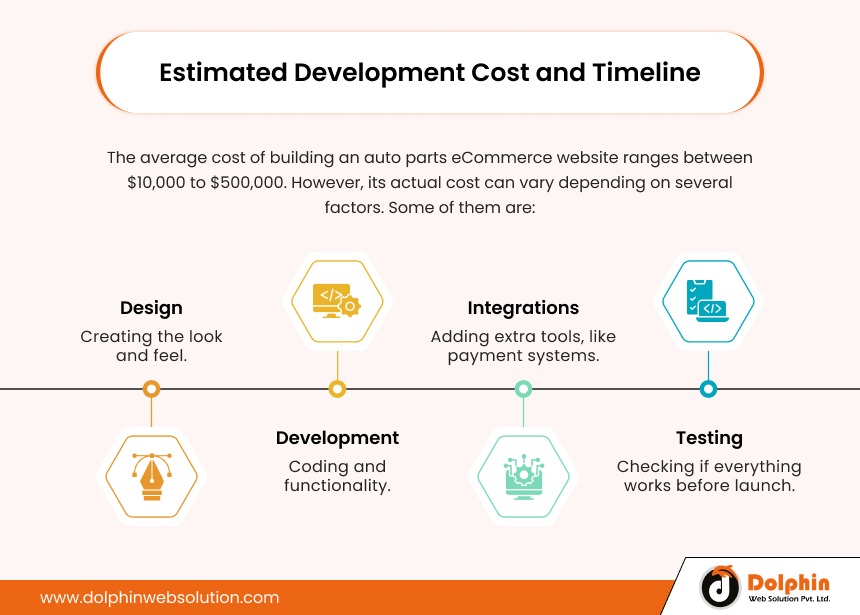
The average cost of building an auto parts eCommerce website ranges between $10,000 to $500,000. However, its actual cost can vary depending on several factors. Some of them are:
- Design: Creating the look and feel
- Development: Coding and functionality.
- Integrations: Adding extra tools, like payment systems.
- Testing: Checking if everything works before launch.
MVP vs Full-Featured Website Timeline
MVP (Minimum Viable Product): Takes 2-4 months. It’s a basic version with the essential features to start quickly.
Full-Featured Website: Takes 6-24 months. It includes all the advanced features and a polished design, which takes more time to develop.
Conclusion
Building a successful auto parts eCommerce website is a great way to reach customers in the growing online automotive market. By focusing on our listed key features and the right technology, you can build a tailored auto parts website that can stand out in today’s competitive world.
We hope this guide helps you understand the auto parts industry, some key features your website needs, and the cost of development to build a successful auto parts eCommerce website for your business in the long term.
Need help building your auto parts website? Contact Us for a free consultation.

Nimesh Patel


Nimesh Patel is the Managing Director of Dolphin Web Solution, a global eCommerce, AI, and software development company helping businesses accelerate digital growth. With over 15 years of experience in technology consulting and product development, he has successfully guided startups, SMBs, and enterprise organizations in building scalable digital solutions. Nimesh specializes in eCommerce development, custom software solutions, mobile application development, and digital transformation strategies. Throughout his career, he has worked closely with businesses across retail, healthcare, automotive, manufacturing, and technology sectors, helping them leverage modern technologies to improve operational efficiency and customer experiences. As a business leader, Nimesh is passionate about innovation, entrepreneurship, and helping organizations turn ideas into successful digital products. His insights focus on eCommerce growth, AI adoption, software development trends, and business transformation through technology.

We can help you with
- Dedicated Team
- Setup Extended Team
- Product Development
- Custom App Development
Our Offices

AHMEDABAD (INDIA)
B- 203-206, Empire Business Hub, Science City Road, Sola, Ahmedabad – 380060

BERLIN (GERMANY)
Badensche Str. 28, 10715 Berlin, Germany

CALIFORNIA (USA)
9601 Reseda Blvd, Apt#223, Northridge CA-91324, USA

ALBERTA (CANADA)
302 Skyview Ranch Drive NE, Calgary, Alberta, Canada T3N0P5





Hello!
Click one of our contacts below to chat on WhatsApp