
-
Dolphin Web SolutionEcommerceAuto Parts eCommerce Website: Cost & Key Features
 15 Min
Auto Parts eCommerce Website: Cost & Key Features


Table of Contents
 Show
Show

Summary :
Building an auto parts eCommerce website involves several factors. This blog covers the key features that your website needs to stand out and its estimated development cost so that you can plan and build a successful auto parts website.
E-commerce has revolutionized various industries. One great example is the automotive industry, which is booming rapidly and offers car lovers the convenience of quickly finding and purchasing car components at an online store.
As per recent stats, the global automotive eCommerce industry will reach $343.13 billion by 2032 with a CAGR of 16.6%. It clearly shows how fast the automotive industry is adapting to digitalization.
Nowadays, every auto part store plans to take their business online to sell car components.
So the question is – How does your online store stand out?
Choosing the right features for your auto part eCommerce website can set your store apart.
However, there are thousands of features in the market, and picking the essential ones can be challenging.
In this blog, we’ll explore the top 10+ features that your online store must have and the estimated cost to develop an auto parts eCommerce website.
So, without any further delay, let’s dive in!
Top Features to Include in an Auto Parts eCommerce Website
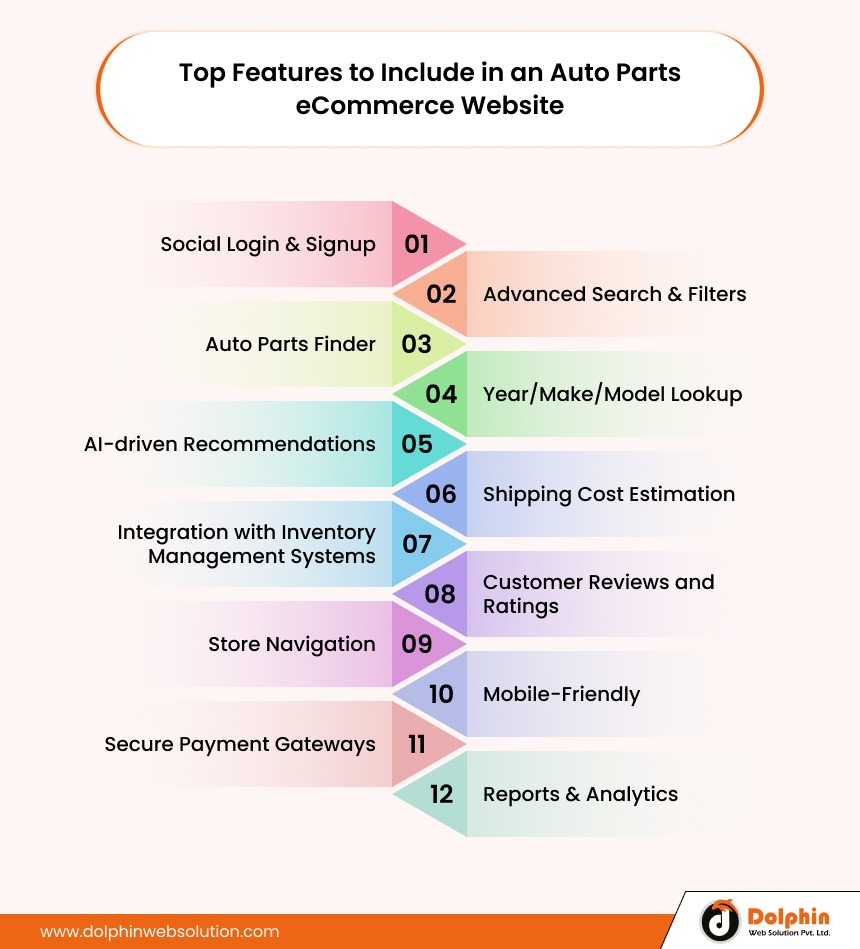
Here are some must-have features of an auto part eCommerce website:
1. Social Login & Signup
Social signup and login are likely the most essential features of all auto parts websites. Social login lets users log in with pre-existing social media accounts like Google or Facebook. This is crucial since it prevents the inconvenience of remembering yet another password or completing lengthy registration forms. It brings customers directly to your site, where they can browse the products and make purchasing decisions.
2. Advanced Search & Filters
The second most important feature is filters and search. It allows customers to get exactly what they need by narrowing down results based on criteria like brand, price, or automobile specifications. Since it saves users time and frustration, customers can narrow their selection and discover the perfect part in seconds instead of navigating through page after page of products.
3. Auto Parts Finder
An Auto Parts Finder tool is a game changer for customers. It lets them search for specific parts by entering their vehicle details, such as make, model, and year. This ensures that customers find only compatible parts for their vehicles and minimizes the chances of making a mistake in their purchase.
4. Year/Make/Model Lookup
Compatibility is key when buying auto parts. Customers often struggle to ensure the parts they purchase will fit their vehicle. The Year/Make/Model lookup feature removes this uncertainty by showing only the parts guaranteed to work with their car. It improves confidence in the purchase, which means fewer returns and happier customers.
5. AI-driven Recommendations
Another powerful feature that can increase your sales is AI-based recommendations. Customers love personalized shopping experiences. Based on browsing or purchase history, AI-based recommendations show users relevant parts they might need or be interested in. This makes shopping more efficient and increases the chances of additional purchases.
6. Shipping Cost Estimation
Shipping estimate is a critical feature that keeps customers in the know. Displaying real-time shipping rates based on the customer’s location avoids surprises at the checkout process. Customers appreciate knowing the full cost upfront, saving customers from leaving their carts behind and reducing cart abandonment.
7. Integration with Inventory Management Systems
Your site integration with an inventory management system is crucial to maintaining smooth operations. This feature updates your stock levels in real-time so that you only sell available items to your customers. This is critical because it will ensure you never undersell or oversell products. It enables effective stock management, enhances order fulfillment, avoids potential customer dissatisfaction, and synchronizes with vendors.
8. Customer Reviews and Ratings
Humans believe in other humans’ opinions. Customer reviews and ratings are social proof that your products are good and trustworthy. Positive reviews help people trust you more and enable them to make better buying decisions. This is an essential feature because positive reviews create social proof, which makes other humans trust your products.
9. Store Navigation
Make your auto parts website simple to use with minimal navigation. Sometimes, customers visit a website but leave due to too many choices. So, keep your website interface simple, easy to use, and clean so customers can quickly find the product they are looking for and pay for it.
10. Mobile-Friendly
Billions of consumers now shop online from their smartphones. If your site is not mobile-optimized, you lose massive revenue—a mobile-optimized website positions your eCommerce site to be easily readable and accessible on every tablet and smartphone.
11. Secure Payment Gateways
Security is most likely the biggest concern for online consumers. Having a secure payment gateway assures customers that their personal and credit card information is protected from hackers. The worth of secure payment systems is to gain credibility with your consumers. They will likely purchase and return to your website when they believe their financial and personal data is safe.
12. Reports & Analytics
These analytical tools give you an idea of how your eCommerce website performs. They monitor significant metrics such as sales, customer behavior, inventory, and website traffic. This is a beneficial feature because it informs you what is performing well and what is not. So that customers can make the right decisions.
Cost of Developing an Auto Parts eCommerce Website
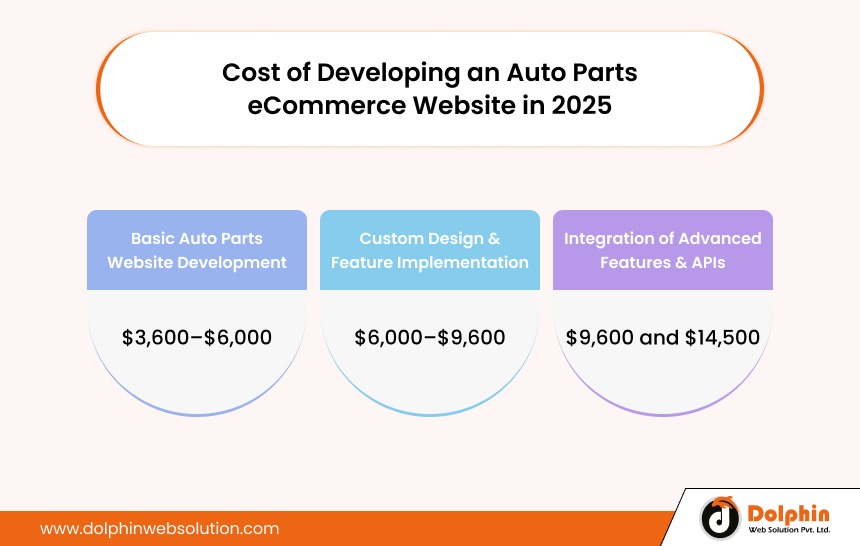
The cost of building an auto parts eCommerce site is dependent on the complexity of the site. The approximate cost breakdown is as follows:
1. Basic Auto Parts Website Development
If you’re a new business owner who needs a simple auto parts website with minimal functions like product listing, shopping cart, and secure payment gateways, it will cost you $3,600–$6,000. It’s a starter package with the minimal requirements to get your online store up and running.
2. Custom Design & Feature Implementation
If you want your site to be different with a custom, branded appearance and need additional functionality, such as better search or a custom buying experience, custom design and feature development will set you back. It will cost anywhere from $6,000–$9,600, allowing you to have the site appear as you want your business to appear.
3. Integration of Advanced Features & APIs
The cost will be higher for a high-end, feature-rich auto parts eCommerce store with features such as AI-driven suggestions, real-time inventory, and sophisticated third-party API integrations. This will range between $9,600 and $14,500, all you need to build a more refined, user-friendly experience with custom solutions and sophisticated, high-tech integrations.
Factors That Influence Auto Parts eCommerce Development Costs
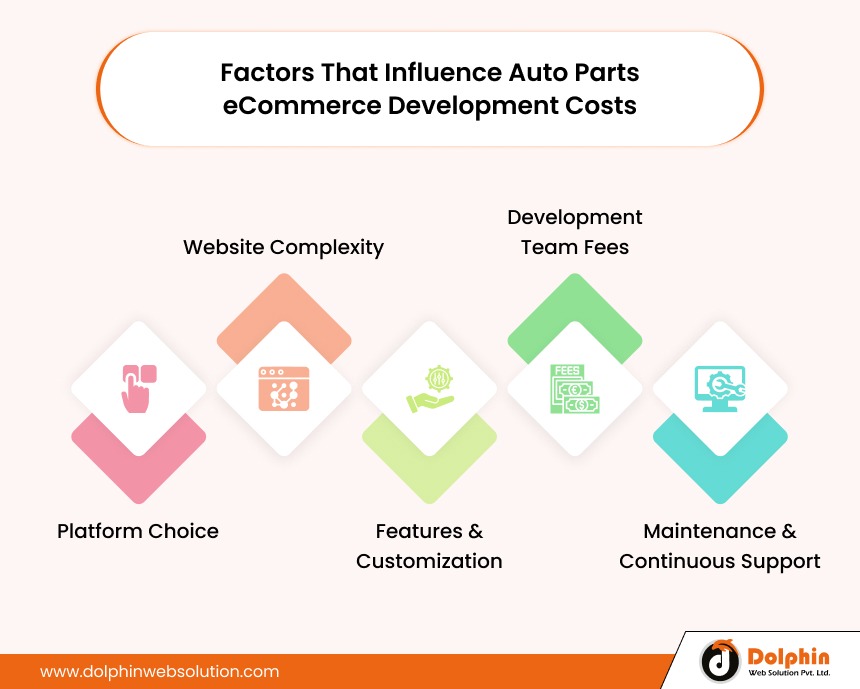
The following are the most important determinants of auto parts website development costs:
- Platform Choice: You must decide where your site will operate. Open-source platforms such as Magento are easy to tailor but expensive to implement. SaaS platforms such as Shopify are easy to use but less adaptable. The decision affects your site’s price and ability.
- Website Complexity: The more complicated your website design (custom layouts, animations, etc.), the pricier it will be. A simple, clean design is cheaper and quicker, but a custom, detailed design costs more and takes longer.
- Features & Customization: Including features like search capabilities, payment functionalities, and recommendations increases the price. Tailoring these features to suit your business requirements raises the level of complexity and cost of your site.
- Development Team Fees: The cost of hiring developers and designers will depend on their location and level of experience. More experienced teams or those in expensive locations will charge more. The size and complexity of the project will also determine the fee the team will charge.
- Maintenance & Continuous Support: Once your site is launched, it will require constant updates, bug fixes, and support. Maintaining the site in the long run with smooth and secure operations will be expensive.
Timeline to Develop an Auto Parts eCommerce Website
The duration of creating an auto parts eCommerce website is based on its complexity.
- Essential Website: A simple auto parts online shopping website will take 3–4 months to develop. It should have features like product listings, a shopping cart, and secure payment integration.
- Advanced Website: An advanced function-rich website with tailored functions is 6–8 months in development time, including advanced features such as custom designs, AI recommendations, and personalization.
Conclusion
Building an auto parts eCommerce site requires careful planning and consideration of fundamental features, prices, and development time. We hope this article helps you understand the basic features your auto parts site must have to surpass the competition. If you want to design a feature-rich auto parts eCommerce site, outsource it to an eCommerce development company and let the professionals handle it from scratch. Contact us today!

Nimesh Patel


Nimesh Patel is the Managing Director of Dolphin Web Solution, a global eCommerce, AI, and software development company helping businesses accelerate digital growth. With over 15 years of experience in technology consulting and product development, he has successfully guided startups, SMBs, and enterprise organizations in building scalable digital solutions. Nimesh specializes in eCommerce development, custom software solutions, mobile application development, and digital transformation strategies. Throughout his career, he has worked closely with businesses across retail, healthcare, automotive, manufacturing, and technology sectors, helping them leverage modern technologies to improve operational efficiency and customer experiences. As a business leader, Nimesh is passionate about innovation, entrepreneurship, and helping organizations turn ideas into successful digital products. His insights focus on eCommerce growth, AI adoption, software development trends, and business transformation through technology.

We can help you with
- Dedicated Team
- Setup Extended Team
- Product Development
- Custom App Development
Our Offices

AHMEDABAD (INDIA)
B- 203-206, Empire Business Hub, Science City Road, Sola, Ahmedabad – 380060

BERLIN (GERMANY)
Badensche Str. 28, 10715 Berlin, Germany

CALIFORNIA (USA)
9601 Reseda Blvd, Apt#223, Northridge CA-91324, USA

ALBERTA (CANADA)
302 Skyview Ranch Drive NE, Calgary, Alberta, Canada T3N0P5





Hello!
Click one of our contacts below to chat on WhatsApp