
Top 10 Generative AI Development Companies in 2026

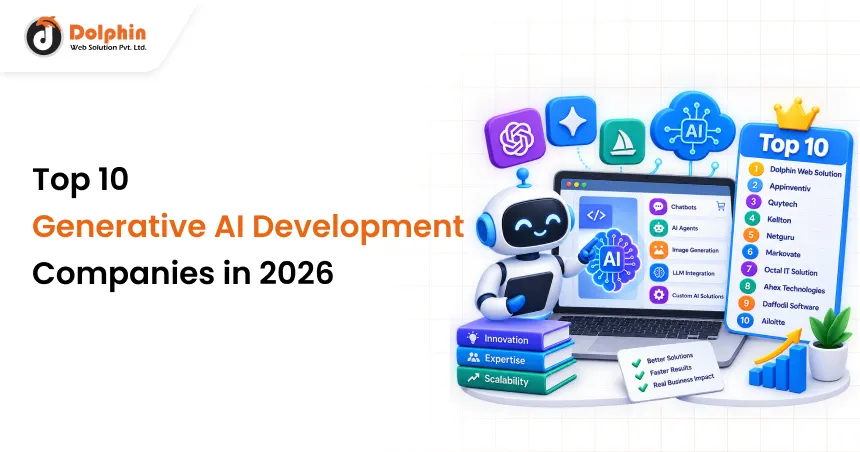

Table of Contents
 Show
Show
- 1 Introduction
- 2 What Is Generative AI Development?
- 3 How We Selected the Top Generative AI Development Companies
- 4 Top 10 Generative AI Development Companies in 2026
- 5 Key Generative AI Services Offered by These Companies
- 6 How to Choose the Right Generative AI Development Company
- 7 Why Businesses Are Investing in Generative AI in 2026
- 8 Why Store Owners and Businesses Trust Dolphin Web Solution With Generative AI Development
- 9 Conclusion

Summary :
Generative AI has moved from pilot projects to full production systems, and choosing the right development partner now decides whether a business gets real ROI or an abandoned prototype. This blog breaks down the top 10 generative AI development companies of 2026, starting with Dolphin Web Solution, and explains what each one brings to the table so you can make an informed, confident decision for your next AI project.
Introduction
Generative AI has moved out of the experimentation phase and into everyday business operations. What started as chatbot pilots and content generation experiments has grown into a full category of practical applications, including AI assistants, retrieval augmented generation systems, autonomous AI agents, workflow automation, and intelligent enterprise applications built entirely around large language models.
With this shift comes a real challenge. Building a secure, scalable, and genuinely useful generative AI system takes more than access to a model API. It takes the right development partner, one who understands data architecture, model behavior, integration complexity, and the business problem the AI is actually meant to solve.
This article covers ten companies that are active and capable in generative AI development in 2026, along with what to look for before you commit to any of them. For a deeper walkthrough of the entire GenAI development process, see the guide for generative AI development services.
What Is Generative AI Development?
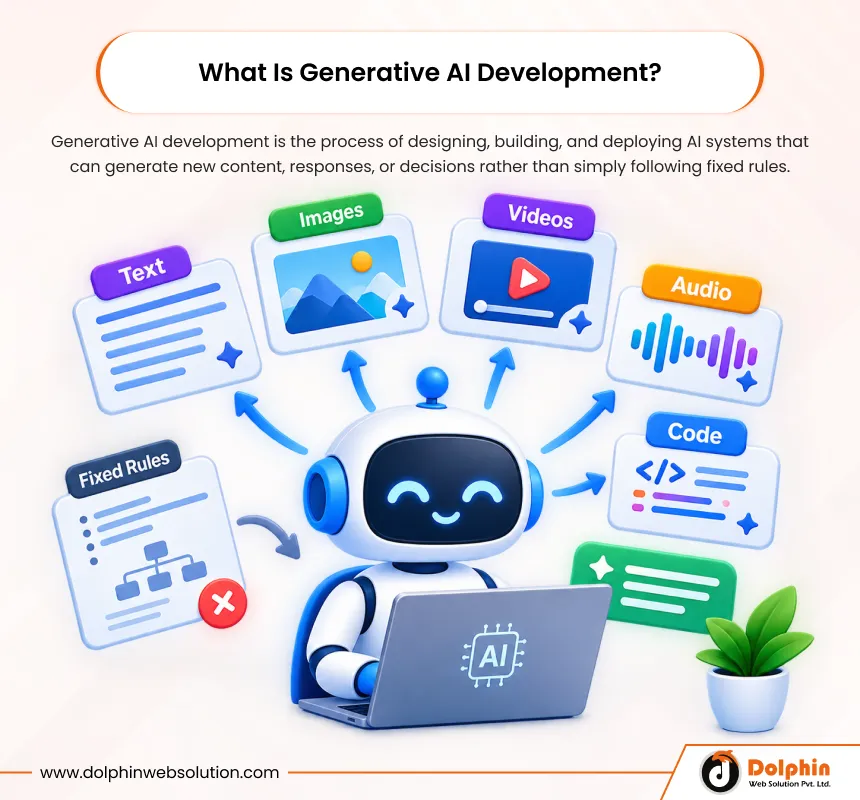
Generative AI development is the process of designing, building, and deploying AI systems that can generate new content, responses, or decisions rather than simply following fixed rules. In practical terms, this usually involves a mix of the following capabilities.
- Large language models: The foundation models that understand and generate human language. These models are trained on massive text datasets and can be adapted for tasks ranging from answering questions to writing code, summarizing documents, and holding natural conversations.
- Custom AI applications: Built around a specific business function, such as support, sales, or internal operations. Instead of a generic AI tool, these applications are designed around a company's exact workflows, terminology, and goals, which makes the output far more relevant and usable.
- Retrieval augmented generation (RAG) based applications: Which ground a model's answers in a company's own documents and data instead of relying only on general training data. This reduces incorrect or made up answers and keeps responses current with information the model was never originally trained on.
- AI chatbots and assistants: That handle customer or employee conversations. These systems can answer questions, guide users through processes, and hand off to a human when a request goes beyond what the AI can safely resolve.
- AI agents: That can take multi step actions, not just answer questions. An agent might pull data from one system, make a decision, and trigger an action in another system, completing a task end to end with minimal human input.
- Text, image, audio, and video generation: Used for content, design, and creative production. Businesses use this to speed up marketing copy, product descriptions, visual assets, and even voice or video content at a scale manual production cannot match.
- LLM integration and fine tuning: Which adapts a general model to a specific domain or dataset. Fine tuning teaches a model the vocabulary, tone, and context of a particular industry or business, improving accuracy for specialized use cases.
- Generative AI integration with existing software: Connecting AI capabilities into CRMs, ERPs, and internal tools businesses already use. This ensures AI features work inside current workflows rather than existing as a separate, disconnected tool employees have to switch to.
A capable generative AI development company should be able to work across most of these areas, not just one narrow piece of the stack.
How We Selected the Top Generative AI Development Companies
This list is not an official ranking, an award, or a paid placement list. It is based on publicly available company information, service pages, and the relevant capabilities each company demonstrates in the generative AI space. The companies below were considered against the following criteria.
- Generative AI development expertise
- LLM and model integration capabilities
- RAG and AI agent experience
- Custom AI application development
- Industry experience
- Portfolio and case studies
- Client reviews and market presence
- Scalability and security
- Post development support
Readers are encouraged to verify current service details directly with each company, since offerings and team capabilities can change over time.
Top 10 Generative AI Development Companies in 2026
1. Dolphin Web Solution
Location: Ahmedabad, Gujarat
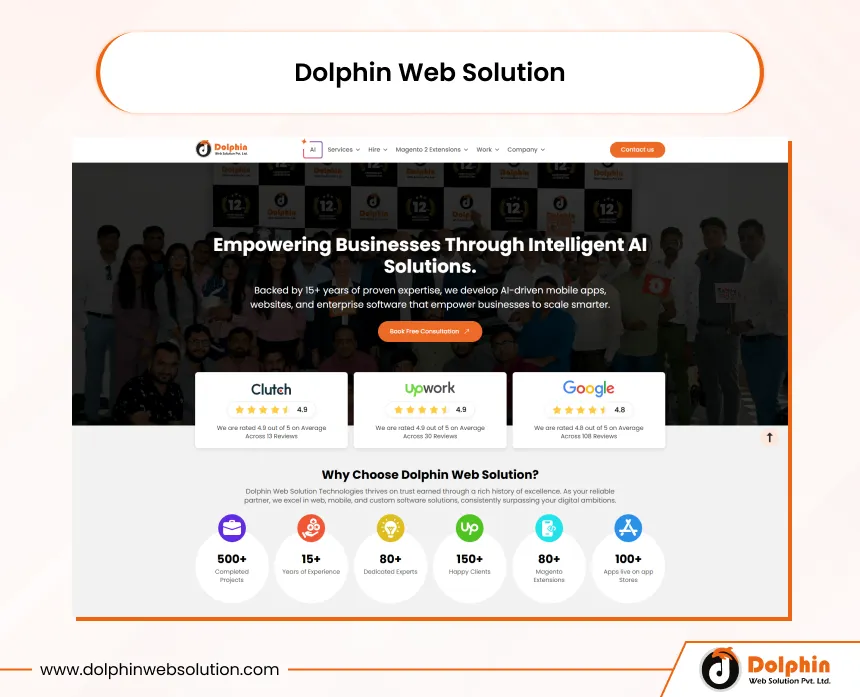
Dolphin Web Solution is a software and digital commerce company with more than 15 years of experience, and generative AI is now a core, dedicated part of its service offering. Rather than treating AI as an add on feature, the team has built a focused practice around GenAI that covers the full spectrum businesses actually need.
Dolphin's generative AI capabilities include:
- Custom generative AI application development
- LLM development and fine tuning
- AI powered content generation
- Image and creative asset generation
- GenAI chatbot and assistant development
- Generative AI integration with existing business systems
Businesses considering Dolphin Web Solution typically want a single accountable partner who can move from strategy to deployment to ongoing support, without splitting the project across multiple vendors along the way. You can review the full scope of services on the Generative AI Development page.
2. Appinventiv
Location: Noida, India
Appinventiv offers a broad generative AI development practice covering AI model development, model integration and deployment, model fine tuning, and AI model architecture design. The company also provides GenAI consulting alongside development, which helps businesses that are still shaping their AI strategy before committing to a build. Its service list includes AI agents and AI assistants as a growing focus area, reflecting the wider industry shift from simple chat interfaces toward more autonomous systems.
3. Quytech
Location: Gurugram, India
Quytech's generative AI offering spans consulting, model development, and full GenAI application builds. The company highlights experience with model replication, ChatGPT integration, AI powered chatbots, and code generation tools, along with core LLM and RAG expertise. This mix makes Quytech a reasonable fit for businesses exploring a range of GenAI use cases rather than a single narrow application.
4. Kellton
Location: India and Global
Kellton positions its generative AI services around enterprise level implementation. Its capabilities include LLM integration, AI content generation, conversational AI, AI copilots, and enterprise knowledge intelligence tools that help large organizations surface information buried across internal systems. The company frames its GenAI work around production ready systems rather than one off prototypes, which matters for larger enterprise buyers.
5. Netguru
Location: Poland and Global
Netguru's AI practice covers generative AI development, RAG systems, and LLM powered applications, along with AI agents and custom model development. The company also lists MLOps and model fine tuning among its capabilities, which is relevant for businesses that need ongoing model management after the initial build. Netguru's broader software engineering background supports full AI integration into existing digital products.
6. Markovate
Location: USA and Global
Markovate focuses on enterprise generative AI, conversational AI, and LLM fine tuning and integration. The company also markets a responsible AI consulting angle, addressing governance and ethical use alongside technical delivery. This combination suits businesses that want AI automation built with a clear eye on compliance and responsible deployment.
7. Octal IT Solution
Location: Jaipur, India
Octal IT Solution appears across current generative AI company directories with a notable focus on AI and GenAI services. Its offering includes generative AI development, AI application development, AI integration, custom AI solutions, and chatbot and assistant development, applied across a range of enterprise use cases.
8. Ahex Technologies
Location: Hyderabad, India
Ahex Technologies combines generative AI development with broader enterprise software development experience. Its capabilities include custom AI applications, AI integration, LLM based applications, and AI driven automation, positioned for businesses that want GenAI features built alongside a larger software system rather than as a standalone tool.
9. Daffodil Software
Location: Haryana, India
Daffodil Software is listed among current generative AI development companies, offering GenAI consulting, LLM integration, AI application development, and intelligent automation. The company's broader enterprise software background supports businesses looking to embed AI capabilities into existing operational systems.
10. Ailoitte
Location: Bengaluru, India
Ailoitte describes itself as an AI native product engineering partner, which shows up in its focus on generative AI, AI agents, and AI powered application development. The company's positioning suits businesses that want AI built into the core of a product from the ground up, rather than layered on as a secondary feature.

Key Generative AI Services Offered by These Companies
Across the ten companies above, a fairly consistent set of core services shows up again and again. Understanding these categories makes it easier to compare vendors on equal footing.
| Service | What It Covers |
|---|---|
| Generative AI consulting | Strategy, use case identification, and technical feasibility |
| Custom GenAI application development | Purpose built AI applications for a specific business need |
| LLM development | Building or adapting large language models |
| LLM fine tuning | Training a model further on domain specific data |
| RAG development | Grounding model outputs in company specific documents and data |
| AI chatbot development | Conversational interfaces for customer or employee use |
| AI agent development | Systems that can take multi step actions autonomously |
| AI copilots | Assistants embedded directly inside existing software tools |
| AI content generation | Text based content creation at scale |
| Image and video generation | Visual and creative asset production |
| Generative AI integration | Connecting AI capabilities into CRMs, ERPs, and internal systems |
| AI model deployment and maintenance | Hosting, monitoring, and updating models after launch |
Businesses evaluating a shortlist should ask each company directly which of these services they deliver in house versus through subcontracted teams, since that affects both quality and accountability.
How to Choose the Right Generative AI Development Company
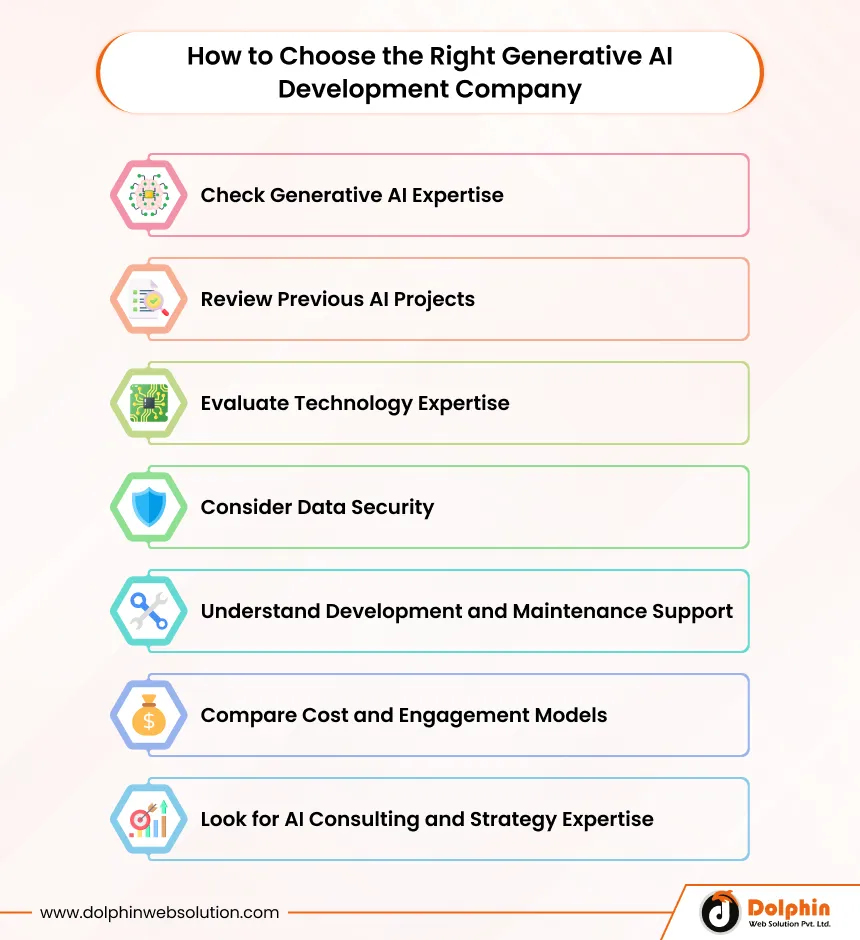
1. Check Generative AI Expertise
Many general software development companies now advertise AI services without having dedicated GenAI teams. Look past the marketing language and ask specific questions about the company's actual experience with LLMs, RAG pipelines, and AI agents, not just generic machine learning work.
2. Review Previous AI Projects
Ask for real case studies and, where possible, references from businesses in a similar industry or use case. A company that has actually shipped production GenAI systems will be able to speak specifically about the challenges they solved, not just the technology they used.
3. Evaluate Technology Expertise
Check the company's hands on experience with large language models, retrieval augmented generation, vector databases, APIs, AI agents, cloud platforms, and modern AI development frameworks. Technical depth here directly affects how reliable and maintainable the final system will be.
4. Consider Data Security
Generative AI systems often touch sensitive business or customer data. Discuss data privacy practices, access controls, governance policies, compliance certifications, and how the company handles secure deployment before any contract is signed.
5. Understand Development and Maintenance Support
A generative AI system is not a one time build. Ask how the company supports optimization, ongoing monitoring, model updates, and ongoing improvements after launch, since model performance can drift over time without proper maintenance.
6. Compare Cost and Engagement Models
Compare project based pricing, dedicated team arrangements, and hourly development models against your actual project requirements. The cheapest option on paper is not always the most cost effective one once maintenance and support are factored in.
7. Look for AI Consulting and Strategy Expertise
A reliable generative AI development company should understand your business needs before recommending a technology or development approach. AI Consulting helps businesses identify suitable AI use cases, evaluate technical feasibility, and create a practical roadmap for implementation. Look for a partner that can connect AI opportunities with your existing systems, budget, and long term business goals rather than simply recommending the latest AI model.
Why Businesses Are Investing in Generative AI in 2026
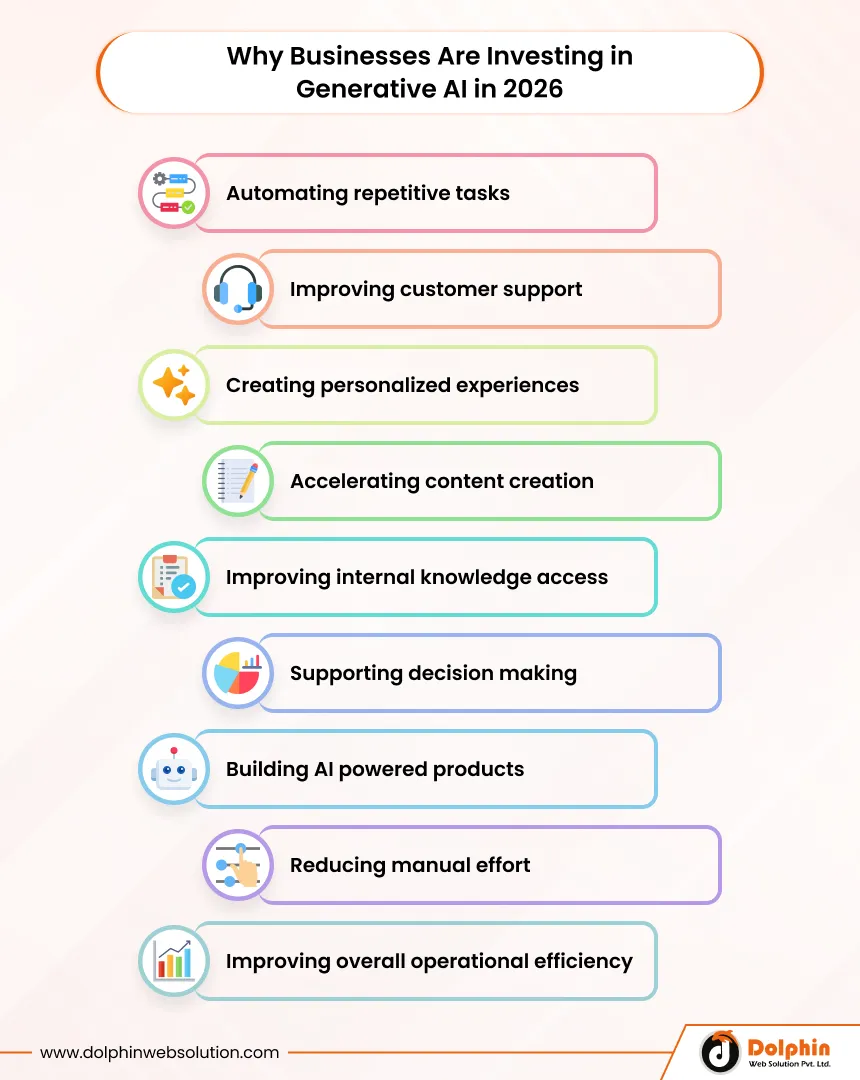
The shift toward generative AI adoption is being driven by practical, measurable business outcomes rather than novelty. Common reasons businesses are investing include the following.
- Automating repetitive tasks: That previously required manual effort, freeing up teams to focus on higher value work instead of routine data entry, ticket sorting, or report generation.
- Improving customer support: Through faster, more accurate AI assistants that can resolve common questions instantly and escalate complex issues to a human agent with full context already gathered.
- Creating personalized experiences: At a scale manual processes cannot match, tailoring product recommendations, content, and communication to individual customer behavior in real time.
- Accelerating content creation: Across marketing, product, and support teams, cutting the time it takes to produce copy, documentation, and creative assets without sacrificing consistency.
- Improving internal knowledge access: So employees find information faster, using AI search and assistants that pull answers directly from internal documents, wikis, and past communications.
- Supporting decision making: With AI powered insights and summaries, turning large volumes of data and reports into clear, actionable takeaways for leadership and teams.
- Building AI powered products: That create new revenue opportunities, embedding generative AI directly into a company's core offering rather than treating it as a backend efficiency tool.
- Reducing manual effort: Across operational and back office processes, including scheduling, documentation, and routine approvals that previously required dedicated staff time.
- Improving overall operational efficiency: Across departments, as AI systems handle repeatable work consistently and free teams to focus on strategic priorities.
These are not future looking benefits anymore. Businesses across industries are already realizing them in production, which is exactly why the choice of development partner matters so much.

Why Store Owners and Businesses Trust Dolphin Web Solution With Generative AI Development
- We know where LLM deployments actually break: Fifteen plus years of hands on software development, combined with focused work on retrieval pipelines, model fine tuning, and production AI systems, means we are not guessing at what causes a GenAI project to stall. We have seen the same failure points repeat across projects, hallucinated answers, slow retrieval under load, brittle prompt chains, and we know which fixes hold up in production versus which ones only work in a controlled demo.
- Every engagement starts with your data: We do not hand every client the same generic AI strategy slide. Our team looks at your actual data sources, existing tech stack, team size, and the real problem you are trying to solve before recommending an architecture, because the right approach for a high volume ecommerce catalog rarely matches the right approach for an internal knowledge assistant.
- We build around your existing systems: Most businesses that come to us already have a CRM, an ERP, a support desk, or a custom platform they depend on daily. Rather than pushing a full replacement, we design the generative AI layer to plug into what already works, so you get new capability without disrupting the operations your business runs on.
- Our work goes beyond the demo: A model that answers questions well in a sandbox means little if it hallucinates under real customer load or the retrieval pipeline slows down once your document set grows. We work across data architecture, retrieval quality, model selection, latency, cost management, and security, because reliable GenAI performance comes from the full stack, not just a polished front end.
- We design for real usage patterns: Live traffic does not behave like a scripted walkthrough. Users ask unexpected questions, push edge cases, and hit the system at unpredictable volumes. We test against those realities and build monitoring into the system from day one, so it holds up once real customers and employees start using it, not just during the pitch.
- One team from design to maintenance: There is no handoff between strategy and execution here. The engineers who architect your generative AI solution are the same ones who build, deploy, and monitor it afterward, so context never gets lost between teams and issues get caught before they affect your business.
Conclusion
Generative AI development has matured into a genuine business discipline, and the market now includes a wide range of capable companies, from India based specialists to global full service partners. Dolphin Web Solution stands out for combining a dedicated GenAI practice with real product and ecommerce delivery experience, making it a strong first choice on this list. Whichever company you ultimately choose, prioritize proven delivery experience, technical depth, data security practices, and long term support over marketing claims alone.
FAQs
What does a generative AI development company actually do?
A generative AI development company designs, builds, and deploys AI systems that generate text, images, code, or other content, typically by combining large language models with a business's own data through retrieval augmented generation or fine tuning.
Is this list an official ranking of the best generative AI companies?
No. This list is based on publicly available company information and relevant GenAI capabilities. It is meant as a practical starting point for research, not a formal or paid ranking.
How do I know if a company has genuine Generative AI expertise?
Ask specific questions about their experience with LLMs, RAG pipelines, fine tuning, and AI agents, and request real case studies rather than general marketing claims about AI capability.
What is the difference between an AI chatbot and an AI agent?
An AI chatbot typically answers questions within a conversation, while an AI agent can take multi step actions on its own, such as completing a task across multiple systems without constant human input.
How much does a generative AI project typically cost?
Cost depends heavily on scope, ranging from a focused pilot project to a full enterprise platform with custom models and integrations. A detailed scoping conversation with your chosen partner is the most reliable way to get an accurate estimate.
Why does post launch support matter for Generative AI systems?
Generative AI systems can drift in accuracy over time as data and usage patterns change. Ongoing monitoring, retraining, and optimization are necessary to keep the system reliable well after the initial launch.
Nimesh Patel


Nimesh Patel is the Managing Director of Dolphin Web Solution, a global eCommerce, AI, and software development company helping businesses accelerate digital growth. With over 15 years of experience in technology consulting and product development, he has successfully guided startups, SMBs, and enterprise organizations in building scalable digital solutions. Nimesh specializes in eCommerce development, custom software solutions, mobile application development, and digital transformation strategies. Throughout his career, he has worked closely with businesses across retail, healthcare, automotive, manufacturing, and technology sectors, helping them leverage modern technologies to improve operational efficiency and customer experiences. As a business leader, Nimesh is passionate about innovation, entrepreneurship, and helping organizations turn ideas into successful digital products. His insights focus on eCommerce growth, AI adoption, software development trends, and business transformation through technology.

We can help you with
- Dedicated Team
- Setup Extended Team
- Product Development
- Custom App Development
Our Offices

AHMEDABAD (INDIA)
B- 203-206, Empire Business Hub, Science City Road, Sola, Ahmedabad – 380060

BERLIN (GERMANY)
Badensche Str. 28, 10715 Berlin, Germany

CALIFORNIA (USA)
9601 Reseda Blvd, Apt#223, Northridge CA-91324, USA

ALBERTA (CANADA)
302 Skyview Ranch Drive NE, Calgary, Alberta, Canada T3N0P5





Hello!
Click one of our contacts below to chat on WhatsApp