
AI Integration in Magento: Benefits, Use Cases and Business Impact

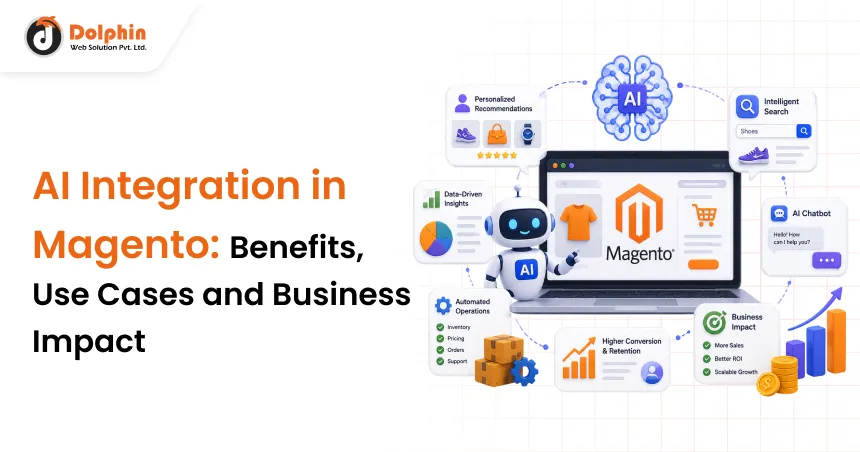

Table of Contents
 Show
Show
- 1 What Is AI Integration in Magento?
- 2 Key Benefits of AI Integration in Magento
- 3 Business Impact of AI Integration in Magento
- 4 Challenges to Consider Before Integrating AI With Magento
- 5 How to Choose the Right AI Integration Approach for Your Magento Store
- 6 Why Choose Dolphin Web Solution for AI Integration in Magento
- 7 Conclusion

Summary :
AI integration is transforming how Magento stores operate by helping businesses automate processes, personalise customer experiences, improve product discovery, and make smarter decisions. This blog explores the benefits of integrating AI with Magento, practical use cases for eCommerce businesses, and the overall impact AI can have on efficiency, sales, and long term growth.
AI is reshaping how online stores operate, and Magento businesses are increasingly at the center of that shift. What used to be a platform built around catalog management, checkout, and order processing is now expected to deliver personalized recommendations, intelligent search, and automated operations that used to require entire teams to manage manually.
Magento businesses are adopting AI for a straightforward reason: customer expectations have moved faster than traditional eCommerce tooling can keep up with on its own. Shoppers now expect a store to understand what they want, often before they have fully articulated it themselves, and the businesses meeting that expectation are seeing it show up directly in conversion and retention numbers. AI driven customer experiences and operations are no longer a competitive edge reserved for the largest retailers, they are becoming a baseline expectation across the Magento ecosystem.
This guide covers what AI integration in Magento actually means, the benefits and business impact it delivers, the challenges worth planning for, how to choose the right approach for your store, and where AI powered Magento stores are headed next.
What Is AI Integration in Magento?
1. Understanding AI Integration in Magento
AI integration in Magento means connecting artificial intelligence capabilities, such as recommendation engines, intelligent search, chatbots, or predictive analytics, directly into a Magento store so they work as part of the shopping and operational experience, rather than existing as a separate disconnected tool.
2. How AI Tools, Models, and APIs Connect With Magento
Most AI integrations connect through APIs, custom modules, or extensions built specifically for the Magento architecture. This can mean calling an external AI model to generate product recommendations in real time, embedding a chatbot powered by a large language model directly into the storefront, or feeding store data into a predictive model that then feeds insights back into Magento's admin dashboard. The technical approach varies, but the goal is consistent: AI capabilities that feel native to the store rather than bolted on.
3. Where AI Supports Customers and Business Teams
On the customer facing side, AI shows up in product recommendations, search, and support. On the operational side, it supports demand forecasting, inventory management, fraud detection, and marketing automation, giving internal teams insight and efficiency that would be difficult to achieve manually at scale.
Key Benefits of AI Integration in Magento
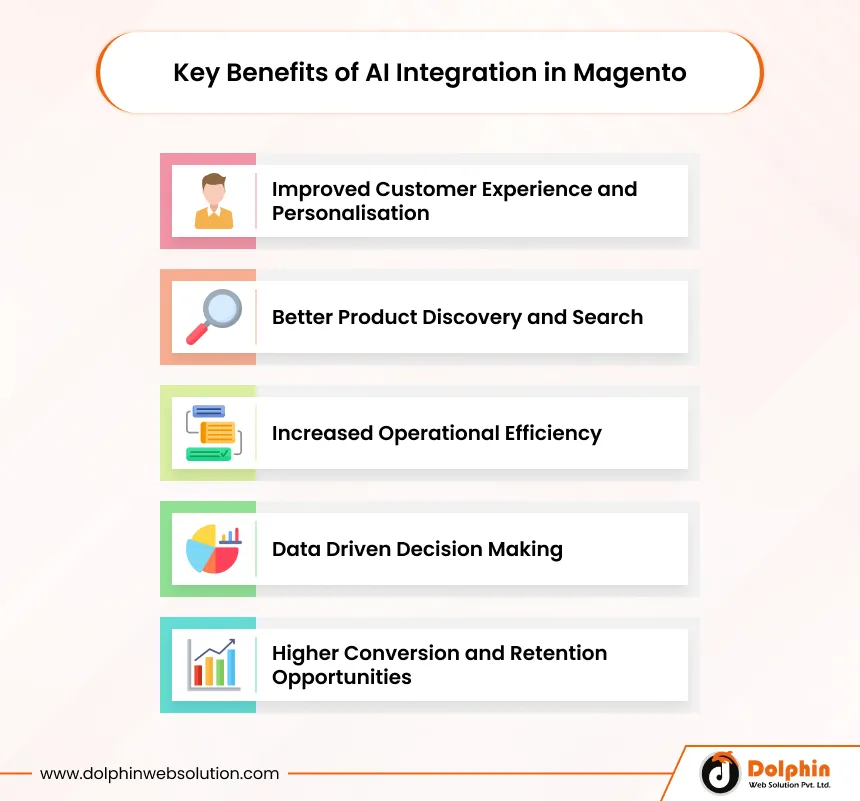
1. Improved Customer Experience and Personalisation
AI allows a Magento store to tailor product recommendations, content, and offers to each individual shopper based on their browsing and purchase behavior, rather than showing every visitor the same generic storefront.
2. Better Product Discovery and Search
AI powered search understands intent and context, not just exact keyword matches, which means shoppers find relevant products even with vague, misspelled, or conversational queries.
3. Increased Operational Efficiency
Tasks like inventory forecasting, pricing adjustments, and customer support inquiries can be partially or fully automated, freeing internal teams to focus on higher value work.
4. Data Driven Decision Making
AI turns the large volume of data a Magento store generates, from browsing behavior to purchase history, into actionable insight that informs merchandising, marketing, and inventory decisions.
5. Higher Conversion and Retention Opportunities
Personalized experiences and faster, more relevant search results consistently translate into higher conversion rates, while ongoing personalization after purchase, such as tailored follow up offers, supports stronger long term retention.

Business Impact of AI Integration in Magento
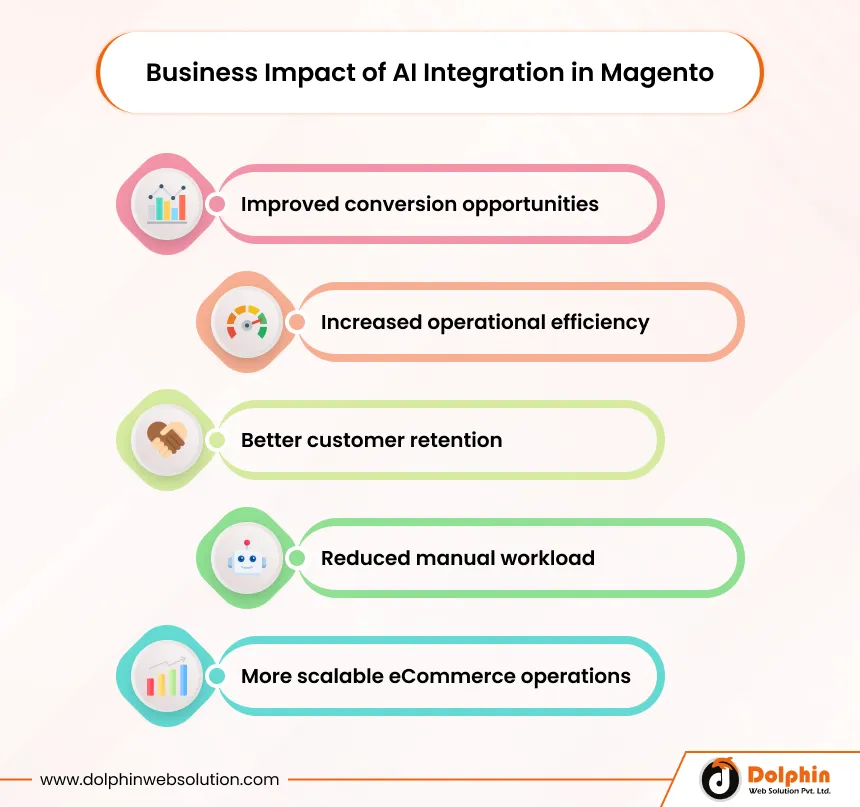
Beyond individual features, AI integration tends to show up in a few consistent business outcomes over time:
| Impact Area | What It Looks Like in Practice |
|---|---|
| Improved conversion opportunities | Relevant recommendations and faster search reduce friction between browsing and purchase |
| Increased operational efficiency | Automated forecasting and support reduce the manual workload on internal teams |
| Better customer retention | Personalized post purchase engagement keeps customers coming back rather than shopping elsewhere |
| Reduced manual workload | Repetitive tasks such as inventory checks and basic support queries require less direct staff time |
| More scalable eCommerce operations | AI systems handle increasing traffic and catalog size without a proportional increase in headcount |
Challenges to Consider Before Integrating AI With Magento
- Data quality and availability: AI recommendations and predictions are only as good as the data behind them, and many Magento stores discover gaps in their product, customer, or transaction data only once an AI project is already underway. A pattern we see often: a store's product catalog has inconsistent attribute data, missing categories on older SKUs, duplicate entries from past migrations, that a human shopper never notices but that quietly breaks a recommendation model's accuracy until it gets cleaned up.
- Integration complexity: Connecting AI tools into an existing Magento store, particularly one with custom extensions or a heavily modified codebase, is rarely as simple as installing a plugin.
- Security and customer data privacy: AI features often rely on customer behavior and purchase data, which means privacy compliance and secure data handling need to be built in from the start, not added after launch.
- Choosing the right AI solution: The number of AI tools and platforms available for eCommerce has grown quickly, and choosing the wrong one for your specific catalog and traffic pattern can waste both budget and time.
- Cost, maintenance, and scalability considerations: AI features carry ongoing costs beyond the initial build, including model usage, monitoring, and updates as your store grows. Our breakdown of Custom AI Integration Cost covers these cost drivers in more detail.
How to Choose the Right AI Integration Approach for Your Magento Store
1. Identify Your Business Goals and Use Cases
Start by defining the specific outcome you want, whether that is higher conversion, reduced support workload, or better inventory accuracy, rather than adopting AI in general terms. Our AI Consulting Services team can help you work through this step before any development begins, so the eventual build is aimed at a clear, validated goal.
2. Evaluate Your Existing Magento Infrastructure
Understand how customized your current Magento setup is, since a heavily modified store may require more careful integration planning than a more standard implementation.
3. Choose Between AI Tools, APIs, and Custom Solutions
Decide whether an existing AI tool or API meets your needs, or whether your use case is specific enough to justify a custom built solution, since this decision significantly affects both cost and timeline.
4. Work With an Experienced Magento and AI Development Partner
Magento's architecture has its own quirks, and combining that expertise with AI development experience matters more than choosing a general AI vendor without eCommerce specific knowledge. Our Magento Integration Services team brings both together, so AI features are built to work with Magento's structure rather than around it.
Why Choose Dolphin Web Solution for AI Integration in Magento
- Magento expertise that predates the AI conversation: We have worked inside Magento's architecture, including its REST and GraphQL APIs, custom module structure, and both Open Source and Adobe Commerce editions, for over 15 years. That matters for AI integration specifically, because a recommendation engine or search model that ignores how Magento actually structures catalog and customer data tends to break in production, not in the demo.
- AI consulting grounded in your actual store, not a generic playbook: Before recommending any technical approach, our AI consulting team reviews your specific catalog size, traffic patterns, and existing customizations to confirm the integration you are planning is actually the right one, rather than defaulting to whatever tool is trending.
- Integration work that respects your existing customizations: Many Magento stores we work with have years of custom extensions and theme modifications layered on top of the core platform. We build AI features to work with that existing structure rather than requiring a rebuild to accommodate them.
- Experience connecting AI to the systems around Magento, not just the storefront: Beyond product recommendations and search, we have integrated AI into the CRM, ERP, and fulfillment systems that Magento stores typically depend on, since a personalization engine that cannot see inventory or order history in real time delivers limited value.
- AI agents scoped to real operational tasks: Where it fits the business, we build agents that handle bounded, well defined operational work, such as flagging low stock before it becomes a stockout or routing support tickets, rather than promising fully autonomous store management that is not yet reliable in practice.
- A single team from strategy through post launch support: Our Magento integration team and our AI development team work as one group on these projects, so there is no handoff gap between the people who designed the approach and the people who built and now maintain it.
Conclusion
AI integration represents a genuine strategic opportunity for Magento businesses, but the value comes from starting with the right use cases rather than adopting AI broadly and hoping something sticks. A store that begins with a clearly defined problem, whether that is improving search relevance or reducing manual support workload, sees far more measurable return than one that adopts AI features without a specific goal in mind.
Done well, the right implementation does not just improve a single metric, it creates long term business value by making the store more personalized, more efficient, and more capable of scaling without a proportional increase in operational overhead. The Magento stores seeing the strongest results from AI are consistently the ones that treated it as a strategic investment rather than a quick feature addition.
Frequently Asked Questions
What is AI integration in Magento?
AI integration in Magento means connecting artificial intelligence capabilities, such as recommendation engines, intelligent search, chatbots, or predictive analytics, directly into a Magento store so they function as part of the shopping and operational experience rather than as a separate tool.
Does AI integration work with Magento Open Source and Adobe Commerce?
Yes, AI can be integrated into both editions, though the approach may differ slightly depending on the platform's existing architecture, available APIs, and how heavily the store has already been customized.
How long does it take to integrate AI into a Magento store?
Timelines vary based on scope, but a single, well defined feature such as AI powered search can often be implemented in a matter of weeks, while broader initiatives involving multiple integrations typically take longer.
Will AI integration slow down my Magento store?
Not if it is implemented properly. AI features are usually handled through asynchronous calls or backend processing, so a well built integration should not noticeably affect page load times or checkout speed.
Is AI integration only worthwhile for large Magento stores?
No. Smaller stores can benefit significantly from focused AI features like search improvement or basic personalization, often with a lower upfront investment than a full scale enterprise rollout.
How much does AI integration in Magento typically cost?
Cost depends on the complexity of the use case, the number of systems involved, and the level of customization required. Our guide to Custom AI Integration Cost breaks down typical pricing ranges and the specific factors that drive them.
Nimesh Patel


Nimesh Patel is the Managing Director of Dolphin Web Solution, a global eCommerce, AI, and software development company helping businesses accelerate digital growth. With over 15 years of experience in technology consulting and product development, he has successfully guided startups, SMBs, and enterprise organizations in building scalable digital solutions. Nimesh specializes in eCommerce development, custom software solutions, mobile application development, and digital transformation strategies. Throughout his career, he has worked closely with businesses across retail, healthcare, automotive, manufacturing, and technology sectors, helping them leverage modern technologies to improve operational efficiency and customer experiences. As a business leader, Nimesh is passionate about innovation, entrepreneurship, and helping organizations turn ideas into successful digital products. His insights focus on eCommerce growth, AI adoption, software development trends, and business transformation through technology.

We can help you with
- Dedicated Team
- Setup Extended Team
- Product Development
- Custom App Development
Our Offices

AHMEDABAD (INDIA)
B- 203-206, Empire Business Hub, Science City Road, Sola, Ahmedabad – 380060

BERLIN (GERMANY)
Badensche Str. 28, 10715 Berlin, Germany

CALIFORNIA (USA)
9601 Reseda Blvd, Apt#223, Northridge CA-91324, USA

ALBERTA (CANADA)
302 Skyview Ranch Drive NE, Calgary, Alberta, Canada T3N0P5





Hello!
Click one of our contacts below to chat on WhatsApp