
Custom AI Integration Cost: A Complete Pricing Guide for Businesses


Table of Contents
 Show
Show
- 1 What Is Custom AI Integration?
- 2 What Is the Average Custom AI Integration Cost?
- 3 Key Factors That Affect Custom AI Integration Cost
- 4 Cost Breakdown by AI Integration Type
- 5 Hidden Costs Businesses Often Overlook
- 6 How to Reduce Custom AI Integration Costs
- 7 Is Custom AI Integration Worth the Investment?
- 8 Why Choose Dolphin Web Solution for Custom AI Integration
- 9 Conclusion

Summary :
Businesses often ask about AI integration cost before they ask anything else, but the real answer depends on scope, data readiness, and technical complexity rather than a single number. This guide breaks down typical pricing tiers, the key factors that drive cost up or down, a cost breakdown by integration type, the hidden costs most businesses miss, and practical ways to reduce spend without cutting corners. It closes with an honest look at ROI and what to expect when working with an experienced AI integration partner.
AI integration has moved from an experimental line item to a core part of how businesses plan their technology budgets. As demand grows across industries, one question comes up in almost every conversation before a project even starts: how much is this actually going to cost?
That question matters more with AI than with most software investments, because AI pricing depends on factors that are not always obvious upfront, from which model you use to how much your existing data needs cleaning before it is usable. Getting a realistic picture of cost before committing to a project avoids the two most common outcomes of skipping this step: sticker shock halfway through, or a budget so conservative it cannot deliver a solution that actually works.
This guide breaks down what custom AI integration actually costs, the factors that drive that cost up or down, a breakdown by integration type, the hidden costs businesses often miss, and how to keep a project within a realistic budget without cutting corners that matter.
What Is Custom AI Integration?
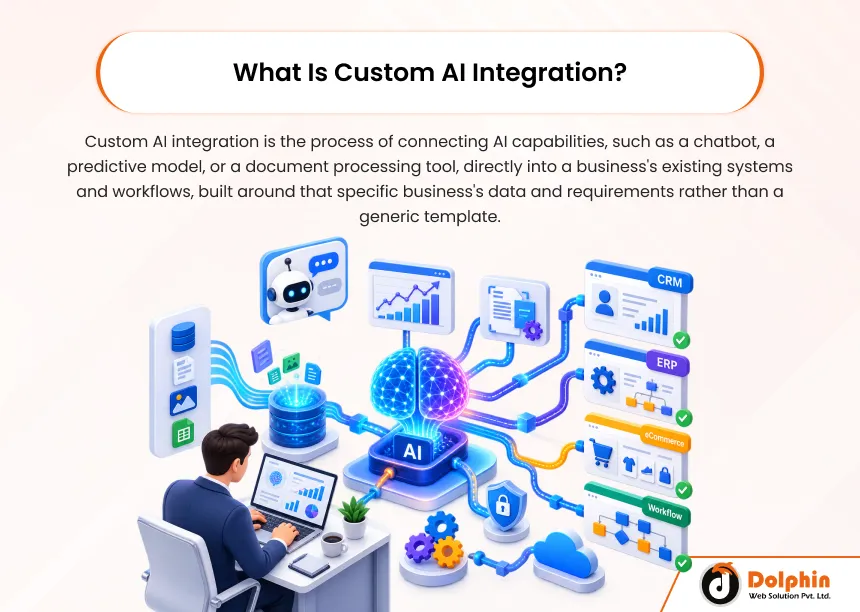
Custom AI integration is the process of connecting AI capabilities, such as a chatbot, a predictive model, or a document processing tool, directly into a business's existing systems and workflows, built around that specific business's data and requirements rather than a generic template.
This is different from off the shelf AI tools, which offer prebuilt functionality that works the same way for every customer. An off the shelf tool is faster to set up and cheaper upfront, but it rarely fits a business's exact processes, and it often cannot connect deeply with proprietary systems or data. Custom integration costs more initially but is built specifically around how your business actually operates.
Common examples of custom AI integration include connecting AI into a CRM to automate lead scoring, embedding predictive tools into an ERP for demand forecasting, adding AI powered recommendations to an eCommerce platform, automating customer support with a chatbot trained on your own documentation, and streamlining internal workflows such as document review or approval routing.
What Is the Average Custom AI Integration Cost?
Pricing varies significantly based on complexity, so there is no single number that applies to every project. That said, most projects fall into one of three general tiers:
| Project Size | Typical Investment Range | What It Usually Includes |
|---|---|---|
| Small AI integrations | $3,000 to $20,000 | A single, well scoped feature such as a basic chatbot or one workflow automation |
| Mid sized business solutions | $20,000 to $80,000 | Multiple integrations, custom workflows, and a moderate amount of data preparation |
| Enterprise AI integrations | $80,000 and up, often well beyond | Complex, multi system integrations, custom models, strict security and compliance needs |
These figures are general guidance, not fixed quotes. The actual cost of your project depends heavily on the specific factors below, and a proper estimate should always be based on your actual scope rather than a generic bracket.
Key Factors That Affect Custom AI Integration Cost
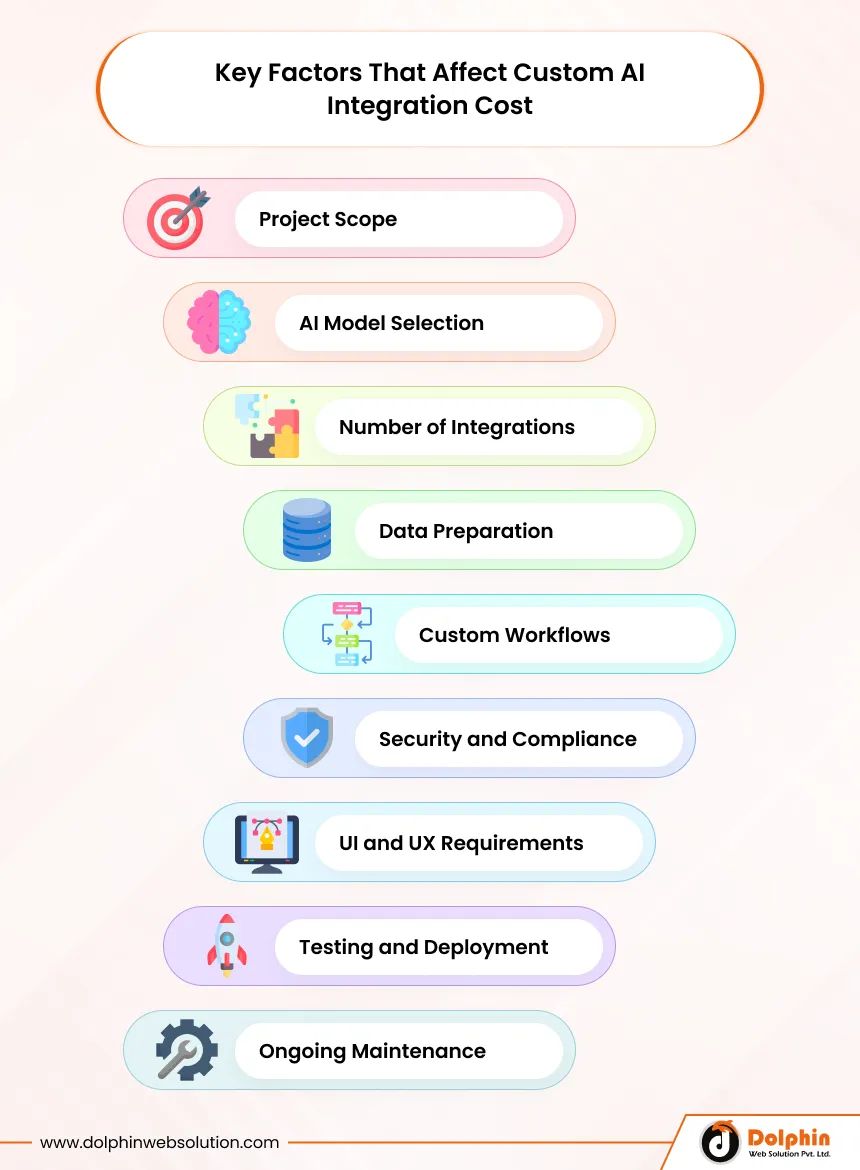
1. Project Scope
A single, narrowly defined feature costs far less than a broad initiative touching multiple departments and systems.
2. AI Model Selection
Choosing between OpenAI, Claude, Gemini, or an open source model affects both licensing cost and development complexity. If your project centers on building genuinely custom generative capabilities rather than a simple API call, our Generative AI Development team can help you scope that work accurately.
3. Number of Integrations
Connecting AI into one system is straightforward compared to connecting it into several systems that each have their own data formats and access rules.
4. Data Preparation
Messy, scattered, or poorly structured data often needs significant cleanup before it can support a reliable AI system, and this work is frequently underestimated.
5. Custom Workflows
Automating a process that follows unique business logic takes more engineering time than implementing a standard, well documented workflow.
6. Security and Compliance
Industries with strict regulatory requirements need additional work for encryption, access control, and audit trails, which adds cost but is not optional.
7. UI and UX Requirements
A polished, custom interface for an AI feature takes more design and development time than a bare functional one.
8. Testing and Deployment
Thorough testing across real world scenarios, rather than just the happy path, adds time but significantly reduces the risk of costly issues after launch.
9. Ongoing Maintenance
AI systems are never truly finished at launch, since models need monitoring and retraining as real usage data comes in.
Cost Breakdown by AI Integration Type
Different types of AI integration carry different typical price ranges, largely based on technical complexity.
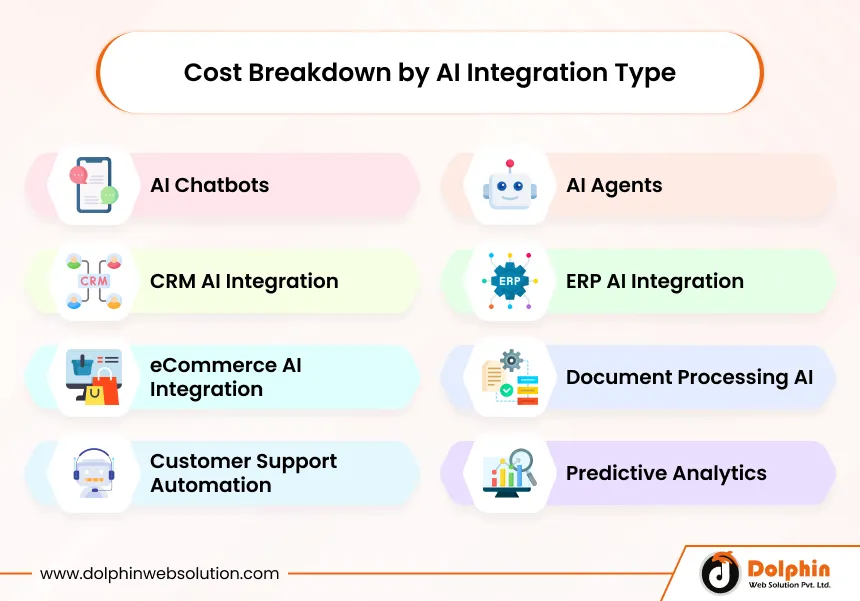
1. AI Chatbots
Typical range: $3,000 to $25,000. Cost depends mainly on the scope of the knowledge base, the number of supported languages, and how deeply the chatbot integrates with existing systems.
2. AI Agents
Typical range: $25,000 to $100,000 and up. Cost is driven by how many tasks the agent can perform autonomously, what tools it needs access to, and how reliable it needs to be for production use.
3. CRM AI Integration
Typical range: $15,000 to $60,000. Cost scales with data volume, the number of workflows being automated, and how heavily the existing CRM has already been customized.
4. ERP AI Integration
Typical range: $30,000 to $120,000. ERP systems tend to be complex, so cost is driven by the number of connected modules and how consistent the underlying data is.
5. eCommerce AI Integration
Typical range: $8,000 to $40,000. Catalog size, personalization depth, and how flexible the existing platform is all directly affect cost.
6. Document Processing AI
Typical range: $15,000 to $60,000. Cost depends on document variety, required accuracy, and the volume of documents processed on an ongoing basis.
7. Customer Support Automation
Typical range: $8,000 to $35,000. Ticket volume, escalation logic complexity, and integration with existing support tools are the main cost drivers.
8. Predictive Analytics
Typical range: $20,000 to $90,000. Data quality, model complexity, and the number of variables being tracked all influence the final cost significantly.
Hidden Costs Businesses Often Overlook
Several cost categories tend to get missed during initial budgeting, only to surface later in the project:
- API usage costs: Which scale with usage and can add up significantly at higher volumes.
- Infrastructure: Including cloud hosting and compute costs for running models in production.
- Data cleaning: Which is often more time consuming than initially estimated.
- Model fine tuning: Needed when a general purpose model does not perform well enough out of the box.
- Monitoring: To catch performance issues or drift before they affect users.
- Security updates: Since AI systems need the same ongoing patching as any other software.
- Employee training: So staff can actually use the new AI tools effectively.
- Maintenance: Covering the continuous work needed to keep a model accurate over time.

How to Reduce Custom AI Integration Costs
- Start with an MVP: Building a minimum viable version of the highest priority feature first validates the approach before committing to a larger budget.
- Prioritize high return use cases: Focusing on the initiatives most likely to deliver measurable value avoids spending on features that sound useful but do not move the needle.
- Use existing APIs where possible: Leveraging proven models and tools instead of building everything custom significantly reduces development time and cost.
- Choose a scalable architecture from the start: Designing for growth upfront avoids the far more expensive cost of rebuilding later once usage increases.
- Work with an experienced AI integration partner: A partner who has solved similar problems before avoids the expensive trial and error that comes with a first attempt.
Is Custom AI Integration Worth the Investment?
The upfront cost of custom AI integration can look significant compared to an off the shelf tool, but the return often justifies it. Time savings from automating manual work compound over months and years, freeing employees for higher value tasks. Operational efficiency improves as AI handles repetitive processes faster and more consistently than manual work ever could.
Reduced manual effort lowers the ongoing cost of running the business, particularly in support, data entry, and routine decision making. Customer experience improves as personalization and faster response times become the norm rather than the exception. And ultimately, all of this tends to translate into real revenue opportunities, whether through better retention, faster sales cycles, or new capabilities the business simply could not offer before.
The businesses that see the strongest return are rarely the ones that chased the lowest upfront price. They are the ones that invested in a solution built around their actual business needs.
Why Choose Dolphin Web Solution for Custom AI Integration
- AI consulting grounded in your actual goals: Before recommending any technical approach, our AI Consulting Services team makes sure the integration you are planning is actually the right one for your business.
- Custom AI development built around your systems: We do not force your business into a generic template, we build integrations specific to how your systems and workflows already operate.
- Deep AI integration experience: From CRM and ERP systems to eCommerce platforms, we have connected AI into a wide range of business critical software.
- AI agents that handle real work: Beyond simple chatbots, we build agents capable of completing multi step tasks autonomously where it makes sense for your business.
- Enterprise software integration expertise: Our team understands the complexity of connecting AI into systems that were never designed with AI in mind.
- End to end implementation: We support your project from initial strategy through deployment, rather than handing off partway through.
- Ongoing support after launch: AI systems need continued attention after deployment, and we stay involved to keep performance on track.

Conclusion
Understanding what drives custom AI integration cost matters more than knowing a single number, since the right investment depends entirely on your specific project scope, data readiness, and business goals. Focusing only on the lowest upfront price often leads to a solution that cannot scale or does not fit the business well enough to deliver real value.
Before starting your next AI project, take the time to understand the cost drivers covered in this guide, and consider the long term business value an integration will deliver rather than upfront cost alone. If you want a clearer picture of what strategy and planning actually involve before you budget for development, our guide on Why Businesses Need Expert Guidance is a useful place to start.
Frequently Asked Questions
What affects AI integration pricing?
Key factors include project scope, the AI model selected, the number of systems being integrated, data preparation needs, custom workflow complexity, security and compliance requirements, and ongoing maintenance.
How long does an AI integration project take?
Timelines vary based on complexity, but most projects move through planning, development, testing, and deployment over a period of several weeks to several months.
Is AI integration suitable for small businesses?
Yes, particularly when scoped as a focused, well defined feature rather than a broad enterprise wide initiative. Starting small allows smaller businesses to validate value before expanding.
Can AI integrate with existing CRM or ERP systems?
Yes, AI can typically be integrated into existing CRM and ERP platforms, though the complexity depends on how customized those systems already are and how accessible their data is.
What is the maintenance cost of AI integration?
Maintenance costs vary but generally include ongoing monitoring, occasional model retraining, security updates, and ongoing API or infrastructure fees, and should be budgeted for as a recurring cost rather than a one time expense.
Nimesh Patel


Nimesh Patel is the Managing Director of Dolphin Web Solution, a global eCommerce, AI, and software development company helping businesses accelerate digital growth. With over 15 years of experience in technology consulting and product development, he has successfully guided startups, SMBs, and enterprise organizations in building scalable digital solutions. Nimesh specializes in eCommerce development, custom software solutions, mobile application development, and digital transformation strategies. Throughout his career, he has worked closely with businesses across retail, healthcare, automotive, manufacturing, and technology sectors, helping them leverage modern technologies to improve operational efficiency and customer experiences. As a business leader, Nimesh is passionate about innovation, entrepreneurship, and helping organizations turn ideas into successful digital products. His insights focus on eCommerce growth, AI adoption, software development trends, and business transformation through technology.

We can help you with
- Dedicated Team
- Setup Extended Team
- Product Development
- Custom App Development
Our Offices

AHMEDABAD (INDIA)
B- 203-206, Empire Business Hub, Science City Road, Sola, Ahmedabad – 380060

BERLIN (GERMANY)
Badensche Str. 28, 10715 Berlin, Germany

CALIFORNIA (USA)
9601 Reseda Blvd, Apt#223, Northridge CA-91324, USA

ALBERTA (CANADA)
302 Skyview Ranch Drive NE, Calgary, Alberta, Canada T3N0P5





Hello!
Click one of our contacts below to chat on WhatsApp