
-
Dolphin Web SolutionEcommerceBest Platforms for Auto Parts eCommerce Website Development
 15 Min
Best Platforms for Auto Parts eCommerce Website Development


Table of Contents
 Show
Show

Summary :
Planning for auto parts eCommerce website development? This blog explores the top 5 specialised platforms for building an auto parts eCommerce website, along with its pros and cons. Plus, helping businesses choose the right platform to meet their unique needs. So that you can make informed decisions.
Are you planning for auto parts eCommerce website development? If yes, you’re at the right place.
With the rapidly changing automotive industry, businesses are shifting to build an online presence, especially after COVID-19. It boosts digitalization and encourages companies to take their business online to sell auto parts. And now it’s become a most preferred option for companies and customers to buy auto parts online.
In fact, the global online automotive market is expected to reach $267.8 billion by 2032 with a CAGR of 16.5%.
It clearly shows how fast the online auto parts market has merged and unlocked various business opportunities.
However, building an auto parts website is complex, especially if you don’t know the right platform to build on it. No worries – we’ve researched for you!
In this blog, we’ve handpicked the top 5 platforms for auto parts eCommerce website development, its benefits and factors to find the best platform for your business so that you can get the max out of it!
Why Does Auto Parts eCommerce Need a Specialised Platform?
Auto parts e-commerce has unique requirements that general platforms can’t handle effectively. Here are some key reasons why auto parts websites require a specialised platform:
1. Complex product data
Auto parts are complicated products compared to what you would find in an online store. Each part has many specifications such as part number, make of vehicle, model, year, size, and what other components are compatible with it. Specialised platforms are designed to hold and display complex product data so that the customer can confidently find the right parts.
2. Bulk inventory & supplier management
Auto parts stores frequently handle large quantities, even thousands or millions, of items. The task of managing that large inventory would be difficult. You must also work with multiple suppliers to ensure stock availability and orders are promptly fulfilled. Specialised platforms remove some difficulty by offering your business a suite of tools to track your inventory levels, automate the reordering process, and manage complex supply chain processes.
3. B2B & B2C hybrid requirements
Auto parts stores often cater to individual customers (B2C) and businesses (B2B), like car repair shops or dealerships. Therefore, you will need a platform that can handle both customer types—retail customers will need individual pricing and bulk discounts or special pricing for B2B value customers.
4. Need for fast search/filtering
Customers shopping for auto parts often look for specific components and don’t have time to sift through pages of irrelevant products. A specialised platform can offer advanced filtering and search options, allowing customers to quickly find parts by category, vehicle compatibility, and other essential details, improving the overall shopping experience.
5. Integration with shipping & warehousing systems
Timely delivery is key for e-commerce success especially in fast-moving industries like auto parts. Specialised platforms are optimally suited to integrate with shipping and warehousing systems. Integrating within the specialised platform ensures adherence to the accuracy of stock, tracking of the shipments, and meeting customer expectations through on-time delivery, stock-out prevention and avoidance of order queues.
Top Platforms for Auto Parts Ecommerce Website Development
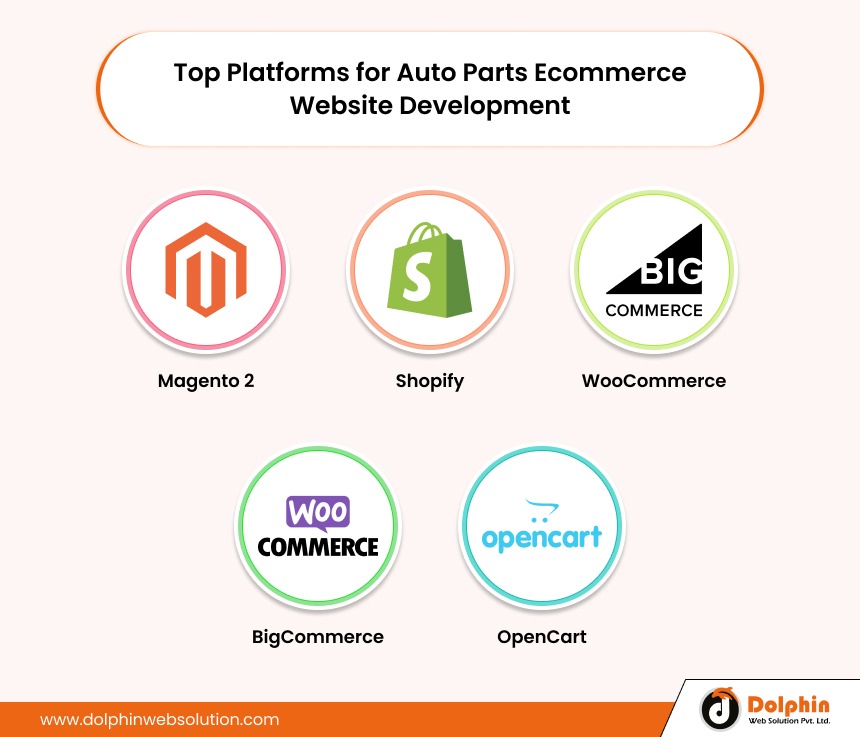
Choosing the right platform is essential when building a successful online auto parts store. Here, we’ve picked the top 5 platforms where each platform offers unique features tailored to the needs of the automotive industry:
1. Magento 2
Adobe Commerce, also known as Magento, is a flexible and scalable eCommerce platform that offers extensive customization and omnichannel support. Magento is one of the best solutions for larger auto parts businesses or those with complex needs requiring advanced features and complete online store control. Magento 2 is widely used by companies that need a tailored solution and have the resources to manage a complex platform.
Pros
- Highly Scalable & Fully Customizable
- Extensive Feature Set for B2B and B2C
- Global Reach (Multi-language, Multi-currency, Payment Gateways)
- Robust Analytics and Reporting
- Large Community and Extensions Marketplace
Cons
- Steep Learning Curve
- High Technical Requirements
- High Costs
- Limited Out-of-the-Box Design Templates
- Additional Costs for Extensions
2. Shopify
Shopify is the best platform for auto parts businesses looking for a user-friendly platform with powerful tools. It’s excellent work for small to midsize auto parts retailers who want an easy-to-use platform with a low learning curve. It’s a complete package builder and is an all-in-one solution for those looking to shop online fast. Shopify is among the best vehicle parts and accessories site builders, providing many tools, integrations and support. It helps auto parts businesses to sell effectively.
Pros
- User-Friendly Interface & Easy Setup
- Highly Scalable
- Built-In Features & Integrations
- Reliable Hosting & Security
- 24/7 Customer Support
Cons
- Transaction Fees for Third-Party Payments
- Limited Customization on Basic Plans
- Higher Costs for Advanced Plans
- Limited Control Over Platform Updates and Features
3. WooCommerce
WooCommerce is a free, open-source plugin for WordPress. It enables any WordPress site to become a complete eCommerce store. It is an excellent option for auto parts businesses because it is flexible, has an inexpensive starting cost, and integrates well with WordPress. WooCommerce is an excellent option for auto parts businesses already using WordPress or with low budgets.
Pros
- Free & Open-Source
- Seamless Integration with WordPress
- Highly Customizable & Flexible
- Scalable Solution for Large Catalogs
- Shipping and Tax Automation
- Advanced Marketing and Analytics
- Large Community and Resources
Cons
- Requires Technical Knowledge for Setup
- Limited Out-of-the-Box Features
- Ongoing Maintenance for Performance & Security
- Hosting & Server Management Responsibility
- Need for Additional Plugins
- Scalability Concerns for Large Businesses
4. BigCommerce
BigCommerce is a robust and scalable cloud-based eCommerce platform with built-in flexibility. It is an excellent choice for fast-growing auto parts companies working in both B2B/B2C, which are looking for a complete solution with many built-in features, strong multi-channel capabilities, and firm support. It can manage extensive inventories and traffic and integrates easily with third-party apps and services.
Pros
- User-Friendly Interface
- Excellent Scalability
- Extensive Built-in Features
- Strong SEO Performance
- Multi-channel Selling Options
- Reliable Hosting and Security
- No Transaction Fees
Cons
- Steeper Learning Curve
- Limited Customization Options
- Limited Free Themesy
- Additional Costs for Premium Integrations
5. OpenCart
OpenCart is an open-source, PHP-based eCommerce solution. It is a viable option for all auto parts businesses because of its flexibility, customizable, and scalability. It is a low-cost option for companies with large inventory and needing multi-store management features. Many developers and users in the OpenCart community provide support and assistance.
Pros
- Free and Open-Source
- User-Friendly Interface
- Extensive Functionality
- Customizable
- SEO-Friendly
- Large Community Support
- No Hidden Costs
Cons
- Slower Page Load Times
- Limited Built-In Features
- Less Scalable for Large Businesses
- Documentation Challenges
- Potential for Performance Issues
- Requires Dedicated Hosting
Factors to Consider Before Choosing a Platform
Here are some key factors you should consider to choosing the right platform:
- Automotive-Specific Functionality: Your platform should support specialised features like YMM filters and VIN Lookup to help customers find the needed parts. These tools are key for handling complex product data and extensive inventories, smoothing the shopping experience.
- Growth-Oriented Technology: Choose a platform that can grow while scaling your auto parts business. Look for platforms that allow API integrations to add new features easily and keep up with changing customer needs and industry trends.
- High and Smooth Performance: With extensive inventories, fast site speed is essential for customer satisfaction. A platform with dedicated hosting ensures fast load times, while bulk updates and advanced import tools make managing extensive inventories and sales promotions much easier.
- Powerful Design Options: Ensure the platform has mobile-friendly design to provide a smooth shopping experience on all devices. Product visualisers allow customers to view parts interactively, increasing confidence in purchase decisions and reducing returns.
- Professional Customer Service: Look for platforms with 24/7 support to ensure issues are resolved quickly and keep operations running smoothly. Access to a strong community and resources can help you troubleshoot and customize your store as needed.
Conclusion
Choosing the right platform for your auto parts eCommerce website is critical for long-term success. That is why we highlighted the top 5 Specialised platforms like Magento, Shopify, WooCommerce, BigCommerce, and OpenCart, each with unique benefits for the automotive sector. However, each business has unique needs, and you can consider the given factors to find the right platform that fulfils your business needs. We hope this guide saves you time and gives you top platforms to build your auto parts website and stay competitive. Once you’ve finalized the right platform, it’s time to hire an experienced eCommerce website development company and let the professional build your auto parts website faster and more efficiently. Contact Us today!

Jigar Shah


Jigar Shah serves as the Chief Operating Officer of Dolphin Web Solution, overseeing business operations, project delivery, client success, and organizational growth initiatives. With more than 15 years of experience in the IT and digital services industry, he plays a vital role in ensuring operational excellence and delivering exceptional outcomes for global clients. His expertise spans strategic planning, project management, process optimization, resource management, and technology operations. Jigar has successfully managed complex eCommerce, AI, web, and mobile application projects while building scalable processes that support sustainable business growth. Passionate about leadership and continuous improvement, Jigar focuses on creating efficient systems, empowering teams, and maintaining the highest standards of quality. He frequently shares perspectives on digital transformation, project execution, operational efficiency, and business growth strategies.

We can help you with
- Dedicated Team
- Setup Extended Team
- Product Development
- Custom App Development
Our Offices

AHMEDABAD (INDIA)
B- 203-206, Empire Business Hub, Science City Road, Sola, Ahmedabad – 380060

BERLIN (GERMANY)
Badensche Str. 28, 10715 Berlin, Germany

CALIFORNIA (USA)
9601 Reseda Blvd, Apt#223, Northridge CA-91324, USA

ALBERTA (CANADA)
302 Skyview Ranch Drive NE, Calgary, Alberta, Canada T3N0P5





Hello!
Click one of our contacts below to chat on WhatsApp