
-
Dolphin Web SolutionEcommerceB2B vs B2C Auto Parts eCommerce: Which Model is Right for You?
 15 Min Read
B2B vs B2C Auto Parts eCommerce: Which Model is Right for You?

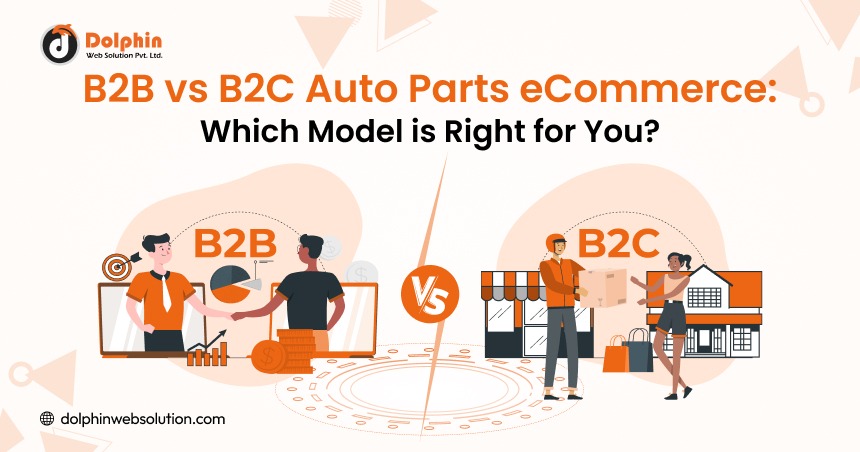

Table of Contents
 Show
Show
- 1 What is B2B Auto Parts eCommerce?
- 2 What is B2C Auto Parts eCommerce?
- 3 Key Differences Between B2B and B2C Auto Parts eCommerce
- 4 Pros and Cons of B2B eCommerce for Auto Parts
- 5 Pros and Cons of B2C eCommerce for Auto Parts
- 6 How to Choose Between B2B and B2C for Your Auto Parts Business?
- 7 Conclusion

Summary :
Are you confused between the B2B vs B2C auto parts eCommerce model? This guide helps you understand both B2B and B2C auto parts eCommerce, their key differences, their pros and cons, and how to choose the right one for your business growth.
With the rapid evolution of online shopping, the auto parts eCommerce sector is experiencing digital transformation. Businesses are now focusing more on digitalization to boost their reach.
In fact, the global automotive eCommerce market is expected to reach $343.13 billion by 2032 with a CAGR of 16.7%. It shows how fast automotive businesses adopt digital presence to grow their business.
However, auto parts businesses are confused about whether to focus on selling to other companies (B2B) or directly to consumers (B2C). Each model comes with its benefits, challenges, and strategies.
Whether you are an auto parts manufacturer, distributor, or retailer, the rise of online shopping has opened up new opportunities, but choosing the right models matters the most for success.
Now, which model should you choose for your business, B2B or B2C?
Understanding the specific needs of each model is key to making the right choice.
That is why, In this blog, we will understand everything about B2B and B2C auto parts eCommerce, the key differences between their pros and cons, and how you can choose the right model for your business.
By the end of this blog, you will know exactly which model is best for your auto parts business.
What is B2B Auto Parts eCommerce?
B2B Auto Parts eCommerce refers to the online buying and selling of auto parts between businesses.
Instead of relying on traditional methods like telephone calls, store visits, or printed catalogs. Now, businesses use online platforms to browse catalogs, order, and make transactions.
B2B ecommerce website development is best for manufacturers, suppliers, distributors, and repair facilities that need high-volume transactions quickly and efficiently.
In a B2B business model, bulk buying and selling are emphasized, and orders usually consist of quantities of parts in large quantities.
This online solution accelerates the purchase and sale process, making it more manageable, transparent, and faster, allowing businesses to improve efficiency, reduce costs, and increase operations.
What is B2C Auto Parts eCommerce?
B2C Auto Parts eCommerce is where businesses directly sell automobile parts to final consumers from their websites.
Instead of driving to a physical store in an automobile, automobile owners, DIYers, or people. Those needing car parts can visit your auto parts website, search through product catalogs, and order parts from home.
The B2C model emphasizes selling individual components such as tires, brake pads, and batteries directly to the consumer, highlighting smaller purchases.
B2C Auto Parts eCommerce enables customers to acquire the required parts from home. It allows companies to reach more customers online, making sales and profits.
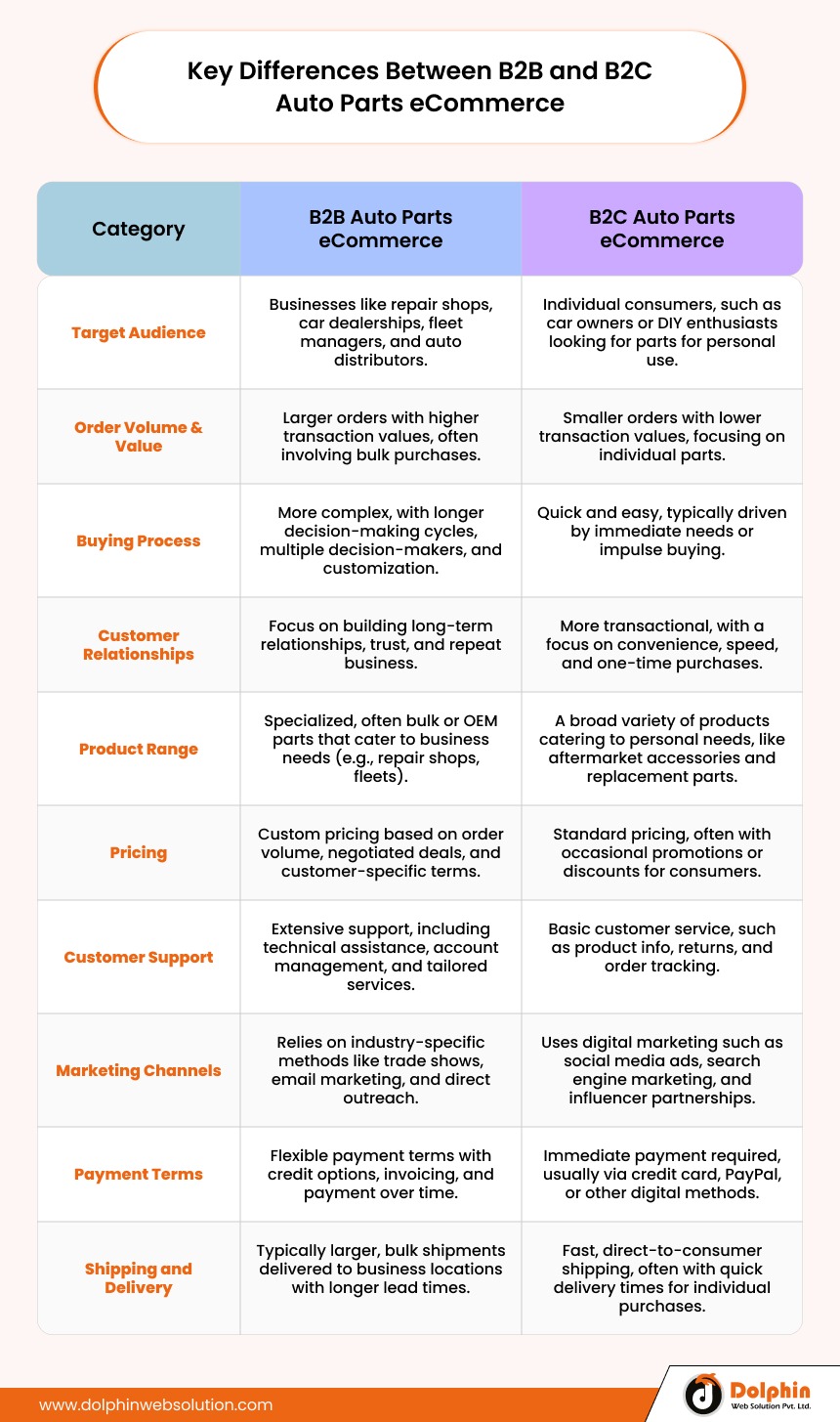
Key Differences Between B2B and B2C Auto Parts eCommerce
Here is the key difference between B2B and B2C auto parts eCommerce:
Pros and Cons of B2B eCommerce for Auto Parts
Here are some pros and cons of B2B auto parts eCommerce:
Pros
- B2B websites can help you in reaching more customers
- You can offer special prices and payment terms that suit each client best.
- Automating orders and payments reduces expenses and saves time.
- B2B makes it easier for you to scale your auto parts business.
- You can gather valuable information to optimize marketing and target your audience better.
- B2B websites enable you to customize services and payment terms.
Cons
- B2B focuses on businesses, so your customer base is smaller than B2C.
- The sales process is slower because more people are involved in the decision-making.
- Customers like personalized products, which are more challenging to handle.
- Installing and hosting a B2B site is expensive and can be a techie.
- There is a lot of competition in B2B, so you must have strong marketing to differentiate yourself.
Pros and Cons of B2C eCommerce for Auto Parts
Here are some pros and cons of B2C auto parts eCommerce:
Pros
- B2C eCommerce helps businesses expand their customer reach.
- Customers can browse at any time, compare, and purchase from home.
- You save on rent and bills since it does not require a physical shop.
- A well-designed website helps businesses expand rapidly and adapt to the evolving market.
- Customer information provides insights that improve sales and marketing efforts.
- Provides customers with special promotions and product recommendations, enhancing their experience.
- Offering customers flexible payment options makes them buy more, enhancing conversion rates.
Cons
- The B2C market is competitive and requires effective marketing and reasonable prices.
- Shipping could be complicated, and systems must be efficient in making proper and timely deliveries.
- An effective support team must manage customer queries, returns, and issues online.
- Customers will be reluctant to buy costly components if they cannot see them in person, so open product information is essential.
How to Choose Between B2B and B2C for Your Auto Parts Business?
Choosing between B2B and B2C auto parts eCommerce depends on your business goals, customer base, and resources. Each model has its advantages, and understanding the differences is crucial. Here is a breakdown to help you make an informed decision.
Choose B2B if:
- Your customers are other businesses, like repair shops or distributors.
- You can handle larger orders with bigger transaction values.
- You are okay with longer sales processes and more decision-makers.
- You are ready to offer personalized support and services.
- You want to build long-term relationships with repeat clients.
- Your business can manage bulk shipments and longer delivery times.
- You can negotiate prices and offer flexible payment options.
Choose B2C if:
- You are selling directly to individual consumers like car owners.
- You want quicker, simpler transactions with immediate decisions.
- You want to reach a wider audience beyond your local area.
- You are okay with smaller, individual purchases.
- You can provide basic customer support like returns and order tracking.
- You want to scale quickly with digital marketing.
- You are ready to invest in online ads and SEO to stand out.
Conclusion
Choosing between B2B and B2C for your auto parts business depends on your target audience and business goals. We hope this guide helps you understand each model, its key differences, and its pros and cons so that you can understand which model is suitable for your business needs, which will help you make the right choice for your business growth and success. Still confused? Connect with our experts and get complete guidance for further planning.
Rohit Prajapati


Rohit Prajapati is the Chief Executive Officer of Dolphin Web Solution and a recognized expert in eCommerce technologies, digital commerce strategy, and product development. With over 15 years of experience in the technology industry, he helps businesses build high-performing online stores, scalable digital platforms, and innovative customer experiences. As a certified Adobe Commerce Business Practitioner (Magento Solution Specialist), Rohit possesses deep expertise in Shopify, Magento, Shopware, Hyvä, and enterprise eCommerce ecosystems. He has successfully consulted businesses worldwide on platform selection, digital transformation, migration strategies, and growth-focused commerce solutions. Rohit regularly shares insights on eCommerce trends, AI-driven commerce, online business growth, and emerging technologies. His mission is to help organizations create future-ready digital experiences that drive measurable business outcomes and long-term success.

We can help you with
- Dedicated Team
- Setup Extended Team
- Product Development
- Custom App Development
Our Offices

AHMEDABAD (INDIA)
B- 203-206, Empire Business Hub, Science City Road, Sola, Ahmedabad – 380060

BERLIN (GERMANY)
Badensche Str. 28, 10715 Berlin, Germany

CALIFORNIA (USA)
9601 Reseda Blvd, Apt#223, Northridge CA-91324, USA

ALBERTA (CANADA)
302 Skyview Ranch Drive NE, Calgary, Alberta, Canada T3N0P5





Hello!
Click one of our contacts below to chat on WhatsApp