
Top 5 Ecommerce Platforms for Wholesale in 2026: Compare Features, Pricing & B2B Capabilities

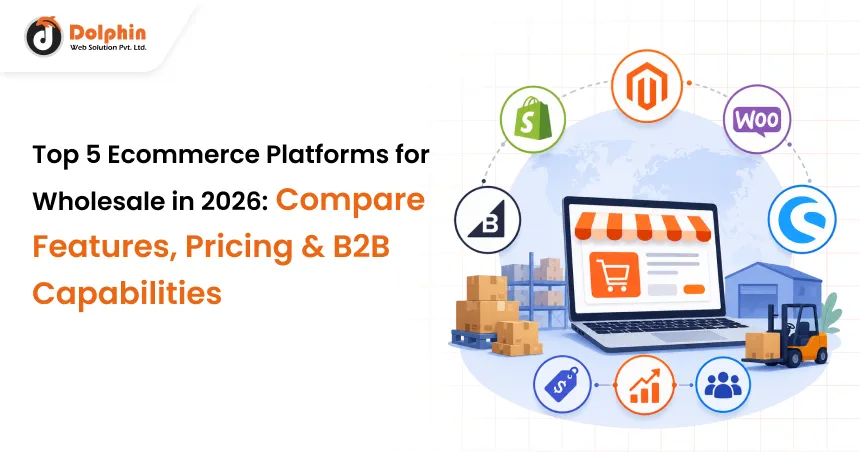

Table of Contents
 Show
Show
- 1 What Makes an Ecommerce Platform Good for Wholesale?
- 2 Top 5 Ecommerce Platforms for Wholesale in 2026
- 3 Side by Side Platform Comparison
- 4 How to Choose the Right Wholesale Ecommerce Platform
- 5 Common Mistakes Wholesale Businesses Make When Choosing a Platform
- 6 Why Choose a Dolphin Web Solution?
- 7 Conclusion

Summary :
This guide compares the top 5 ecommerce platforms for wholesale businesses in 2026 — Magento, Shopware, WooCommerce, Shopify Plus, and BigCommerce. It covers B2B features, pricing, account management, scalability, costs, and helps businesses choose the right platform. Created by Dolphin Web Solution with 15+ years of ecommerce development experience.
Wholesale ecommerce is not the same as retail ecommerce. A platform built for consumer shopping rarely meets the demands of bulk ordering, tiered pricing, company account management, and custom payment terms that wholesale businesses depend on every day.
The B2B buying experience has shifted dramatically over the past few years. Wholesale buyers now expect the same digital convenience as retail consumers. They want self service portals, real time pricing, quick order capabilities, and seamless account management without picking up the phone or sending an email.
Choosing the wrong platform means dealing with expensive workarounds, feature gaps, and a checkout experience that frustrates your buyers. The right platform handles your most complex B2B requirements out of the box and scales as your business grows.
This guide covers the five best ecommerce platforms for wholesale in 2026, comparing B2B features, pricing, pros, cons, and what type of business each one suits best. If you are planning a B2B ecommerce development project, this comparison will help you make the right call before committing to a platform.
What Makes an Ecommerce Platform Good for Wholesale?
Not every ecommerce platform is built with wholesale in mind. Most are designed primarily for retail and add B2B features as an afterthought. Platforms that genuinely work for wholesale have these capabilities built into their core architecture.
Key Features Every Wholesale Platform Must Have
- Tiered and customer group specific pricing
- Minimum order quantity controls
- Bulk ordering and quick order forms
- Company account management with multiple buyers under one account
- Custom payment terms including net 30 and net 60
- Quote and request for quote management
- Purchase order and approval workflows
- Restricted catalog visibility for registered buyers only
- ERP, inventory, and accounting integration
Wholesale vs Retail Ecommerce: Key Differences
| Factor | Retail Ecommerce | Wholesale Ecommerce |
|---|---|---|
| Pricing | Fixed public pricing | Custom tiered pricing per customer |
| Order Size | Small individual orders | Large bulk orders |
| Payment Terms | Immediate payment | Net 30, Net 60, credit terms |
| Buyer Type | Anonymous consumer | Registered business account |
| Catalog Visibility | Public | Gated or restricted |
| Checkout Flow | Standard | Custom approval workflows |
Understanding these differences is essential before evaluating any platform. Our blog on B2B ecommerce website development covers the full scope of what a proper wholesale store requires.
Top 5 Ecommerce Platforms for Wholesale in 2026
1. Magento (Adobe Commerce)
Magento is widely regarded as the most capable open source ecommerce platform for B2B and wholesale operations. Its native B2B suite is comprehensive and covers nearly every requirement a wholesale business could have without relying on third party extensions.
Adobe Commerce, the enterprise version, adds cloud hosting, AI powered product recommendations, and advanced business intelligence. The open source Community Edition is free but requires self hosting and developer expertise.
Key B2B Features
- Native company account management with multiple buyers and roles.
- Customer group pricing and shared catalogs.
- Tiered pricing based on quantity and customer type.
- Purchase order workflow with approval chains.
- Quick order and requisition lists.
- Custom payment terms per account.
- Request for quote functionality.
- Strong ERP and third party integration capabilities.
Pros
- Most complete native B2B feature set available.
- Handles very large catalogs and high transaction volumes.
- Full control over customization and business logic.
- Strong community and extension ecosystem.
- Excellent SEO and performance optimization capabilities.
Cons
- High development and ongoing maintenance cost.
- Requires experienced developers to implement correctly.
- Not suitable for small budgets or simple wholesale setups.
- Longer time to market compared to hosted platforms.
Best For
Large wholesalers, distributors, manufacturers, and enterprise B2B brands with complex pricing rules, large catalogs, and custom workflow requirements. Businesses investing in Magento development typically have the scale and complexity that justifies the investment.
2. Shopware
Shopware is a modern open source platform built on an API first architecture. Originally strong in European markets, it has grown into a serious global contender for B2B and wholesale ecommerce. Shopware 6 is the current version and represents a complete rebuild with composable commerce in mind.
Its B2B Suite covers the most important wholesale requirements without heavy customization, though it is available only on higher tier commercial editions.
Key B2B Features
- Company account structure with roles and permissions.
- Customer specific pricing and price lists.
- Rule Builder for dynamic pricing and content personalization.
- Flow Builder for automating business processes without code.
- Request for quote management.
- Custom payment and shipping rules per customer group.
- Headless and API first architecture for flexible frontend builds.
Pros
- Modern developer friendly architecture.
- Strong content and merchandising tools alongside B2B features.
- More flexible than Shopify with a lighter footprint than Magento.
- API first design supports headless and composable builds.
- Active open source community with growing partner network.
Cons
- B2B Suite is only available on paid commercial editions.
- Smaller extension ecosystem compared to Magento or Shopify.
- Requires experienced developers for complex implementations.
- Still building brand recognition outside Europe.
Best For
Mid market wholesalers and B2B brands looking for a modern alternative to Magento. Businesses that want open source flexibility with a cleaner architecture will find Shopware a compelling option. The Shopware vs Magento comparison covers how these two platforms differ at an architectural and feature level.
3. WooCommerce
WooCommerce powers a significant share of ecommerce stores worldwide and benefits from the enormous WordPress ecosystem. For wholesale businesses with smaller catalogs, existing WordPress infrastructure, or tighter budgets, WooCommerce is a practical and flexible option.
Native B2B features in WooCommerce are limited, but a combination of well supported plugins can replicate most wholesale functionality at a fraction of the cost of enterprise platforms.
Key B2B Features
- Wholesale Suite plugin for tiered pricing and wholesale user roles.
- Customer specific pricing through plugins.
- Minimum order quantity controls via extensions.
- Company account management through third party plugins.
- Integration with accounting and ERP tools.
- WooCommerce Subscriptions for recurring wholesale orders.
Pros
- No platform subscription fee.
- Massive plugin ecosystem covering most wholesale requirements.
- Full ownership and control of your store and data.
- Ideal for content driven stores that rely heavily on SEO.
- Lower initial development cost compared to Magento or Shopware.
Cons
- Native B2B features require plugins rather than built in functionality.
- Performance depends heavily on hosting quality and optimization.
- Security and updates are the store owner's responsibility.
- Not ideal for very large catalogs or extremely high order volumes.
Best For
Small to mid sized wholesalers, businesses already running on WordPress, and distributors with moderate catalog complexity that do not need enterprise level B2B workflows. If you are weighing WooCommerce against another open source option, Shopware vs WooCommerce offers a useful side by side perspective.

4. Shopify Plus
Shopify Plus is the enterprise tier of Shopify, designed for high volume merchants including wholesale and B2B sellers. Shopify has invested heavily in B2B functionality in recent years and the current feature set is far more capable than what standard plans offer.
It remains a hosted platform, which means Shopify manages infrastructure, security, and uptime. This makes it easier to run but limits deep customization compared to open source alternatives.
Key B2B Features
- Dedicated B2B sales channel with company profiles.
- Customer specific price lists and payment terms.
- Blended stores supporting both retail and wholesale from one backend.
- Custom checkout via Shopify Functions.
- Wholesale order forms and bulk ordering.
- Draft orders and manual invoicing.
- Net payment terms for B2B buyers.
- Headless commerce support via Storefront API.
Pros
- Fastest path to a functioning wholesale store.
- Reliable hosting with excellent uptime.
- Strong app ecosystem for extending B2B functionality.
- Good support for multichannel and international selling.
- Easier to manage without deep technical resources.
Cons
- Monthly cost starts from $2,500 which is significant for smaller wholesalers.
- Customization is limited compared to open source platforms.
- Complex B2B pricing logic can require workarounds.
- Transaction fees apply when not using Shopify Payments.
- Less control over technical SEO compared to open source platforms.
Best For
Wholesale businesses that want a fast, reliable launch without managing server infrastructure. Brands that sell both retail and wholesale from one storefront will find Shopify Plus particularly well suited.
5. BigCommerce
BigCommerce is a hosted SaaS platform with strong native B2B capabilities that punch above its price point. It does not charge transaction fees on any plan, which is a meaningful advantage for wholesale businesses processing large order volumes.
BigCommerce B2B Edition, available as an add-on, significantly extends native B2B functionality and brings it closer to what Magento and Shopware offer natively.
Key B2B Features
- Customer groups with custom pricing and catalog visibility.
- Price lists for account specific pricing.
- B2B Edition add-on with company accounts, buyer roles, and invoice management.
- No transaction fees on any plan.
- Strong multichannel selling capabilities.
- Headless commerce support via API.
- Sales representative management tools.
Pros
- No transaction fees at any plan level.
- More built in features than standard Shopify at similar price points.
- Strong headless and API capabilities.
- Reliable hosted infrastructure with good uptime.
- Good fit for businesses selling across multiple channels.
Cons
- Annual sales thresholds that force plan upgrades.
- Full B2B functionality requires the B2B Edition add-on at extra cost.
- Smaller app marketplace compared to Shopify.
- Less brand recognition than Shopify or Magento in some markets.
Best For
Growing wholesale and B2B brands that want hosted reliability with strong built in B2B features and no transaction fees, particularly if you sell across multiple channels simultaneously.
Side by Side Platform Comparison
| Feature | Magento | Shopware | WooCommerce | Shopify Plus | BigCommerce |
|---|---|---|---|---|---|
| Native B2B Suite | ✅ | ✅ | Plugin | ✅ | ✅ |
| Tiered Pricing | ✅ | ✅ | Plugin | ✅ | ✅ |
| Company Accounts | ✅ | ✅ | Plugin | ✅ | ✅ |
| Quote and RFQ | ✅ | ✅ | Plugin | Limited | ✅ |
| Custom Payment Terms | ✅ | ✅ | Plugin | ✅ | ✅ |
| Approval Workflows | ✅ | ✅ | ❌ | Limited | ✅ |
| Open Source | ✅ | ✅ | ✅ | ❌ | ❌ |
| Headless Ready | ✅ | ✅ | Limited | ✅ | ✅ |
| Transaction Fees | None | None | None | Yes* | None |
| Scalability | Very High | High | Medium | High | High |
Shopify Plus charges transaction fees when not using Shopify Payments.
How to Choose the Right Wholesale Ecommerce Platform
- Choose Magento if your business has a large catalog, complex B2B pricing rules, multiple storefronts, and the budget to support a proper enterprise implementation.
- Choose Shopware if you want a modern open source platform with strong B2B features and a developer friendly architecture without the full complexity of a Magento build.
- Choose WooCommerce if you are already on WordPress, have a smaller catalog, and want full ownership of your store without a platform subscription fee.
- Choose Shopify Plus if you want a fast and reliable launch and prefer managed hosting over the responsibility of maintaining your own server infrastructure.
- Choose BigCommerce if you want hosted reliability with strong built in B2B features and no transaction fees, particularly if you sell across multiple channels.
For a broader technical comparison across the leading platforms, Magento vs Shopify vs WooCommerce breaks down the key differences in depth.
Common Mistakes Wholesale Businesses Make When Choosing a Platform
- Treating it like a retail ecommerce project: Wholesale stores have fundamentally different requirements. A platform evaluation focused only on storefront design and product display misses the most important capabilities entirely.
- Ignoring ERP and inventory integration: Wholesale operations depend on accurate real time inventory data. If your platform cannot integrate cleanly with your ERP or inventory system, you will be managing data manually across multiple systems.
- Underestimating pricing complexity: Wholesale pricing logic can be extremely complex with different rates per customer, per quantity, per product category, and per region. Not every platform handles this natively.
- Choosing without developer input: A brief conversation with an experienced ecommerce developer before committing to a platform can prevent months of costly problems later.
- Focusing only on launch cost: Total cost of ownership including hosting, maintenance, extensions, and developer support matters far more than the initial build cost across a three to five year horizon.
Why Choose a Dolphin Web Solution?
Building a wholesale ecommerce store requires more than picking the right platform. The implementation, integration, and ongoing optimization determine whether your store actually performs at the level your business demands.
Dolphin Web Solution has over 15 years of experience in ecommerce development across Magento, Shopware, WooCommerce, and Shopify. Our team has worked with wholesale businesses, distributors, and B2B brands across industries including auto parts, industrial supplies, fashion wholesale, and healthcare.
We bring platform expertise, B2B specific development experience, and a practical understanding of what wholesale buyers expect from a modern digital experience. Every project we deliver is built with performance, scalability, and long term maintainability in mind.

Conclusion
The best ecommerce platform for wholesale in 2026 depends entirely on your business size, catalog complexity, B2B workflow requirements, and budget. Magento leads for enterprise complexity. Shopware offers a modern open source alternative. WooCommerce works well for smaller operations on WordPress. Shopify Plus provides the fastest path to a reliable wholesale store. BigCommerce delivers strong built in B2B features without transaction fees.
Whichever platform you choose, working with a team that understands wholesale ecommerce from the ground up makes the difference between a store that just works and one that genuinely drives business growth. Contact Dolphin Web Solution to discuss your wholesale ecommerce project and get a platform recommendation tailored to your specific requirements.
Frequently Asked Questions
What is the best ecommerce platform for wholesale business?
Magento and Shopware are the strongest options for complex wholesale operations with large catalogs and advanced B2B requirements. Shopify Plus and BigCommerce are better suited for businesses that want hosted reliability with solid B2B features and faster time to market.
Can Shopify handle wholesale orders?
Shopify Plus includes a dedicated B2B sales channel with company accounts, customer specific pricing, and net payment terms. Standard Shopify plans have very limited B2B capability and are not suitable for serious wholesale operations.
Is Magento good for B2B wholesale?
Yes. Magento has one of the most comprehensive native B2B feature sets available, including company accounts, tiered pricing, purchase order workflows, and shared catalogs. It is the platform of choice for large and complex wholesale operations.
What is the difference between B2B and B2C ecommerce platforms?
B2C platforms are designed for consumer shopping with fixed public pricing and standard checkout flows. B2B platforms support company accounts, custom pricing per buyer, bulk ordering, approval workflows, and custom payment terms that wholesale business relationships require.
Does WooCommerce support wholesale pricing?
WooCommerce does not include wholesale pricing natively but supports it through plugins like Wholesale Suite. This covers tiered pricing, wholesale user roles, and minimum order quantities, making it a workable option for smaller wholesale operations.
Which wholesale ecommerce platform is best for small distributors?
WooCommerce is the most cost effective starting point for small distributors already using WordPress. Shopify Plus is a better option if ease of management and hosted reliability matter more than minimizing subscription costs.
How much does a wholesale ecommerce website cost?
Costs vary significantly by platform and complexity. A WooCommerce wholesale store can start from $5,000 to $20,000. A Shopify Plus implementation typically ranges from $15,000 to $60,000. A Magento or Shopware enterprise build can range from $30,000 to $200,000 depending on the scope of requirements.
Do I need a custom built wholesale platform or can I use an existing one?
For most wholesale businesses, an existing platform configured and customized by an experienced development team is the right approach. Custom built platforms are only justified for very large enterprises with requirements that no existing platform can meet.
Rohit Prajapati


Rohit Prajapati is the Chief Executive Officer of Dolphin Web Solution and a recognized expert in eCommerce technologies, digital commerce strategy, and product development. With over 15 years of experience in the technology industry, he helps businesses build high-performing online stores, scalable digital platforms, and innovative customer experiences. As a certified Adobe Commerce Business Practitioner (Magento Solution Specialist), Rohit possesses deep expertise in Shopify, Magento, Shopware, Hyvä, and enterprise eCommerce ecosystems. He has successfully consulted businesses worldwide on platform selection, digital transformation, migration strategies, and growth-focused commerce solutions. Rohit regularly shares insights on eCommerce trends, AI-driven commerce, online business growth, and emerging technologies. His mission is to help organizations create future-ready digital experiences that drive measurable business outcomes and long-term success.

We can help you with
- Dedicated Team
- Setup Extended Team
- Product Development
- Custom App Development
Our Offices

AHMEDABAD (INDIA)
B- 203-206, Empire Business Hub, Science City Road, Sola, Ahmedabad – 380060

BERLIN (GERMANY)
Badensche Str. 28, 10715 Berlin, Germany

CALIFORNIA (USA)
9601 Reseda Blvd, Apt#223, Northridge CA-91324, USA

ALBERTA (CANADA)
302 Skyview Ranch Drive NE, Calgary, Alberta, Canada T3N0P5





Hello!
Click one of our contacts below to chat on WhatsApp