
Why Your Magento Store Needs a Performance Optimisation Strategy


Table of Contents
 Show
Show
- 1 Introduction
- 2 The Real Cost of a Slow Magento Store
- 3 Common Reasons Magento Stores Slow Down
- 4 What a Performance Optimisation Strategy Actually Covers
- 5 Performance and SEO Go Hand in Hand
- 6 Building a Long Term Performance Strategy
- 7 Why Expert Support Makes a Measurable Difference
- 8 Why Store Owners Trust Dolphin Web Solution With Magento Performance
- 9 Conclusion

Summary :
This blog explains why performance optimisation should be an ongoing priority for Magento stores. It covers the key factors affecting Magento performance, the business impact of slow page speeds, and practical strategies businesses can use to build a faster, more efficient, and conversion focused online store.
Introduction
Online shoppers rarely wait around. If your Magento store takes more than a few seconds to load, most visitors will simply leave and buy from a competitor instead. For store owners, this is not a small inconvenience. It is a direct hit to revenue, search visibility, and brand reputation.
Magento is a powerful platform capable of running large, complex catalogs, but that same power comes with a cost. Without proper optimisation, Magento stores tend to accumulate bloated code, unused extensions, unoptimised images, and inefficient database queries over time. The result is a store that feels heavier with every passing month.
This is exactly why a defined performance optimisation strategy matters. It is not a one time fix. It is an ongoing process that keeps your store fast, stable, and ready to scale as your business grows.
The Real Cost of a Slow Magento Store
Every additional second your store takes to load has a measurable business impact. Studies across the e commerce industry consistently show that even a one second delay can reduce conversions noticeably. For a store generating steady traffic, that adds up to thousands of dollars in lost sales every year.
Beyond conversions, speed also affects how Google views your store. Search engines factor page experience and load speed into ranking decisions, which means a sluggish store can lose organic visibility over time, even if the content itself is strong.
There is also a trust factor. Shoppers associate speed with reliability. A store that loads slowly or feels unresponsive during checkout raises doubts about security and professionalism, often before a customer has even seen your products.
Common Reasons Magento Stores Slow Down
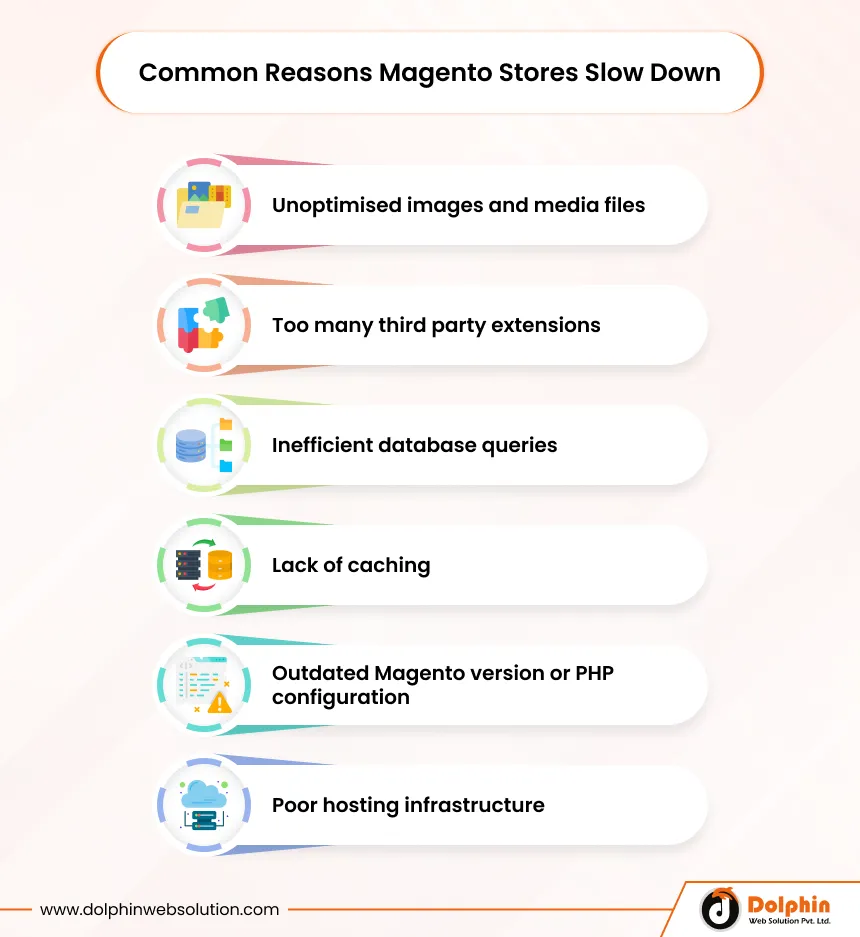
Before building a strategy, it helps to understand where performance problems usually originate. A few of the most frequent culprits include:
- Unoptimised images and media files: Large, uncompressed product images are one of the biggest contributors to slow page loads, especially on category and product pages with dozens of thumbnails.
- Too many third party extensions: Every extension adds extra code that needs to load and execute. Stacking too many, especially poorly coded ones, creates conflicts and drags down performance.
- Inefficient database queries: As product catalogs and order histories grow, poorly indexed or unoptimised queries can slow down everything from search to checkout.
- Lack of caching: Magento relies heavily on caching layers such as full page cache and Redis. When these are misconfigured or disabled, every request puts unnecessary load on the server.
- Outdated Magento version or PHP configuration: Running an old Magento version or an unsupported PHP version means missing out on performance improvements the platform has already built in.
- Poor hosting infrastructure: Even a perfectly coded store will struggle on shared or undersized hosting that cannot handle traffic spikes.
What a Performance Optimisation Strategy Actually Covers
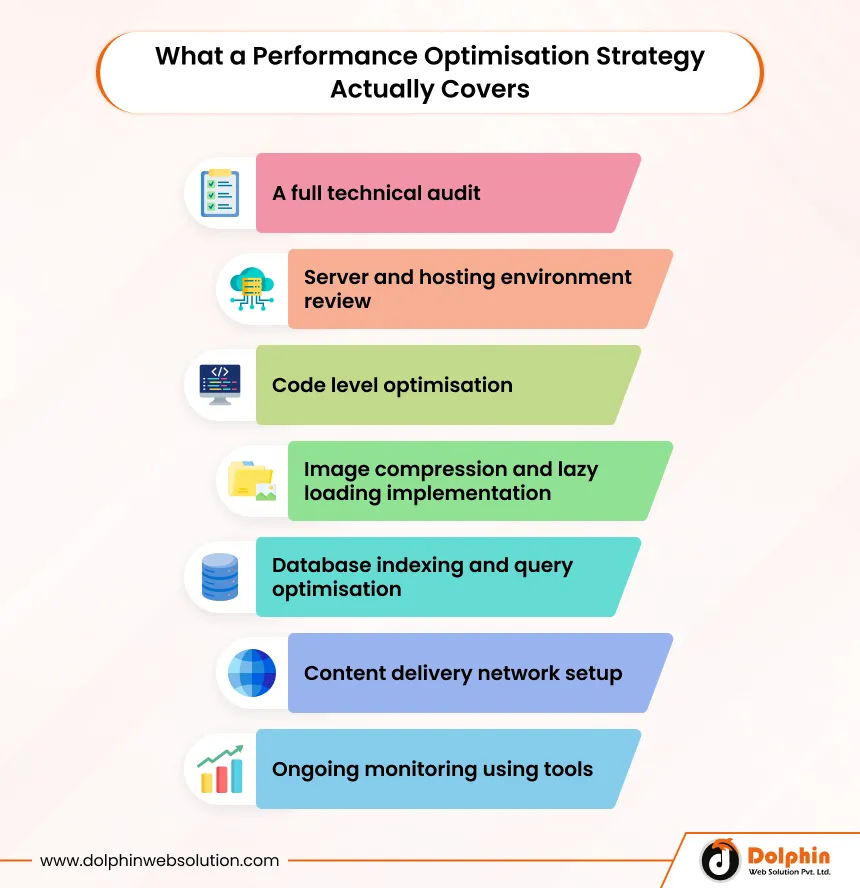
A genuine optimisation strategy goes far beyond installing a caching plugin. It typically includes:
- A full technical audit of front end and back end performance
- Server and hosting environment review, including PHP, MySQL, and Redis configuration
- Code level optimisation to remove redundant or conflicting scripts
- Image compression and lazy loading implementation
- Database indexing and query optimisation
- Content delivery network setup for faster global load times
- Ongoing monitoring using tools like Google PageSpeed Insights, Lighthouse, and New Relic
This is precisely the kind of structured work our team handles through dedicated Magento 2 Development services, where performance is treated as a core part of the build rather than an afterthought.
Performance and SEO Go Hand in Hand
Google has been clear that page experience signals, including load speed and stability, play a role in how pages rank. A technically sound Magento store supports every other SEO effort you make, from content to backlinks. If your pages load slowly, even well written content and strong keyword targeting will struggle to perform at their full potential.
This is also where emerging technology can help. Many stores are now using intelligent tools to personalise product recommendations, automate customer support, and streamline operations without adding unnecessary load to the front end. If you are curious how this fits into a modern Magento setup, our detailed guide on AI Integration in Magento explains the practical applications in more depth.

Building a Long Term Performance Strategy
Performance optimisation should not be treated as a single project with a start and end date. Magento stores evolve constantly, with new products, promotions, extensions, and design updates being added regularly. Each change has the potential to introduce new performance issues.
A long term strategy typically includes:
- Baseline benchmarking to understand current load times across key pages such as home, category, product, and checkout.
- Regular audits, ideally quarterly, to catch new bottlenecks before they affect customers.
- Proactive monitoring using automated alerts for uptime, server load, and page speed.
- Scheduled maintenance including database cleanup, log rotation, and cache clearing.
- Scalability planning so your infrastructure can handle seasonal traffic spikes such as sales events or holiday shopping periods.
Store owners who treat performance as an ongoing discipline consistently see better retention, stronger conversion rates, and steadier organic growth compared to those who only address speed issues after something breaks.
Why Expert Support Makes a Measurable Difference
Magento performance tuning requires a combination of server administration knowledge, front end optimisation skills, and a deep understanding of how Magento itself processes requests. Getting this balance wrong can create new problems, such as broken layouts or cache related bugs, instead of solving the original issue.
This is why many growing businesses choose to work with a dedicated development partner rather than relying solely on in house resources. If your internal team needs additional bandwidth or specialised expertise, you can explore options to Hire Magento 2 Developers who focus specifically on performance, scalability, and long term platform health.

Why Store Owners Trust Dolphin Web Solution With Magento Performance
- We have been inside Magento's core long enough to know where it breaks: Fifteen plus years of hands on work with Magento's indexing, caching layers, and database structure means we are not guessing at what slows a store down. We have seen the same bottlenecks repeat across hundreds of stores, and we know which fixes hold up under real traffic versus which ones only look good in a staging environment.
- Every audit starts with your store, not a checklist: We do not run a generic speed test and hand you a template report. Our team looks at your actual server setup, extension stack, catalog size, and traffic patterns before recommending anything, because the right fix for a five thousand SKU store rarely matches the right fix for a boutique catalog.
- We optimise around your customizations instead of erasing them: Most Magento stores we take on have years of custom modules, theme edits, and third party integrations already in place. Rather than pushing a rebuild, we identify what is actually causing drag and fix it without disrupting the features your business already depends on.
- Our fixes go beyond the front end: A fast loading homepage means little if checkout stalls under load or the database chokes during a sale. We work across server configuration, PHP and MySQL tuning, and code level cleanup, because real performance gains come from the full stack, not just image compression.
- We build for the traffic spikes you actually get, not average days: Flash sales, seasonal promotions, and paid campaigns can multiply your normal traffic overnight. We stress test and scale infrastructure with those moments in mind, so your store holds up when it matters most, not just on a quiet Tuesday.
- The team that audits your store is the team that maintains it: There is no handoff between diagnosis and execution. The developers who identify your performance issues are the same ones who implement the fixes and monitor the results afterward, so nothing gets lost in translation.
Conclusion
A Magento store is never truly finished. As your catalog grows, your traffic increases, and your marketing efforts bring in more visitors, performance needs to keep pace. Treating optimisation as an ongoing strategy rather than a one time task protects your search rankings, your conversion rates, and ultimately your bottom line.
If your store has started to feel slower than it used to, or you simply want to make sure it is prepared for future growth, now is the right time to invest in a proper performance strategy.
Frequently Asked Questions
How do I know if my Magento store has a performance problem?
Common signs include slow page load times, high bounce rates on product pages, cart abandonment during checkout, and lower rankings compared to competitors. Running your store through Google PageSpeed Insights or Lighthouse is a good first step to identify specific issues.
How often should I audit my Magento store for performance?
Most stores benefit from a full technical audit at least once every quarter, with lighter monitoring happening continuously. Stores with frequent updates or high traffic may need more regular reviews.
Can too many extensions really slow down my store?
Yes. Each extension adds additional code that Magento needs to process. Poorly coded or conflicting extensions are one of the most common causes of slow load times and unexpected bugs.
Does upgrading to the latest Magento version improve performance?
In most cases, yes. Newer Magento versions include performance improvements, security patches, and better compatibility with modern PHP and MySQL versions, all of which contribute to a faster store.
Will performance optimisation actually improve my search rankings?
Page speed and overall page experience are known ranking factors for Google. While optimisation alone will not guarantee top rankings, a slow store can actively hold back the results of your other SEO efforts.
How long does a typical Magento performance optimisation project take?
Timelines vary depending on the size and complexity of the store, but most projects range from a couple of weeks for focused fixes to a few months for a full scale audit, replatforming, or infrastructure overhaul.
Rohit Prajapati


Rohit Prajapati is the Chief Executive Officer of Dolphin Web Solution and a recognized expert in eCommerce technologies, digital commerce strategy, and product development. With over 15 years of experience in the technology industry, he helps businesses build high-performing online stores, scalable digital platforms, and innovative customer experiences. As a certified Adobe Commerce Business Practitioner (Magento Solution Specialist), Rohit possesses deep expertise in Shopify, Magento, Shopware, Hyvä, and enterprise eCommerce ecosystems. He has successfully consulted businesses worldwide on platform selection, digital transformation, migration strategies, and growth-focused commerce solutions. Rohit regularly shares insights on eCommerce trends, AI-driven commerce, online business growth, and emerging technologies. His mission is to help organizations create future-ready digital experiences that drive measurable business outcomes and long-term success.

We can help you with
- Dedicated Team
- Setup Extended Team
- Product Development
- Custom App Development
Our Offices

AHMEDABAD (INDIA)
B- 203-206, Empire Business Hub, Science City Road, Sola, Ahmedabad – 380060

BERLIN (GERMANY)
Badensche Str. 28, 10715 Berlin, Germany

CALIFORNIA (USA)
9601 Reseda Blvd, Apt#223, Northridge CA-91324, USA

ALBERTA (CANADA)
302 Skyview Ranch Drive NE, Calgary, Alberta, Canada T3N0P5





Hello!
Click one of our contacts below to chat on WhatsApp