
Custom AI Software Development Cost in 2026

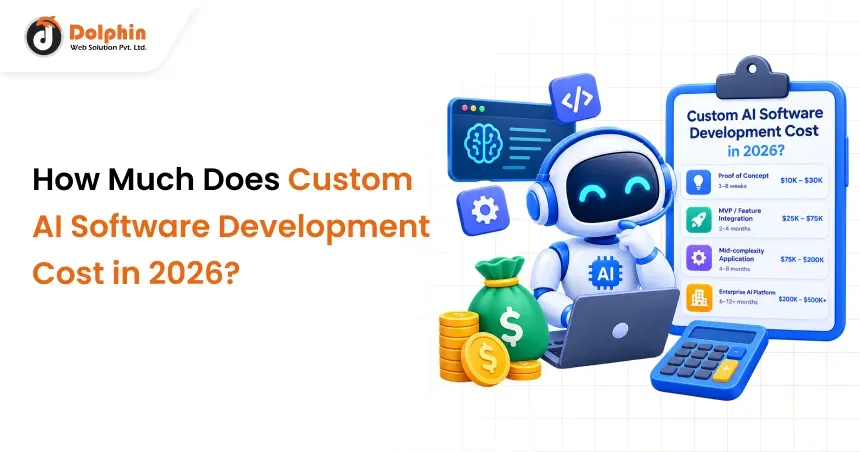

Table of Contents
 Show
Show
- 1 What Is Custom AI Software Development?
- 2 Custom AI Software Development Cost in 2026: Indicative Ranges
- 3 Key Factors That Influence AI Software Development Cost
- 4 Cost by Type of AI Solution
- 5 Cost Breakdown by Development Phase
- 6 Hidden and Ongoing Costs Most Budgets Miss
- 7 In House Team vs Outsourcing: Which Costs Less?
- 8 How to Control Your AI Development Budget
- 9 Why Partner with an Experienced Development Team of Dolphin Web Solution
- 10 Conclusion

Summary :
Custom AI software in 2026 can cost anything from a focused proof of concept to a large enterprise platform. This guide explains indicative cost ranges by project tier and solution type, the factors that move the budget, the running costs most teams overlook, and practical ways to control spending. It also compares in house teams with outsourcing and explains how an experienced partner helps you plan a realistic, phased AI budget.
What Is Custom AI Software Development?
Custom AI software is built around your business data, workflows, and goals instead of being bought as a generic product. It can be a brand new application or an AI layer added to systems you already run.
Common examples include:
- Conversational assistants trained on your product catalog, policies, or support history.
- Recommendation engines for ecommerce stores.
- Document processing tools that read invoices, contracts, or claims.
- Demand forecasting and inventory planning models.
- Computer vision for quality inspection or visual product search.
- AI agents that complete multistep tasks across your internal tools.
Custom AI vs Off the Shelf AI Tools
The difference comes down to fit and control. Off the shelf AI tools cost less upfront, usually as a subscription, but they are built for general use and limited to the connectors and settings the vendor provides. Custom AI software costs more to build, yet it is designed around your processes, integrates as deeply as your systems allow, and handles data under rules you define.
Long term costs differ too. Subscription fees tend to grow with seats or usage, while custom software carries hosting, usage, and maintenance costs. The biggest advantage of custom AI is that competitors cannot simply buy the same tool.
Off the shelf tools are often the right starting point. Custom development makes sense when a tool cannot handle your data, your workflow, or your scale.
Custom AI Software Development Cost in 2026: Indicative Ranges
Most custom AI projects fall into one of four broad tiers, from a small proof of concept to a full enterprise platform. The table below shows indicative planning ranges in US dollars.
| Project tier | What it typically includes | Indicative cost (USD) | Indicative timeline |
|---|---|---|---|
| Proof of concept | Tests one use case on sample data to check feasibility | $10,000 to $30,000 | 3 to 8 weeks |
| MVP or AI feature integration | One AI feature built on an existing model API and connected to your app | $25,000 to $75,000 | 2 to 4 months |
| Mid complexity AI application | Several features, retrieval over your own data, and integrations with CRM, ERP, or ecommerce platforms | $75,000 to $200,000 | 4 to 8 months |
| Enterprise AI platform | Custom or fine tuned models, multiple data pipelines, strict security and compliance, high scale | $200,000 to $500,000 or more | 6 to 12 months or more |
These are planning ranges, not quotes. Your actual cost depends on scope, data readiness, team location, and compliance needs, which we cover next.
Key Factors That Influence AI Software Development Cost
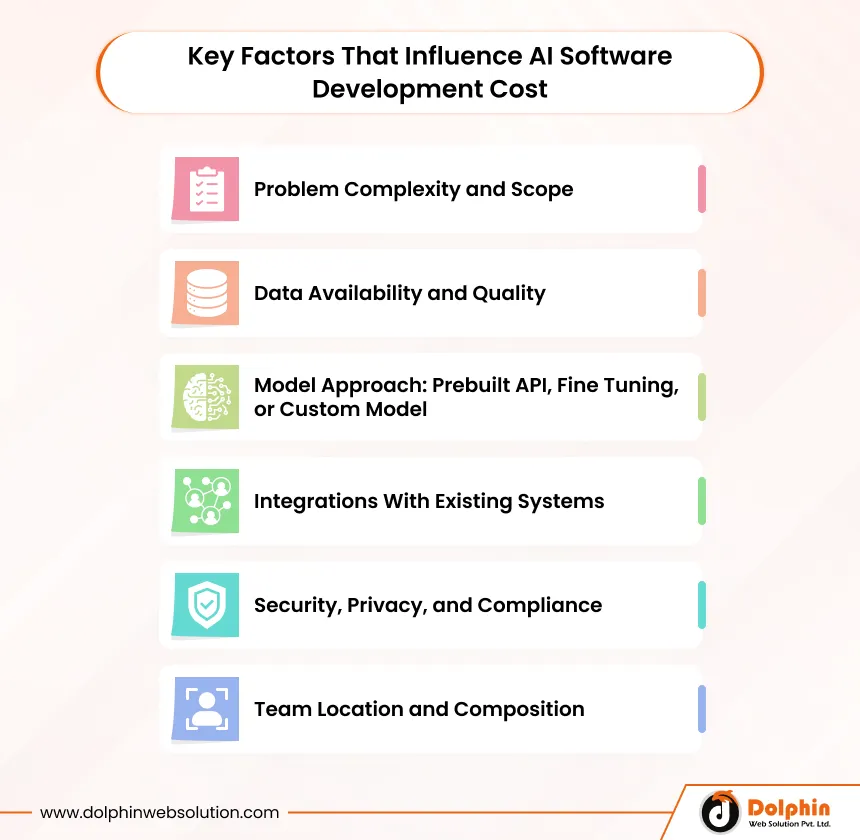
Scope and data readiness usually move the budget more than anything else, but six variables together shape the final number.
1. Problem Complexity and Scope
A single feature that answers customer questions from a knowledge base is far simpler than a system that makes decisions, triggers actions, and learns from outcomes. Every additional feature, user role, and edge case adds design, development, and testing time.
2. Data Availability and Quality
AI is only as good as the data behind it. If your data is scattered across systems, inconsistent, or unlabeled, a meaningful part of the budget goes into collecting, cleaning, and structuring it before any model work begins. Teams with clean, accessible data move faster and spend less.
3. Model Approach: Prebuilt API, Fine Tuning, or Custom Model
- Prebuilt model via API: Uses an existing commercial or open model with prompt design and retrieval over your data. It has the lowest upfront cost and suits chatbots, summarization, smart search, and content features.
- Fine tuned model: Adapts an existing model to your domain using your own examples. Upfront cost is moderate, and it works well for specialized language, consistent output formats, and domain accuracy.
- Custom trained model: Trains a model largely on your proprietary data. It carries the highest upfront cost and fits unique prediction, forecasting, or vision problems.
Many businesses start with the API approach and move to fine tuning only when there is a clear accuracy or cost reason to do so.
4. Integrations With Existing Systems
Connecting AI to your ERP, CRM, ecommerce platform, payment systems, or legacy databases is often where hidden effort lives. Older systems without modern APIs may need middleware or custom connectors, which adds development time.
5. Security, Privacy, and Compliance
Projects that handle personal, financial, or health data need access controls, encryption, audit trails, and sometimes regional data hosting. Obligations under laws such as the EU's GDPR or India's Digital Personal Data Protection Act, along with sector rules in healthcare and finance, add review and engineering effort.
6. Team Location and Composition
A typical AI project draws on several roles:
- AI or machine learning engineers
- Data engineers
- Backend and frontend developers
- UI and UX designers
- QA engineers
- A project manager or product owner
Rates for these roles vary widely by region and seniority, which we cover in the outsourcing section below.
Cost by Type of AI Solution
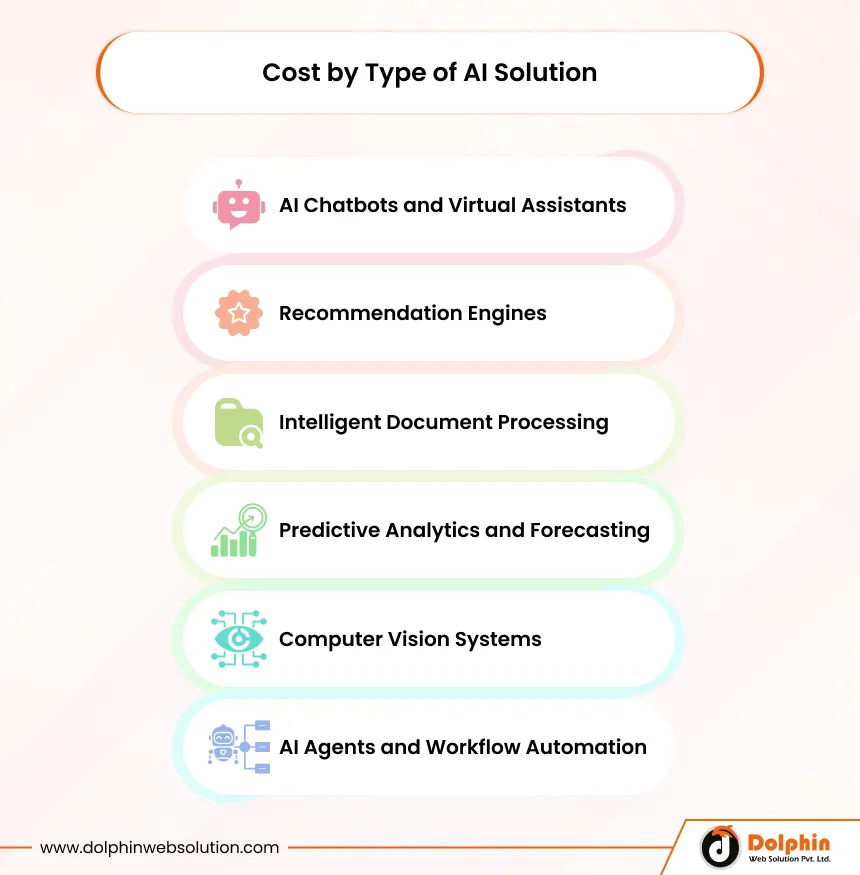
The kind of solution you build sets a baseline before any other factor applies. The ranges below are indicative and shift with scope, data, and integrations.
1. AI Chatbots and Virtual Assistants
Assistants that answer questions from your content and hand complex queries to human agents typically fall in an indicative range of $20,000 to $80,000. Cost rises with the number of channels, languages, and systems the assistant connects to.
2. Recommendation Engines
Personalized product or content suggestions usually range from about $40,000 to $150,000. Catalog size, the quality of your customer behavior data, and real time requirements decide where your project lands.
3. Intelligent Document Processing
Tools that extract and validate data from invoices, forms, and contracts generally fall between $40,000 and $150,000, depending on how varied your documents are and the accuracy level your process demands.
4. Predictive Analytics and Forecasting
Demand, churn, or risk prediction models often cost $50,000 to $200,000. Much of the effort goes into preparing historical data and validating that predictions hold up in real conditions.
5. Computer Vision Systems
Image or video based inspection, recognition, or visual search typically ranges from $60,000 to $250,000. Image labeling and camera or hardware integration are major cost drivers.
6. AI Agents and Workflow Automation
Agents that plan and carry out tasks across your tools can range from $50,000 to $250,000 or more, because each connected system and each automated decision needs careful testing and safeguards.
If you are planning a new AI powered product or adding intelligence to an existing app, our AI App Development team can help you define the right scope before you commit a full budget.

Cost Breakdown by Development Phase
An AI budget is spread across six phases, and cutting corners in the early ones usually makes the later ones more expensive.
- Discovery and strategy: Define the business problem, success metrics, feasibility, and data sources. This is where expert AI Consulting Services can save money by ruling out approaches that will not work before development starts.
- Data preparation: Collect, clean, label, and structure your data. This is often one of the most underestimated phases.
- Model selection or development: Choose an API model, fine tune an existing one, or train your own, then design prompts, retrieval, and evaluation methods.
- Application and integration development: Build the user interface, backend, APIs, and connections to your existing systems.
- Testing and evaluation: Check accuracy, bias, security, edge cases, and performance under real load.
- Deployment and launch: Set up cloud infrastructure, monitoring, and a controlled rollout to users.
How the budget splits across these phases varies a lot. A data heavy project spends more in phase two, while an integration heavy project spends more in phase four.
Hidden and Ongoing Costs Most Budgets Miss
Launch is not the finish line. AI software carries running costs that a traditional application often does not, and they should be planned from day one.
1. Model and API Usage Fees
If your product uses a commercial model API, you pay per use, usually based on the volume of text (tokens) processed. Costs grow with traffic and prompt length, and providers update their pricing over time, so always check the provider's current pricing page when budgeting.
2. Cloud Infrastructure and Compute
Hosting, vector databases, storage, and GPU compute for self hosted or custom models are recurring monthly costs that scale with usage.
3. Monitoring, Retraining, and Model Drift
Models can lose accuracy as customer behavior, products, or data change over time. Ongoing monitoring and periodic retraining or prompt updates keep results reliable.
4. Maintenance, Security Updates, and Support
- Library and framework updates
- Security patches and vulnerability reviews
- New feature requests from users
- Compliance reviews as regulations evolve
Ask any development partner to estimate first year running costs alongside the build cost, so you see the full picture before you commit.
In House Team vs Outsourcing: Which Costs Less?
For businesses without an existing AI team, an experienced outsourcing partner is usually the faster and more cost efficient route. An in house team makes more sense when AI is a long term core capability.
| Factor | In house team | Outsourced development partner |
|---|---|---|
| Upfront investment | Hiring, salaries, benefits, and tools | Project or monthly fee |
| Time to start | Months to recruit specialized talent | Typically weeks |
| Access to skills | Limited to the people you hire | Full team across AI, data, and software |
| Scalability | Slow to scale up or down | Flexible as needs change |
| Knowledge retention | Stays inside the company | Needs good documentation and handover |
| Best for | Long term, core AI capability | New products, defined projects, faster launch |
Approximate Hourly Rates by Region
- United States and Canada: roughly $100 to $200 or more per hour
- Western Europe and UK: roughly $70 to $150 per hour
- Eastern Europe: roughly $40 to $90 per hour
- India: roughly $25 to $60 per hour
These rates are approximate and vary widely by seniority, specialization, and company size, so confirm current rates directly with any vendor you evaluate. If you are considering an offshore partner, our guide to the Top 10 AI Software Development Companies in India is a useful place to start your shortlist.
Common Engagement Models
- Fixed price: Best for small, clearly defined projects such as a proof of concept. Cost is predictable, but scope changes need renegotiation.
- Time and materials: You pay for actual effort. Best when scope will evolve as you learn from data and user feedback.
- Dedicated team: A full team works on your product on a monthly basis. Best for long running AI programs delivered in several phases.
How to Control Your AI Development Budget
The most reliable way to keep AI costs in check is to start small, prove value, and scale only what works.
- Start with a proof of concept to validate feasibility before a full build.
- Define measurable success metrics such as time saved, conversion lift, or support tickets resolved.
- Use existing model APIs first and move to fine tuning only when your data shows a clear need.
- Audit your data early so cleanup costs do not surprise you halfway through.
- Build in phases and get an MVP in front of real users quickly.
- Plan running costs, including API usage and monitoring, from day one.
- Choose a partner who will tell you when a simpler solution without AI is enough.

Why Partner with an Experienced Development Team of Dolphin Web Solution
Getting a realistic AI budget, and staying within it, is far easier when you work with a team that has genuine depth in both AI and software engineering. Experience matters here in practical ways:
- An experienced team can tell you honestly when AI is not the right fit for your problem, so you do not spend on the wrong solution.
- Reliable estimates come from having scoped and delivered real projects, not from guesswork.
- Strong software architecture keeps AI features stable, secure, and maintainable, which lowers long term running costs.
- A team that has shipped real projects understands the gap between a working demo and a production ready system, and budgets for it upfront.
- Long standing client relationships mean ongoing support, not a one time handoff.
Dolphin Web Solution has spent more than 15 years building ecommerce platforms, custom software, and now AI powered features for businesses across industries. That combination of software engineering discipline and applied AI experience is often exactly what is missing when AI projects fail to move past the prototype stage, or when budgets grow without clear results.
Conclusion
Custom AI software development in 2026 can cost anywhere from a focused five figure proof of concept to a six figure enterprise platform. Scope, data readiness, model approach, integrations, compliance, and team location all shape where your project lands. The smartest budgets account for both the build and the running costs that follow launch.
Rather than chasing a single average number, start with a clear business problem, validate it with a small proof of concept, and scale what proves its value. With the right partner, your AI investment becomes a measurable business asset instead of an open ended experiment.
Frequently Asked Questions
1. What is the average cost of custom AI software development in 2026?
There is no single reliable average because projects vary so much. As an indicative guide, a proof of concept may cost around $10,000 to $30,000, a mid complexity AI application often falls between $75,000 and $200,000, and enterprise platforms can reach $500,000 or more. A short discovery phase gives you a figure specific to your project.
2. How long does it take to build custom AI software?
A proof of concept can take a few weeks, an MVP usually takes around 2 to 4 months, and larger platforms can take 6 to 12 months or longer. Scope, data readiness, and integrations are the biggest influences on timeline.
3. Is using an existing AI model API cheaper than building a custom model?
Usually yes, at least upfront. API based solutions avoid training costs, but usage fees grow with traffic. Fine tuned or custom models cost more to build but can make sense for specialized accuracy needs or very high volumes.
4. What ongoing costs should I expect after launching AI software?
Plan for model API usage, cloud hosting and compute, monitoring, retraining or prompt updates, security patches, and support. Ask your development partner for a first year running cost estimate along with the build quote.
5. Why do many businesses outsource AI development to India?
Many companies choose Indian development partners for lower hourly rates than North America or Western Europe, access to a large engineering talent pool, and experience working with global clients. Quality varies between companies, so review portfolios, case studies, and references before you decide.
6. How can I get an accurate cost estimate for my AI project?
Share your business goal, the data you have, the systems the solution must connect with, and your target timeline. An experienced team can then run a short discovery phase and give you an itemized estimate. Dolphin Web Solution can help you scope your project and prepare an estimate based on your specific requirements.Write a blog for our company, "Dolphin Web Solution," as per my recommendations.The title for the blog is "How Much Does Custom AI Software Development Cost in 2026?"Also, I want to write a slug, a meta title, a meta description, and a blog summary. Do not use hyphens in the article. I want to add my services and blog pages links as internal links with given anchor text in brackets.Service Page link: https://dolphinwebsolution.com/ai-app-development-services/ anchor text for this link is (AI App Development)Service Page link: https://dolphinwebsolution.com/ai-consulting-services/ anchor text for this link is (AI Consulting Services)Blog page link: https://dolphinwebsolution.com/blog/top-ai-software-development-companies-in-india/Anchor text for this link is (Top 10 AI Software Development Companies in India)Set all internal links with relevant anchor text.Do not set the same link 2 times.Also, we include 2 CTA images in our blog, so write 2 different CTA contents.Also, write according to these details: "You are the senior content strategist and SEO copywriter for Dolphin Web Solution, a leading e-commerce and software development company with over 15 years of experience. Your responsibility is to write high-quality, human-written, EEAT-focused blogs that rank on Google while generating qualified leads. Every article should educate first and sell second."Write 5 to 6 FAQs at the end.Use bullet points and tables wherever they are relevant to the outline and help present the information more clearly. Add them naturally when the content requires a structured comparison, list, process, or set of key points. Do not force them into every section; include them naturally when they improve readability, make comparisons clearer, or help organize important information.Add EEAT focused content right before the conclusion. I want to write like this “Why Partner with an Experienced Development Team of Dolphin Web SolutionChoosing between AI development and software development is easier when you work with a team that has genuine depth in both. Experience matters here in practical ways:An experienced team can tell you honestly when AI is not the right fit for your problemStrong software architecture keeps AI features stable, secure, and maintainableA team that has shipped real projects understands the gap between a working demo and a production ready systemLong standing client relationships mean ongoing support, not a one time handoffDolphin Web Solution has spent more than 15 years building ecommerce platforms, custom software, and now AI powered features for businesses across industries. That combination of software engineering discipline and applied AI experience is often exactly what’s missing when AI projects fail to move past the prototype stage.” You can use bullet points also here.You can use bullet points content in EEAT Focused content also.Use appropriate H2 and H3 headings for each outline section based on the topic and content structure. Ensure the heading hierarchy is clear and logical, with H2 for main sections and H3 for relevant subtopics. Mention H2 and H3 at the end of every outline for understanding easily.
Nimesh Patel


Nimesh Patel is the Managing Director of Dolphin Web Solution, a global eCommerce, AI, and software development company helping businesses accelerate digital growth. With over 15 years of experience in technology consulting and product development, he has successfully guided startups, SMBs, and enterprise organizations in building scalable digital solutions. Nimesh specializes in eCommerce development, custom software solutions, mobile application development, and digital transformation strategies. Throughout his career, he has worked closely with businesses across retail, healthcare, automotive, manufacturing, and technology sectors, helping them leverage modern technologies to improve operational efficiency and customer experiences. As a business leader, Nimesh is passionate about innovation, entrepreneurship, and helping organizations turn ideas into successful digital products. His insights focus on eCommerce growth, AI adoption, software development trends, and business transformation through technology.

We can help you with
- Dedicated Team
- Setup Extended Team
- Product Development
- Custom App Development
Our Offices

AHMEDABAD (INDIA)
B- 203-206, Empire Business Hub, Science City Road, Sola, Ahmedabad – 380060

BERLIN (GERMANY)
Badensche Str. 28, 10715 Berlin, Germany

CALIFORNIA (USA)
9601 Reseda Blvd, Apt#223, Northridge CA-91324, USA

ALBERTA (CANADA)
302 Skyview Ranch Drive NE, Calgary, Alberta, Canada T3N0P5





Hello!
Click one of our contacts below to chat on WhatsApp