
How Much Does It Cost to Maintain an eCommerce Website? Cost Breakdown & Factors

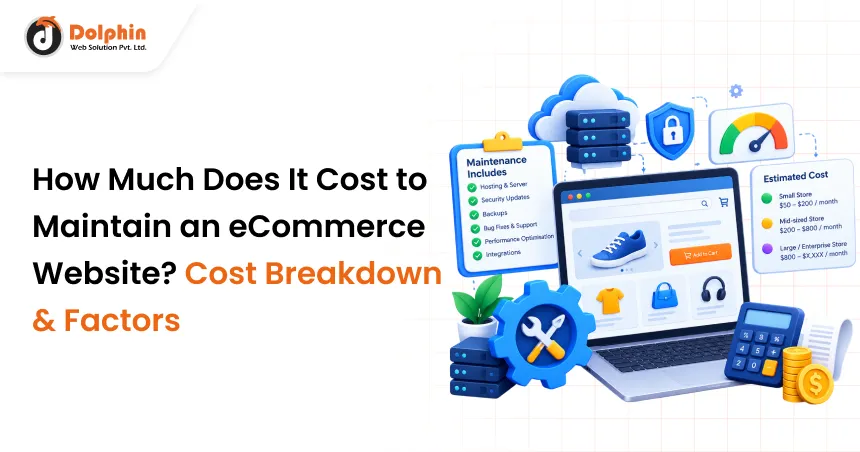

Table of Contents
 Show
Show
- 1 Introduction
- 2 Why eCommerce Website Maintenance Matters
- 3 Average Cost to Maintain an eCommerce Website
- 4 Cost Breakdown: What You Are Actually Paying For
- 5 Key Factors That Affect Your Maintenance Cost
- 6 How to Reduce eCommerce Maintenance Costs
- 7 Should You Handle Maintenance In House or Outsource It?
- 8 The Experience Behind Every Maintenance Plan We Build
- 9 Conclusion

Summary :
Maintaining an eCommerce website involves more than fixing technical issues. From hosting and security updates to performance optimisation, backups, third-party integrations, and ongoing development, several expenses contribute to the overall maintenance cost.
Introduction
Building an online store is a major milestone, but it is not the finish line. Once your store goes live, it enters a phase that many business owners underestimate: ongoing maintenance. Servers need monitoring, plugins need updating, security patches need to be applied, and your platform needs to keep pace with new features and customer expectations.
So how much does eCommerce website maintenance actually cost? The honest answer is that it depends on your platform, store size, and the level of support you need. In this guide, we will break down every component of maintenance cost, explain what drives the price up or down, and help you plan a realistic yearly budget for your store.
Why eCommerce Website Maintenance Matters
Your website is a living system, not a one time project. Search engines favor sites that load fast and stay secure. Customers expect a smooth checkout every single time. A single outdated plugin or an expired SSL certificate can lead to lost sales, damaged trust, or even a security breach.
Regular maintenance protects your revenue, your reputation, and your search rankings. Skipping it often costs far more in the long run than investing in it consistently.
Average Cost to Maintain an eCommerce Website
While every store is different, here is a general range business owners can expect:
| Store Type | Typical Catalog Size | Estimated Monthly Cost | What It Usually Covers |
|---|---|---|---|
| Small store | Under 100 products | 50 to 200 dollars | Basic hosting, SSL, core updates, minimal support |
| Mid sized store | 100 to 1000 products | 200 to 800 dollars | Better hosting, security monitoring, regular updates, moderate support hours |
| Large or enterprise store | 1000+ products, custom features | 800 dollars to several thousand dollars | Dedicated or cloud hosting, advanced security, performance tuning, dedicated support team |
These figures cover hosting, security, updates, and basic support. Custom development, marketing, and advanced integrations are usually billed separately.
Cost Breakdown: What You Are Actually Paying For
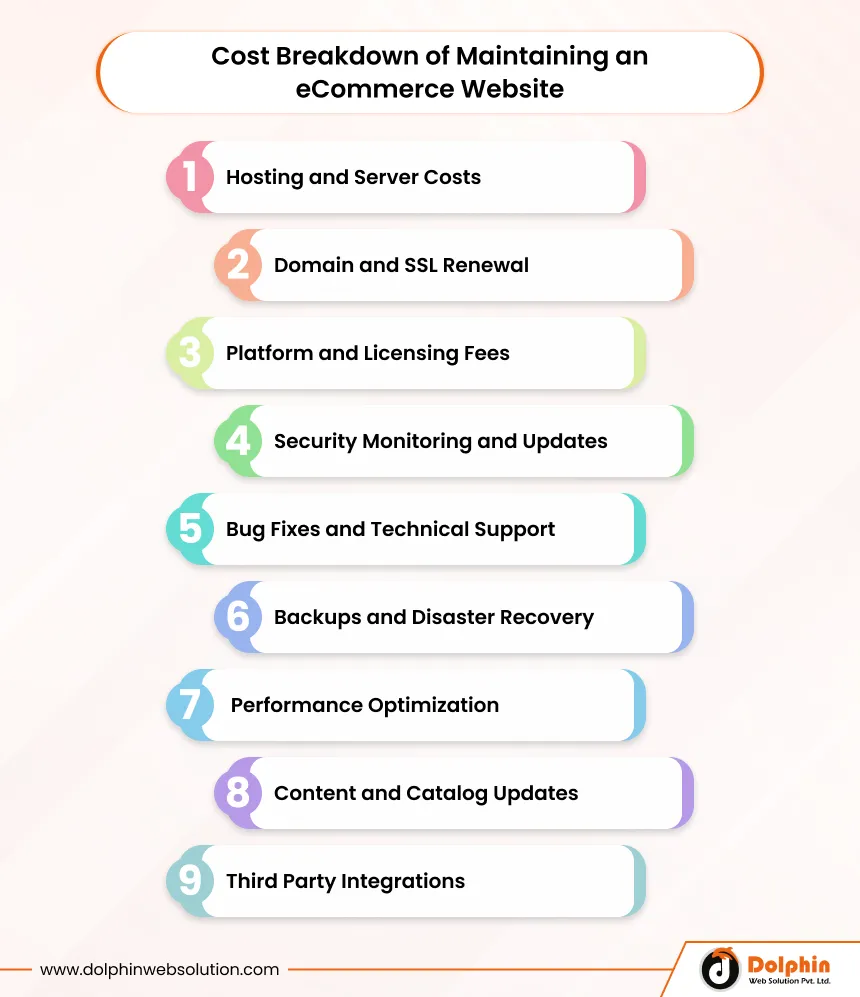
1. Hosting and Server Costs
Hosting is the foundation of your store. Shared hosting is cheap but limited, while dedicated or cloud hosting scales with traffic and offers better speed and uptime. Expect to pay anywhere from 20 dollars a month for basic shared hosting to several hundred dollars a month for a dedicated or cloud environment that can handle heavy traffic and large catalogs.
2. Domain and SSL Renewal
Domain renewal typically costs between 10 and 20 dollars per year. SSL certificates range from free (basic options) to 100 dollars or more per year for extended validation certificates that build extra trust with customers.
3. Platform and Licensing Fees
If you use a SaaS platform like Shopify, you pay a recurring subscription fee. If you use an open source platform such as Magento, WooCommerce, or PrestaShop, the software itself is free, but you may need paid extensions, themes, or enterprise licenses depending on your needs. Businesses building on a scalable open source platform often turn to our Magento 2 Development team to structure licensing and architecture the right way from day one.
4. Security Monitoring and Updates
This includes malware scanning, firewall management, regular core and plugin updates, and vulnerability patching. Security packages typically range from 30 to 300 dollars per month depending on store size and risk level.
5. Bug Fixes and Technical Support
Even a well built store will occasionally run into checkout errors, broken layouts after an update, or third party integration issues. Ongoing developer support is often billed hourly (50 to 150 dollars per hour) or through a monthly retainer.
6. Backups and Disaster Recovery
Automated daily or weekly backups protect you from data loss due to hacks, failed updates, or server crashes. This usually adds 10 to 50 dollars per month, and it is one of the least negotiable line items on this list.
7. Performance Optimization
Page speed directly affects conversions and SEO rankings. Ongoing performance work such as image optimization, caching configuration, and database cleanup can cost 100 to 500 dollars per month depending on how frequently it is done.
8. Content and Catalog Updates
Adding new products, updating pricing, refreshing banners, and managing seasonal campaigns all require time. Many businesses budget 100 to 400 dollars per month for ongoing content management, either in house or outsourced.
9. Third Party Integrations
Payment gateways, shipping APIs, CRM tools, and marketing platforms all need to stay connected and updated. Integration maintenance can range from 50 to 300 dollars per month depending on how many tools your store relies on.
Key Factors That Affect Your Maintenance Cost
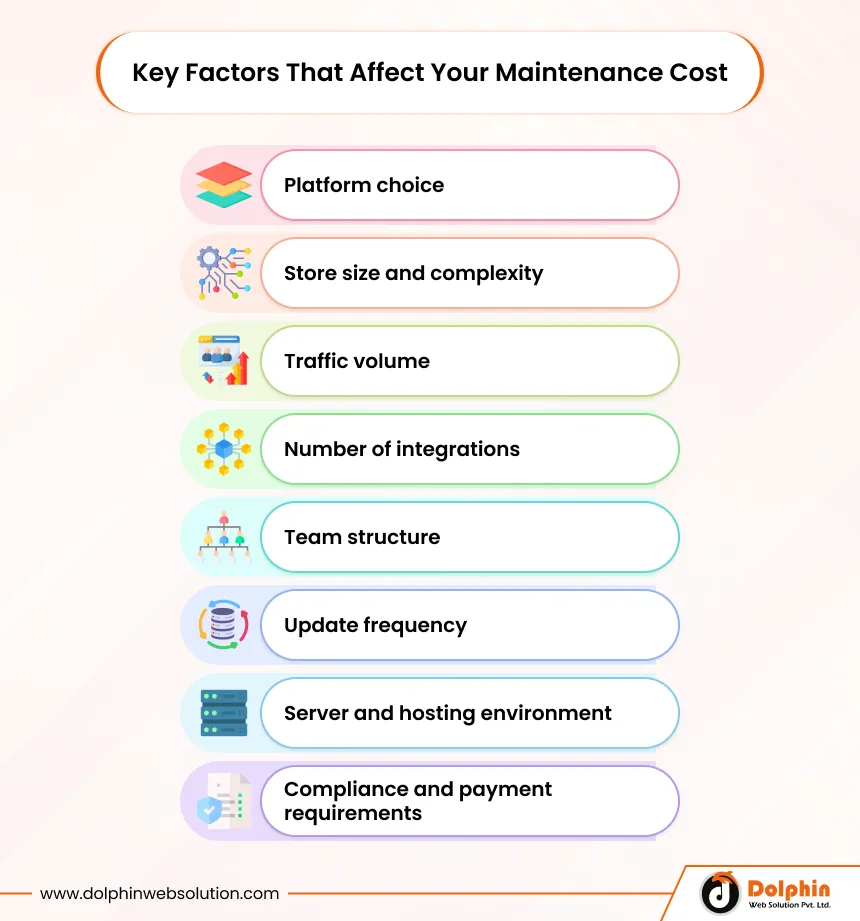
- Platform choice: A custom built store generally costs more to maintain than a store built on a mature platform with strong community and vendor support. Open source platforms often need extra budgeting for hosting and security, while SaaS platforms bundle much of this into a subscription fee.
- Store size and complexity: More products, more pages, and more custom features all mean more surface area to maintain. A store with five thousand SKUs and multiple custom modules will always need more attention than a small catalog with a standard theme.
- Traffic volume: High traffic stores need better hosting, more frequent performance tuning, and stronger security monitoring. A store pulling in thousands of daily visitors cannot run on the same infrastructure as one getting a few hundred.
- Number of integrations: Every connected tool, from your ERP to your email marketing platform, adds a maintenance dependency. Each integration needs to be tested and updated whenever the platform, plugin, or third party API changes.
- Team structure: In house maintenance gives you more control but requires salaries, training, and management time. Outsourced maintenance is often more cost effective for small and mid sized businesses since you get a full team without the overhead of hiring each specialist separately.
- Update frequency: Stores that run frequent promotions, launch new products often, or test new features regularly will naturally need more maintenance hours than a store that stays largely static month to month.
- Server and hosting environment: Older or misconfigured hosting environments often require more troubleshooting and manual intervention, which raises ongoing support costs compared to a properly configured, modern hosting setup.
- Compliance and payment requirements: Stores handling sensitive customer data or operating across multiple regions often need extra security layers and compliance checks, which adds to the regular maintenance workload.
If you are still evaluating which platform fits your business model and growth plans, choosing the right foundation matters just as much as ongoing upkeep. Our eCommerce Development team helps businesses select and build on a platform that keeps long term maintenance costs predictable.

How to Reduce eCommerce Maintenance Costs
- Choose a scalable platform from the start: Migrating to a new platform later on is far more expensive than choosing the right one up front. A platform that fits your catalog size, traffic goals, and growth plans today will save you thousands in rebuild costs down the road.
- Automate what you can: Backups, security scans, and basic performance checks should not depend on someone remembering to run them manually. Automating these tasks reduces human error and cuts down the hours your team or agency needs to bill.
- Bundle services with one reliable development partner: Juggling separate vendors for hosting, security, updates, and design almost always costs more, since each vendor charges its own management fee and issues tend to fall through the cracks between them. A single partner who understands your full stack can usually resolve problems faster and cheaper.
- Audit your integrations regularly: Every extension, plugin, and third party tool you are no longer using is still consuming update cycles, testing time, and sometimes licensing fees. A yearly integration audit often uncovers easy savings.
- Invest in performance early: A slow database or bloated codebase left unaddressed for years becomes far more expensive to fix than if it had been handled early. Small, ongoing optimization is almost always cheaper than a large emergency fix later.
- Plan maintenance into your budget, not around it: Businesses that treat maintenance as an afterthought tend to spend more reacting to problems. Setting aside a predictable monthly maintenance budget, based on your store size and traffic, keeps costs stable and prevents surprise invoices.
- Review your hosting plan as you grow: Many stores outgrow their original hosting plan without realizing it, which leads to slow performance and reactive upgrades. Reviewing your hosting tier every year or two ensures you are paying for what you actually need, not for what you signed up for at launch.
Choosing the right platform for your business model also plays a major role in long term costs. If you are still comparing options, this guide on the Top 5 Ecommerce Platforms for Wholesale breaks down which platforms scale best for bulk and B2B selling.
Should You Handle Maintenance In House or Outsource It?
Small businesses with limited technical staff usually benefit from outsourcing maintenance to a dedicated agency, since it provides access to a full team of experts (security, performance, development) without the cost of hiring each specialist separately. Larger enterprises with predictable, high volume needs sometimes build an internal team once their store reaches a certain scale.
For most growing businesses, a hybrid approach works well: an in house team for day to day content updates, paired with an experienced development partner for security, performance, and technical support.
The Experience Behind Every Maintenance Plan We Build
Cost breakdowns only tell half the story. The other half is who is actually managing your store once the numbers are agreed on, and that is where our background matters.
Dolphin Web Solution has spent over 15 years working inside live eCommerce stores, not just building them and walking away. That distinction shapes how we approach maintenance.
We have watched stores fail for the same handful of reasons, over and over. Slow database queries, unpatched security holes, and outdated extensions are rarely unique problems. After 15 plus years of hands on work across Magento, Shopify, WooCommerce, and custom builds, our team recognizes these patterns early, often before they show up as a customer complaint.
Our recommendations are based on your store, not a template. Before we quote a maintenance plan, we look at your actual traffic history, server logs, extension list, and catalog structure. A boutique store with 200 products and a large B2B store with 10,000 SKUs need very different maintenance strategies, and we build accordingly.
Transparency is built into how we bill. You will always know what a fix costs before we start it, and you will see exactly what was done during each maintenance cycle. There are no vague monthly retainers with no explanation attached.
We also believe trust is earned through consistency, not a single project. A large share of our client relationships started as a one time audit or bug fix and grew into a long term maintenance partnership, simply because the work held up over time. That track record, built store by store, is the reason business owners continue to hand us their most important digital asset.
Conclusion
eCommerce website maintenance is not a single expense; it is a collection of smaller, ongoing investments that keep your store fast, secure, and profitable. Understanding where your money goes, hosting, security, updates, support, and optimization, helps you plan a realistic budget and avoid surprise costs down the road.
At Dolphin Web Solution, we have spent over 15 years helping online businesses build and maintain stores that perform. Whether you need a full maintenance plan or a one-time technical audit, our team is ready to help you protect your investment. Contact us today to discuss your eCommerce website maintenance needs.

Frequently Asked Questions
How much should I budget monthly for eCommerce website maintenance?
Most small to mid sized stores spend between 50 and 800 dollars per month, while larger or highly customized stores can spend well beyond that depending on traffic and feature requirements.
Is eCommerce maintenance a one time cost or an ongoing expense?
It is an ongoing expense. Hosting, security, updates, and support are all recurring needs that continue for as long as your store is live.
Does the platform I choose affect my long term maintenance cost?
Yes. SaaS platforms often bundle maintenance into a subscription fee, while open source platforms give you more flexibility but may require separate budgeting for hosting, security, and updates.
What happens if I skip regular maintenance?
Skipping maintenance increases the risk of security breaches, slow page speed, broken features, and lost search rankings, all of which can directly reduce sales.
Can I reduce my maintenance costs without sacrificing security?
Yes. Automating backups and security scans, removing unused integrations, and working with one reliable development partner instead of multiple vendors can all lower costs while keeping your store protected.
Should I outsource eCommerce maintenance or hire an in house team?
It depends on your store size and budget. Outsourcing is usually more cost effective for small and mid sized businesses, while larger enterprises with consistent, high volume needs may benefit from an in house team.
Nimesh Patel


Nimesh Patel is the Managing Director of Dolphin Web Solution, a global eCommerce, AI, and software development company helping businesses accelerate digital growth. With over 15 years of experience in technology consulting and product development, he has successfully guided startups, SMBs, and enterprise organizations in building scalable digital solutions. Nimesh specializes in eCommerce development, custom software solutions, mobile application development, and digital transformation strategies. Throughout his career, he has worked closely with businesses across retail, healthcare, automotive, manufacturing, and technology sectors, helping them leverage modern technologies to improve operational efficiency and customer experiences. As a business leader, Nimesh is passionate about innovation, entrepreneurship, and helping organizations turn ideas into successful digital products. His insights focus on eCommerce growth, AI adoption, software development trends, and business transformation through technology.

We can help you with
- Dedicated Team
- Setup Extended Team
- Product Development
- Custom App Development
Our Offices

AHMEDABAD (INDIA)
B- 203-206, Empire Business Hub, Science City Road, Sola, Ahmedabad – 380060

BERLIN (GERMANY)
Badensche Str. 28, 10715 Berlin, Germany

CALIFORNIA (USA)
9601 Reseda Blvd, Apt#223, Northridge CA-91324, USA

ALBERTA (CANADA)
302 Skyview Ranch Drive NE, Calgary, Alberta, Canada T3N0P5





Hello!
Click one of our contacts below to chat on WhatsApp