
How to Build an eCommerce Mobile App: A Complete Step-by-Step Guide


Table of Contents
 Show
Show

Summary :
Are you planning to build an eCommerce mobile app? This blog will explain the role of an eCommerce mobile app, its benefits and how to make an eCommerce mobile app step by step so that you can plan and build a feature-rich app with estimated cost and timeline.
The eCommerce landscape has completely revolutionized how people do shopping. From groceries, clothes, and sneakers to sunglasses, people now order almost everything online from the comfort of their homes.
As per the latest stats, global eCommerce sales are expected to reach $8 trillion by 2027. This shows how big this market has become for merchants and retailers to scale their business online.
But there is one more crazy fact: Around 1.65 billion customers use their smartphones to do online shopping, which is why eCommerce businesses are now building their mobile apps to target more customers because it is the most direct way for companies to target their potential customers.
So, if your eCommerce business app is not ready, you will lose many sales and growth opportunities and stay behind your competitors.
Whether you are a small startup or an established brand, going online is not an option; it is a must-have to build a strong online presence, especially via mobile apps.
Now the question is – How can you build an eCommerce mobile app? No worries!
In this guide, we will understand everything about an eCommerce mobile app, its benefits and how you can build an eCommerce mobile app with a complete roadmap.
What is an eCommerce Mobile App?
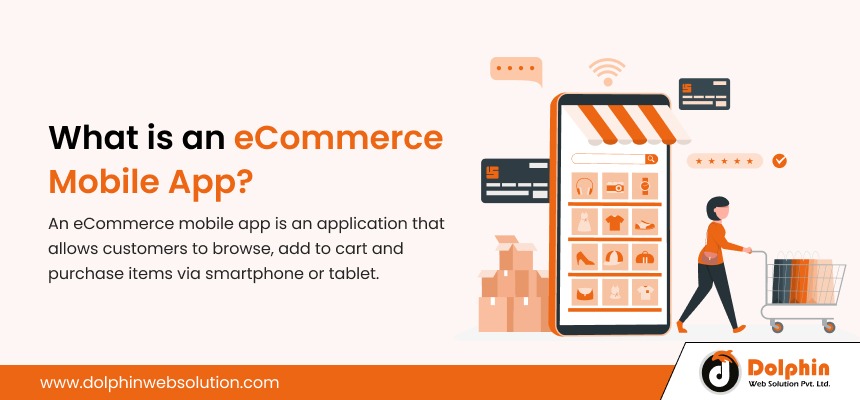
An eCommerce mobile app is an application that allows customers to browse, add to cart and purchase items via smartphone or tablet. These mobile apps make online shopping convenient and easy.
Plus, an app offers many beneficial features to the customer, including secure payment gateways, personalized recommendations, real-time order tracking, and the ability to build trust on your brand’s behalf.
Why Invest in an eCommerce Mobile App?
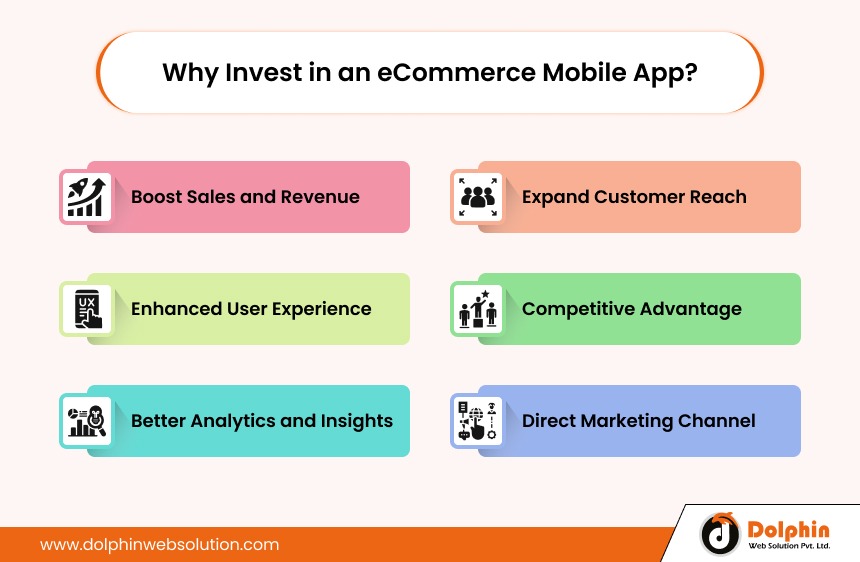
Here are some key reasons why you should invest in an eCommerce mobile app:
1. Boost Sales and Revenue
A mobile app lets customers search, shop, and check out easily. With better navigation, quicker loads, and personalized experience, consumers are more likely to complete a purchase. It leads to increased orders and revenue.
2. Expand Customer Reach
A mobile app places your store at every customer’s fingertip, regardless of where they are in this world, which means easy reach to everyone and potential clients across the globe.
3. Enhanced User Experience
The apps give users a seamless, faster shopping experience. They quickly load, offer recommendations, and even work offline, enhancing shopping ease and fun.
4. Competitive Advantage
Having an app puts you ahead of those who have just a website. It indicates that your business is modern and customer-oriented. It provides an improved shopping experience that wins and retains customers.
5. Better Analytics and Insights
Mobile apps provide better data about customers’ behaviour, such as what products they prefer and how they engage with the app. This makes you enhance your products and advertising strategies.
6. Direct Marketing Channel
You can send direct messages to customers through a mobile app regarding sales, new products, and promotions. This keeps them active and makes them shop more frequently.
How to Build an eCommerce Mobile App?
Here are simple steps to build an eCommerce mobile app:
Step 1: Define Your Business Goals & Target Audience
Before you start building your eCommerce app, defining its purpose is essential. You should ask yourself:
- What are your business goals?
- Is your goal to increase sales?
- Reach a broader audience?
- Improve customer experience?
- Enhanced your brand visibility?
Once you know your goals, then understand your target audience
- Who are they, and what do they need?
- Are you targeting individual consumers (B2C) or other businesses (B2B)?
Understanding your audience helps you tailor your app’s features and design to meet their needs.
Step 2: Choose the Right eCommerce App Model
Next, decide on the type of eCommerce model your app will follow. Common models include:
- B2C (Business-to-Consumer): Selling directly to consumers, like Amazon or eBay.
- B2B (Business-to-Business): Providing services or products to other businesses, like Alibaba.
- C2C (Consumer-to-Consumer): Allowing individuals to sell to each other, like eBay or Poshmark.
- C2B (Consumer-to-Business): Where consumers sell their products or services to businesses.
Choosing the right model helps you focus on the necessary features and functionalities that best suit your business.
Step 3: Essential Features to Include
For your application to be practical, add some must-have eCommerce features. These are among the essential features:
- User-Friendly Interface: Ensure navigation is intuitive and the layout is clean
- Product Catalog: An orderly presentation of products with good images and descriptions
- Shopping Cart & Checkout: Make it an easy experience so that products can be added easily and purchased securely
- Various Payment Options: Offer convenience in payment options like credit cards, wallets, and PayPal
- Personalized Recommendations: Utilize AI to recommend products based on user behaviour
- Order Tracking: enable customers to see orders in real-time
- Customer Support: Have support readily available through chat, email or phone
- Push Notifications: Engage users with new products, offers, or promotions through notifications
- Reviews & Ratings: Enable the customers to leave feedback, creating trust
As your company grows, you need to add more sophisticated features to support your company’s needs and goals.
Step 4: UI/UX Design Process
Here, you concentrate on what your app is like and how it feels to users. A practical design helps users easily search, browse, and purchase items without confusion. Your app must be in line with the style of your brand and accessible on any screen size. Clear buttons, easy layouts, and seamless navigation assist customers in enjoying the shopping process and returning for more.
Step 5: Tech Stack Selection
Choosing the appropriate technology is crucial to the performance and scalability of your application. Essential tech stacks are:
- Backend (App Brain): Employ PHP or Python to control your application’s operation in the background.
- Frameworks: Laravel and CodeIgniter are examples of tools that assist in developing the app quicker and maintaining clean code.
- Databases: MySQL, PostgreSQL (structured) or MongoDB (flexible) hold your product and user information.
- Frontend (What Users See): HTML, CSS, and JavaScript build the layout, design, and interactions.
- Frontend Tools: React, jQuery, or Angular give your app a modern look and feel and make it fast.
- Design Helpers: Bootstrap or Foundation makes your app beautiful on every screen size.
- Servers: Apache or Nginx serve your app smoothly to your users
- Code Management: Git makes tracking changes and collaborating with developers easy.
- Hosting: Host on AWS, Google Cloud or Azure to keep your app running smoothly online.
- Payments: Stripe, PayPal, or Authorize.Net allow users to pay safely.
- Security: An SSL certificate encrypts and protects your user info.
- Mobile Coding: Swift for iOS and Kotlin for Android to develop individual native apps.
- Cross-Platform: React Native or Flutter allows you to create a single app for both Android and iPhone.
Select technologies that align with your app’s requirements and developers’ expertise.
Step 6: Development & Integration
This is the phase where the development process starts for your app. Where the developers begin creating the actual app, coding the front-end and backend. They also implement all the necessary features, such as payment gateways, user logins, product databases, and shipping systems, to make all components function properly.
Step 7: Launch & Deployment
It is time to go live after your app is fully designed and tested. This process means releasing your app on the Apple App Store and Google Play Store. So that customers can download and install it. You must also have the app hosted on a good server to handle users’ traffic.
Cost & Time Estimation
The cost of an eCommerce mobile app will range from $10,000 to $150,000. The actual price will depend on many factors. It includes the app’s complexity, the UI/UX design, the number of features, the development time it takes to build the app, and the developers’ location. A team generally takes 3 to 9 months to develop a fully functional eCommerce mobile app.
Conclusion
Building an eCommerce mobile app is not just an option – it is a need of today’s world to stay competitive. However, building an eCommerce mobile app requires proper planning and research. We hope this guide helps you understand everything about eCommerce mobile apps, their benefits, and a step-by-step process to make with their estimated cost and time. Now, it is your turn to hire an experienced eCommerce app development company and let the professionals build your eCommerce mobile app within budget and on a timeline.

Jigar Shah


Jigar Shah serves as the Chief Operating Officer of Dolphin Web Solution, overseeing business operations, project delivery, client success, and organizational growth initiatives. With more than 15 years of experience in the IT and digital services industry, he plays a vital role in ensuring operational excellence and delivering exceptional outcomes for global clients. His expertise spans strategic planning, project management, process optimization, resource management, and technology operations. Jigar has successfully managed complex eCommerce, AI, web, and mobile application projects while building scalable processes that support sustainable business growth. Passionate about leadership and continuous improvement, Jigar focuses on creating efficient systems, empowering teams, and maintaining the highest standards of quality. He frequently shares perspectives on digital transformation, project execution, operational efficiency, and business growth strategies.

We can help you with
- Dedicated Team
- Setup Extended Team
- Product Development
- Custom App Development
Our Offices

AHMEDABAD (INDIA)
B- 203-206, Empire Business Hub, Science City Road, Sola, Ahmedabad – 380060

BERLIN (GERMANY)
Badensche Str. 28, 10715 Berlin, Germany

CALIFORNIA (USA)
9601 Reseda Blvd, Apt#223, Northridge CA-91324, USA

ALBERTA (CANADA)
302 Skyview Ranch Drive NE, Calgary, Alberta, Canada T3N0P5





Hello!
Click one of our contacts below to chat on WhatsApp