
-
Dolphin Web SolutionEcommerceBest eCommerce Platform for Startup: A Complete Guide
 15 Min Read
Best eCommerce Platform for Startup: A Complete Guide


Table of Contents
 Show
Show

Summary :
Want to start an online business? This guide for 2026 explains the best eCommerce platforms for startups. Learn about their features, advantages, and how to choose the right one for your business.
The eCommerce industry is experiencing unprecedented growth, with global retail eCommerce sales projected to surpass $3.6 trillion in 2026 and climb to over $4.9 trillion by 2030. For startups, this represents an incredible opportunity to tap into a booming market. However, success in the competitive online retail space begins with one critical decision: choosing the right eCommerce platform.
The platform you select becomes the foundation of your entire online business. It impacts everything from your website’s loading speed and user experience to your ability to scale operations as you grow. A wrong choice can result in poor performance, costly migrations, limited features, and ultimately, lost revenue. With over 33% of the world’s population shopping online, startups need a platform that not only meets current needs but can evolve with changing market demands.
At Dolphin Web Solution, we’ve helped numerous startups navigate this crucial decision, leveraging our expertise in Shopify development, Magento development, and WooCommerce development to build successful online stores. This comprehensive guide will walk you through everything you need to know about selecting the best eCommerce platform for your startup in 2026.
Why Choosing the Right eCommerce Platform Matters
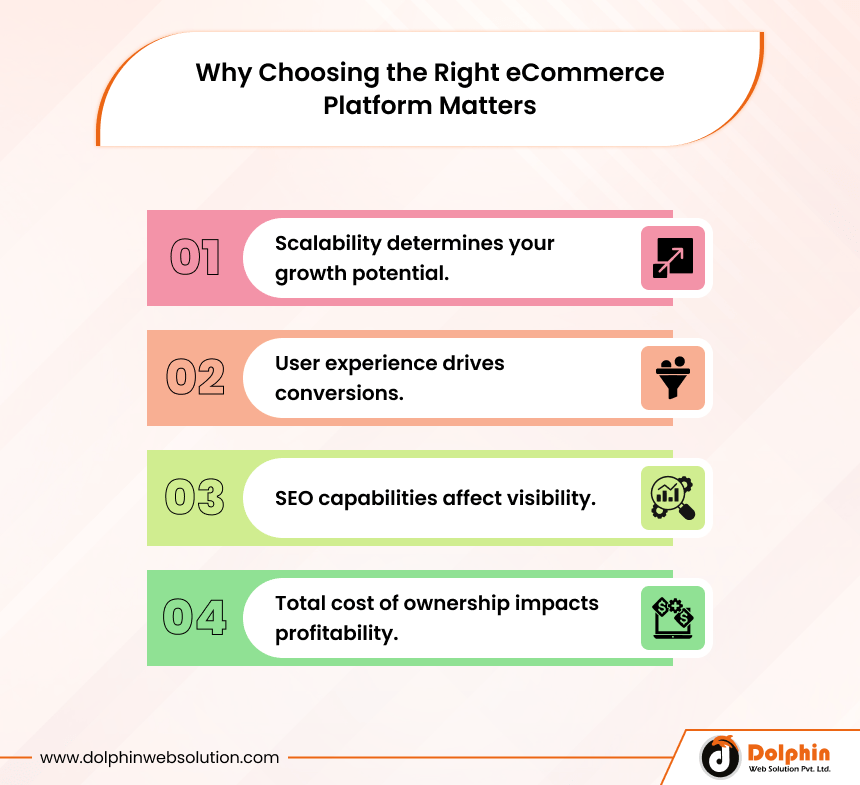
Your eCommerce platform choice directly influences your startup’s ability to compete and thrive in the digital marketplace. This decision affects multiple critical aspects of your business, and understanding these implications is essential before making a commitment.
1. Scalability determines your growth potential.
A platform that works well with 100 orders per month might struggle when you scale to thousands. As your product catalog expands and traffic increases, your platform needs to handle the load without compromising performance. Shopify and Magento excel in scalability, with Magento particularly suited for handling large stores and high traffic volumes.
WooCommerce’s scalability depends heavily on your hosting infrastructure and can struggle with very large stores.
2. User experience drives conversions.
The checkout process, page loading speed, mobile responsiveness, and overall site navigation all impact whether visitors become customers. Research shows that 81% of shoppers abandon their carts when preferred delivery options are missing, highlighting how platform features directly affect your bottom line. Shopify’s average loading time of 309 milliseconds significantly outperforms WooCommerce’s 776 milliseconds, potentially improving conversion rates.
3. SEO capabilities affect visibility.
Your platform’s built-in SEO features determine how easily potential customers can find your store through search engines. WooCommerce, being a WordPress plugin, offers superior SEO capabilities with full control over URLs, meta tags, and technical SEO settings. Magento provides advanced SEO control, while Shopify continues improving its SEO optimization features.
4. Total cost of ownership impacts profitability.
Beyond the monthly subscription, consider transaction fees, payment processing costs, theme purchases, app installations, and potential development expenses. For instance, Shopify charges transaction fees unless you use Shopify Payments, while WooCommerce is free to install but requires hosting, plugins, and potentially developer support.
Consider a real-world scenario: a fashion startup launches on a budget-friendly platform without considering future needs. Within a year, they experience explosive growth but discover their platform can’t handle increased traffic during sales events. The site crashes during their biggest promotional weekend, resulting in lost sales and damaged reputation. The subsequent platform migration costs them months of development time and significant resources, all of which could have been avoided with proper initial planning.
Key Factors to Consider Before Choosing a Platform
Before evaluating specific platforms, startups must assess their unique requirements and constraints. These foundational considerations will guide you toward the most suitable solution for your business.
1. Budget and total cost of ownership
extends beyond the advertised monthly fee. Calculate the complete investment including hosting, domain registration, SSL certificates, premium themes, essential plugins, payment processing fees, and potential developer costs. For a beginner startup, total annual costs can range from $3,618 to $17,388, while medium-sized businesses might spend $25,170 to $104,408 annually. WooCommerce appears free initially but requires hosting investment and technical expertise, while Shopify’s all-inclusive pricing provides predictability.
2. Ease of use and customization
balances convenience with flexibility. Non-technical founders often prefer platforms like Shopify or Wix that offer intuitive drag-and-drop interfaces and don’t require coding knowledge. However, this convenience sometimes comes at the expense of customization depth. WooCommerce and Magento offer virtually unlimited customization but demand technical proficiency or developer assistance. Our experts at Dolphin Web Solution always recommend analyzing your team’s technical capabilities honestly before committing to a platform.
3. Integration with payment gateways and third-party tools
ensures seamless operations. Your platform should support popular payment methods relevant to your target market, including credit cards, digital wallets, UPI, and potentially cryptocurrency. Payment gateway integration typically takes 2 to 5 months and costs between $20,000 to $100,000 depending on complexity. Shopify offers 100+ payment integrations out of the box, while WooCommerce provides two default options and requires additional plugin configuration. Beyond payments, consider integrations with email marketing tools, CRM systems, inventory management software, accounting platforms, and shipping providers.
4. SEO and mobile optimization
Are non-negotiable in 2026, with mobile commerce driving significant online purchases. Your platform must generate mobile-responsive designs automatically and provide robust SEO features including customizable meta tags, clean URL structures, fast loading speeds, and schema markup support. With 70% of global consumers expecting to shop primarily through social media by 2030, social commerce integration also matters.
5. Scalability and security
Protect your investment long-term. Cloud-based platforms with elastic scalability can dynamically allocate resources during traffic spikes, preventing crashes during promotional events. Security features including SSL certificates, PCI DSS compliance, regular vulnerability assessments, and secure payment processing protect both your business and customers. Magento offers enterprise-grade security features, while Shopify provides automatic SSL connections and compliance.
6. Developer and community support
Becomes crucial when problems arise. Platforms with extensive documentation, active community forums, and responsive customer service help you resolve issues quickly. Shopify offers 24/7 support via phone, email, and live chat, while WooCommerce relies on community forums and documentation. The size and activity of the developer community also determines the availability of themes, plugins, and professional assistance.
Top eCommerce Platforms for Startups in 2026
After extensive analysis of market leaders, these platforms stand out as the best options for startups in 2026. Each serves different needs, so understanding their strengths and limitations helps you make an informed choice.
1. Shopify – Best for Quick Launch and Ease of Use
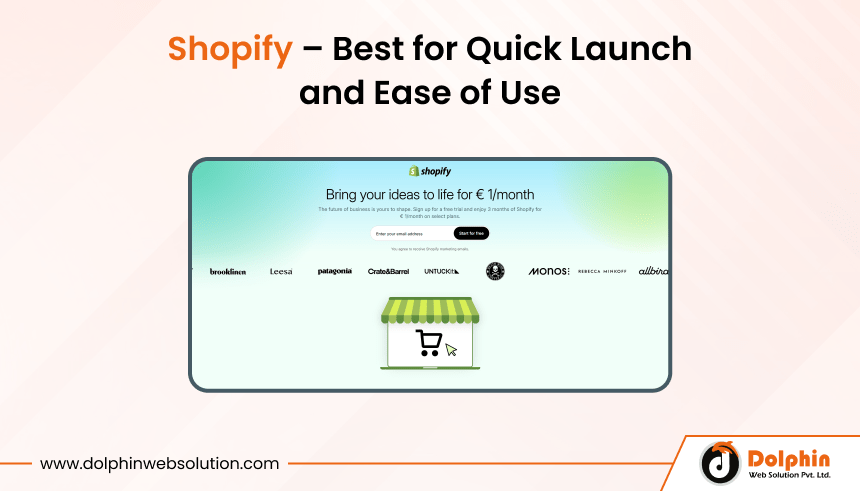
Shopify dominates the hosted eCommerce platform market with its user-friendly interface and comprehensive feature set. It’s the ideal choice for non-technical founders who want to launch quickly without managing technical infrastructure.
Pros:
- Intuitive drag-and-drop website builder requiring no coding skills.
- Fully hosted solution with security, updates, and maintenance handled automatically.
- 200+ beautiful, mobile-responsive themes providing professional designs.
- Built-in payment gateway (Shopify Payments) and 100+ payment processor integrations.
- Robust app marketplace with 13,000+ extensions for added functionality.
- Excellent performance with average loading time of 309 milliseconds.
- 24/7 customer support via phone, email, and live chat.
- Built-in SEO and marketing tools including abandoned cart recovery.
- Seamless integration with Amazon, Facebook, TikTok, Instagram, eBay, and Pinterest for multichannel selling.
Cons:
- Monthly subscription fees range from $39 to $399, with Shopify Plus starting at $2,000 monthly.
- Transaction fees of up to 2% unless using Shopify Payments.
- Limited control over backend code restricts advanced customization.
- Some advanced features require paid apps, increasing total cost.
Ideal for: First-time entrepreneurs, direct-to-consumer brands, small to medium businesses prioritizing speed to market, and anyone wanting a reliable, hassle-free solution.
2. WooCommerce – Best for Flexibility and Content-Driven Stores
WooCommerce transforms WordPress websites into fully functional online stores, offering unmatched flexibility and customization for businesses wanting complete control.
Pros:
- Free to install, with costs limited to hosting, domain, and optional plugins.
- Highly customizable with access to source code and thousands of WordPress plugins.
- Superior SEO capabilities leveraging WordPress’s content management strengths.
- Complete control over design, checkout process, and functionality.
- Extensive plugin library with 900+ WooCommerce-specific extensions and 59,000+ WordPress plugins.
- Ideal for content-rich stores combining blogging with eCommerce.
- Large community of developers and abundant resources.
- Supports multiple payment gateways including UPI, Razorpay, Paytm, and cash on delivery.
Cons:
- Requires technical knowledge for setup, maintenance, and troubleshooting.
- Performance depends heavily on hosting quality and can be resource-intensive.
- Average loading time of 776 milliseconds slower than competitors.
- Limited scalability with very large stores or extremely high traffic.
- Requires regular updates and plugin management.
- No built-in customer support; relies on community forums.
Ideal for: Bloggers and content creators, businesses already using WordPress, startups with technical team members, companies wanting maximum customization without monthly subscription fees.
3. Magento (Adobe Commerce) – Best for Scalability and Enterprise-Grade Features
Now known as Adobe Commerce, Magento delivers powerful capabilities for ambitious startups planning rapid growth or handling complex requirements from day one.
Pros:
- Highly scalable architecture handles unlimited products and massive traffic volumes.
- Unparalleled customization and control over every aspect of the store.
- Advanced features including multi-store management, multiple currencies, and multilingual support.
- Robust inventory management and order processing systems.
- Strong B2B capabilities for wholesale operations.
- Superior SEO control with full technical optimization options.
- Headless commerce ready with PWA Studio and GraphQL API.
- Extensive security features and enterprise-grade performance.
Cons:
- Steep learning curve requiring specialized developer expertise.
- Open Source version is free but Adobe Commerce starts at $22,000 annually.
- High hosting and development costs.
- Complex setup and lengthy implementation period.
- Ongoing maintenance demands technical resources.
Ideal for: Fast-growing startups with technical resources, businesses with complex catalog requirements, companies planning international expansion, B2B operations, and ventures backed by significant funding.
4. BigCommerce – Best for Multi-Channel Selling
BigCommerce provides a powerful hosted solution balancing ease of use with advanced features, particularly excelling at selling across multiple channels.
Pros:
- No transaction fees regardless of payment processor choice.
- Built-in features including SEO tools, marketing capabilities, and analytics
- Excellent scalability for growing businesses.
- Strong multi-channel integration with marketplaces and social platforms.
- Customizable product options and comprehensive inventory management.
- High performance and reliable uptime.
- Competitive pricing from $29.95 monthly.
Cons:
- Annual sales thresholds can force plan upgrades.
- Limited themes compared to competitors.
- Some advanced features require additional costs.
- Steeper learning curve than Shopify.
Ideal for: Businesses selling across multiple channels, companies expecting rapid growth, startups prioritizing built-in features over apps.
5. Wix eCommerce– Best for Creative Startups with Small Product Ranges
Wix caters to creative entrepreneurs and small product catalogs, emphasizing beautiful design and simplicity.
Wix eCommerce Pros:
- Extremely user-friendly drag-and-drop builder
- Over 500 free, mobile-responsive templates
- Affordable pricing from $23 monthly
- All-in-one solution with hosting included
- Built-in SEO and social media marketing tools
Wix eCommerce Cons:
- Limited scalability for growing businesses
- Fewer advanced eCommerce features
- Restricted payment gateway options
Ideal for: Artists, designers, photographers, fashion boutiques, lifestyle brands, and businesses with under 100 products prioritizing aesthetics.
6. Shopify Plus and Headless Commerce – Best for Fast-Growing Startups
For venture-backed startups expecting explosive growth, Shopify Plus and headless commerce solutions provide enterprise capabilities with modern architecture.
Shopify Plus offers dedicated support, higher API limits, custom checkout experiences, and advanced automation starting at $2,000 monthly. Headless commerce decouples the frontend presentation from backend functionality, enabling lightning-fast performance and omnichannel experiences. Shopify’s Hydrogen framework supports React-based headless builds, while Magento offers PWA Studio for progressive web apps.
Ideal for: Well-funded startups, businesses expecting viral growth, companies requiring custom experiences, operations targeting global markets.
Comparison Table
| Platform | Ease of Use | Scalability | Cost | Customization | Ideal For |
|---|---|---|---|---|---|
| Shopify | ⭐⭐⭐⭐⭐ | ⭐⭐⭐⭐ | $$$ | ⭐⭐⭐ | Beginners & Quick Launch |
| WooCommerce | ⭐⭐⭐ | ⭐⭐⭐ | $$ | ⭐⭐⭐⭐⭐ | Content-Driven & Flexible |
| Magento | ⭐⭐ | ⭐⭐⭐⭐⭐ | $$$$ | ⭐⭐⭐⭐⭐ | Large Startups & Complex Needs |
| BigCommerce | ⭐⭐⭐⭐ | ⭐⭐⭐⭐ | $$$ | ⭐⭐⭐ | Multi-Channel Sellers |
| Wix | ⭐⭐⭐⭐⭐ | ⭐⭐ | $$ | ⭐⭐ | Creative & Small Catalogs |
Conclusion
Selecting the best eCommerce platform for your startup is one of the most important decisions you’ll make as a founder. It lays the foundation for your entire online business and impacts everything from daily operations to long-term growth. With global eCommerce sales expected to reach $4.9 trillion by 2030, the opportunity for startups is huge. Each platform offers unique strengths — Shopify is ideal for quick launches and ease of use, WooCommerce offers flexibility for content-focused businesses, Magento provides enterprise-level scalability, and BigCommerce supports multi-channel selling. Meanwhile, platforms like Wix are perfect for smaller catalogs that emphasize design and creativity. The key is choosing a platform that fits your business goals, technical skills, and growth plans so that it can scale as your brand grows.
At Dolphin Web Solution, we help startups make this crucial choice with confidence through our eCommerce development services. Our team combines technical expertise and business insight to recommend and implement the most suitable eCommerce solutions. From Shopify and Magento to WooCommerce and custom platforms, we ensure your online store is built for performance, scalability, and success. Don’t let the wrong platform limit your potential — the right one can fuel your growth and simplify your journey to success. Partner with experts who understand both the technology and the unique challenges startups face, and start building your thriving online business today.

Nimesh Patel


Nimesh Patel is the Managing Director of Dolphin Web Solution, a global eCommerce, AI, and software development company helping businesses accelerate digital growth. With over 15 years of experience in technology consulting and product development, he has successfully guided startups, SMBs, and enterprise organizations in building scalable digital solutions. Nimesh specializes in eCommerce development, custom software solutions, mobile application development, and digital transformation strategies. Throughout his career, he has worked closely with businesses across retail, healthcare, automotive, manufacturing, and technology sectors, helping them leverage modern technologies to improve operational efficiency and customer experiences. As a business leader, Nimesh is passionate about innovation, entrepreneurship, and helping organizations turn ideas into successful digital products. His insights focus on eCommerce growth, AI adoption, software development trends, and business transformation through technology.

We can help you with
- Dedicated Team
- Setup Extended Team
- Product Development
- Custom App Development
Our Offices

AHMEDABAD (INDIA)
B- 203-206, Empire Business Hub, Science City Road, Sola, Ahmedabad – 380060

BERLIN (GERMANY)
Badensche Str. 28, 10715 Berlin, Germany

CALIFORNIA (USA)
9601 Reseda Blvd, Apt#223, Northridge CA-91324, USA

ALBERTA (CANADA)
302 Skyview Ranch Drive NE, Calgary, Alberta, Canada T3N0P5





Hello!
Click one of our contacts below to chat on WhatsApp