
-
Dolphin Web SolutionWebBack-end Development Costs: What You Need to Know Before You Start
 15 Min
Back-end Development Costs: What You Need to Know Before You Start



Table of Contents
 Show
Show

Summary :
Businesses must cosider the back-end development costs when planning a project to budget it accurately. Several factors affect the back-end development cost. Understanding these factors makes the whole development process smooth and cost-effective. This blog post discusses these factors and different pricing models for back-end development.
Have you ever noticed how some websites or applications have a great interface that makes you stay and navigate through all the pages? While some websites have an average interface that makes you leave.
It is not what you see that holds you to stay and scroll. Instead, it’s a back-end development operation that makes a website appealing and easy to navigate. In recent years, around 83% of businesses have started selling online. It clearly shows the importance and reach of the website, which is directly connected with back-end development costs.
So, in the blog post, we will explore factors affecting web development cost, different pricing models, and various factors affecting its development.
What Is Back-end Development?
As the name suggests, it is the process of developing the serverside elements of a website or application that the user does not get to see. The person who does all the back-end development is called back-end developer.
Developers use programming languages like Python, Java, Ruby, Node.js, and Django to develop the website’s back-end or the application. They are also responsible for the website or app performance, application programming interface APIs, and server.
Factors Influencing Back-end Development Costs
Back-end development involves various steps, such as developing server-side logic, database management, and API creation.
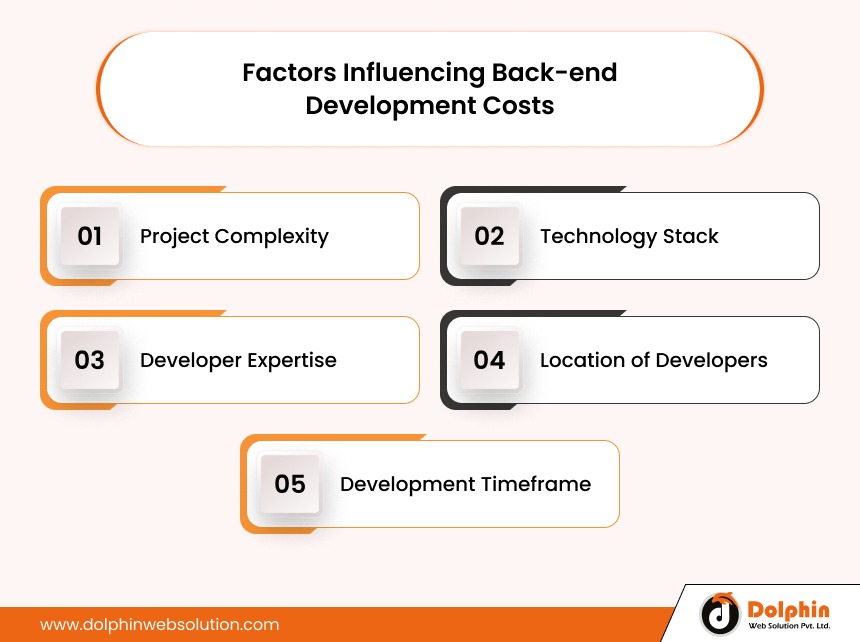
These operations are dependent on multiple factors, as follows.
1. Project Complexity
More features in a website increase the time and effort to develop it.
For example, a website integrating an AI chatbot will take extra writing code and designing a framework, which increases the development cost. Also, handling a large volume of data for the app or website increases the developer’s workload and cost.
On the other hand, if you are making a simple e-commerce site, then it will be quite simple and easy to make.
2. Technology Stack
Depending on the type of project, different technologies may be used, which can also influence the back-end development cost.
If you are developing a more featured app or website, you will need programming languages like Python and Node.js. You also need cloud platform stations like AWS, Azure, and GCP.
You need experts who work on these technologies who are expensive to hire.
3. Developer Expertise
If you want the best website or app, you will need a proficient developer who can understand and create your required app or website.
Experienced developers also understand your project’s requirements more easily and deliver better results than you expect.
Since quality comes with a price, an experienced developer requires more investments than a new developer.
4. Location of Developers
It does affect back-end development costs. If you’re hiring developers from locations where the average salary is lower compared to your location, it will be cost-effective.
A recent report suggests that the average hourly rate for senior back-end developers in Silicon Valley is higher than in Eastern Europe or Southeast Asia.
However, the cost will be higher if the developer location has a higher average salary than yours.
5. Development Timeframe
The time to develop an app or website can also drive the cost up. If you have a small website or app, it may only take a few weeks. It can cost less than a large website, which might need more developers working for longer periods.
Often, this depends on the project’s urgency or how fast the client wants the product to hit the market.
Projects with tighter deadlines and schedules can cost more than those with flexible timelines.
Pricing Models for Back-end Development
When choosing a pricing model, consider project complexity, budget, time, and required features.
Choosing the right back-end development pricing models is one of the most important tasks.
Let’s check them out here.
1. Fixed Price
Fixed price is implemented mostly where the project end goal is well defined with minimal to no change. This model works best for projects where budget and time are fixed. It works best for small-size projects.
Pro
1. It makes all operations clear and smooth on both ends, whether project cost or deliverable.
2. Since the project is well defined it maintains the work quality under a given budget and time frame.
3. As the project is defined under contract based. So you don’t need to keep checking on the workflow.
Cons
1. Due to contract-based work models, there is less to no scope for further change or feature addition.
2. If the project complexity increases beyond the contract, the service charge of the developers may also increase.
2. Hourly Rate
Unlike fixed prices, the hourly rate is flexible. An hourly rate is the way to go if your project doesn’t have a clear work goal or scope.
It lets you choose the way and function you want the developer to add to your project. One of the good things is you will only pay for the developer’s work.
Since it’s hourly based without a clear set of goals, if any project takes longer than your expectation, it can overrun your project budget.
The Typical Hourly Rates by Region:
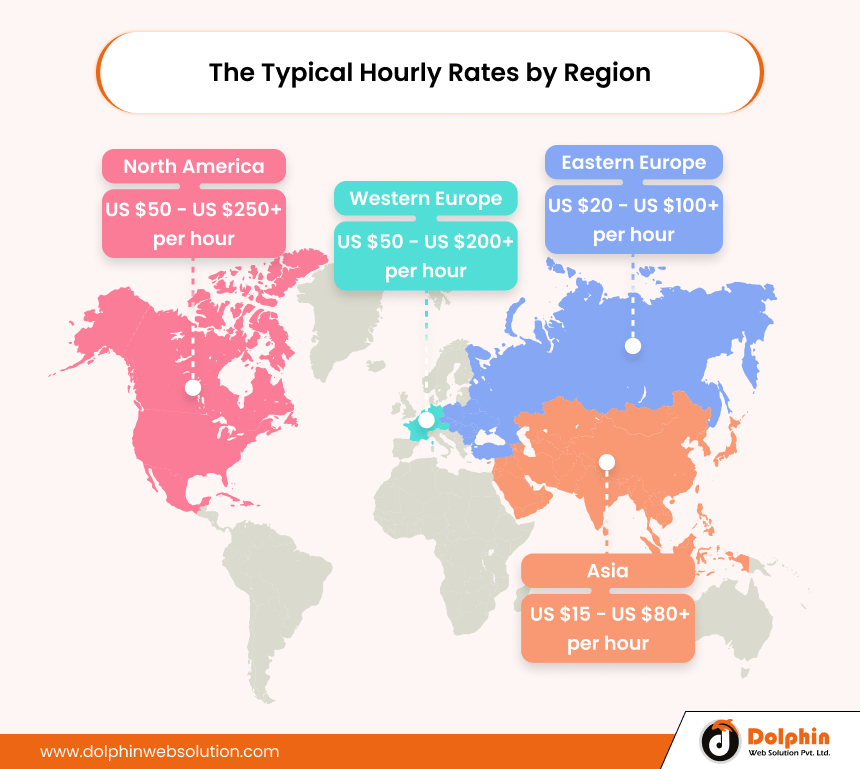
- North America: US $50 – US $250+ per hour
- Western Europe: US $50 – US $200+ per hour
- Eastern Europe: US $20 – US $100+ per hour
- Asia: US $15 – US $80+ per hour
These are the standard hourly rate ranges, and they can vary according to the developer’s experience and project requirements.
3. Retainer-Based
This works for businesses that need long-term commitment. It can be ongoing maintenance or development work for any project. It works best for businesses with continuous projects or platforms needing continuous maintenance and testing.
Back-end developers get paid monthly or bi-weekly in retainer-based work with a decided number of working days and hours.
Typical Cost Range for Back-end Development
Back-end development cost depends on multiple factors, from project type to feature integration and target audience to traffic volume.
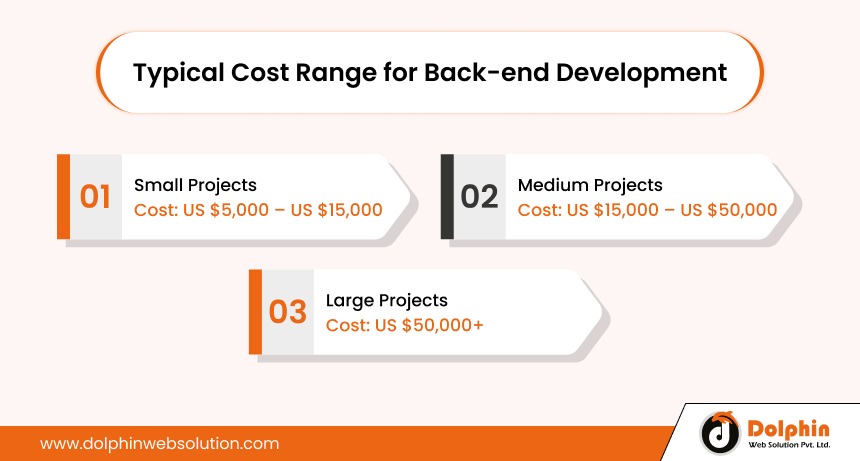
Let’s explore them here:
1. Small Projects
- Cost: US $5,000 – US $15,000
In small projects, the budget is low, and so is the work. Most small projects are one-time tasks with clearly defined goals.
Personal or blogging websites are common in this category.
2. Medium Projects
- Cost: US $15,000 – US $50,000
In medium projects, the complexity of the work and range are higher, leading to increased costs. An experienced developer is a must for medium-size projects requiring more investment.
It involves projects such as developing new applications, revamping old ones, etc.
3. Large Projects
- Cost: US $50,000+
Big-budget startups or well-established businesses mostly use large projects for their projects.
The companies that deal with game development, cloud space, real estate, SaaS, and Blockchain hire back-end developers for large projects.
These industries are in high demand with continuous innovation, so they get big funding with conscious work.
Hire a Cost-effective Back-end Development Agency
Every business needs back-end developers to meet their project requirements. These projects can range from small to medium and complex, which also determines the cost. Hence, choosing a reliable and established back-end development agency for websites and apps is key to success.
If you are unsure about the right pricing model for your project, consider contacting an app or web development company like Dolphin Web Solution.
We are a team of experienced back-end developers who can help you develop a website or application. With expert back-end developers for hire in our team, we can meet all your app development goals.
For a free consultation, reach us now.

Jigar Shah


Jigar Shah serves as the Chief Operating Officer of Dolphin Web Solution, overseeing business operations, project delivery, client success, and organizational growth initiatives. With more than 15 years of experience in the IT and digital services industry, he plays a vital role in ensuring operational excellence and delivering exceptional outcomes for global clients. His expertise spans strategic planning, project management, process optimization, resource management, and technology operations. Jigar has successfully managed complex eCommerce, AI, web, and mobile application projects while building scalable processes that support sustainable business growth. Passionate about leadership and continuous improvement, Jigar focuses on creating efficient systems, empowering teams, and maintaining the highest standards of quality. He frequently shares perspectives on digital transformation, project execution, operational efficiency, and business growth strategies.

We can help you with
- Dedicated Team
- Setup Extended Team
- Product Development
- Custom App Development
Our Offices

AHMEDABAD (INDIA)
B- 203-206, Empire Business Hub, Science City Road, Sola, Ahmedabad – 380060

BERLIN (GERMANY)
Badensche Str. 28, 10715 Berlin, Germany

CALIFORNIA (USA)
9601 Reseda Blvd, Apt#223, Northridge CA-91324, USA

ALBERTA (CANADA)
302 Skyview Ranch Drive NE, Calgary, Alberta, Canada T3N0P5





Hello!
Click one of our contacts below to chat on WhatsApp