---
title: "How to add Custom Random Order Number in Magento 2"
url: "https://dolphinwebsolution.com/how-to-add-custom-random-order-number-in-magento-2"
date: "2023-04-24T13:10:19+05:30"
modified: "2023-08-29T05:32:52+05:30"
author:
name: "Rutvik Monpara"
categories:
- "Magento2"
word_count: 1376
reading_time: "7 min read"
summary: "By default, Magento 2 generates order numbers sequentially, based on the time of the order. However, in some cases, you may want to use custom random order numbers instead. For example, you may wan..."
description: "By default, Magento 2 generates order numbers sequentially, based on the time of the order. However, in some cases, you may want to use custom random order n..."
keywords: "Magento2"
language: "en"
schema_type: "Article"
related_posts:
- title: "Magento vs PrestaShop: Which eCommerce Platform is the Best?"
url: "https://dolphinwebsolution.com/blog/magento-vs-prestashop/"
- title: "How to set logo in system configuration tab in Magento 2"
url: "https://dolphinwebsolution.com/how-to-set-logo-in-system-configuration-tab-in-magento-2"
- title: "Benefits of Hyvä Theme for Your Magento Store"
url: "https://dolphinwebsolution.com/blog/benefits-of-hyva-themes-for-magento/"
---
# How to add Custom Random Order Number in Magento 2
_Published: April 24, 2023_
_Author: Rutvik Monpara_

- By default, Magento 2 generates order numbers sequentially, based on the time of the order. However, in some cases, you may want to use custom random order numbers instead. For example, you may want to use a different numbering system for your orders, or you may want to prevent customers from being able to predict the next order number. In this article, we will show you how to add a custom random order number in Magento 2.
- To add a custom order number in Magento 2, you can follow these steps.
**Step 1** : Register your module
Create a [custom module](https://dolphinwebsolution.com/how-to-create-module-in-magento-2) in Magento 2.
**Step 2** : Create Configuration
- Create **system.xml** file at
**app/code/Dolphin/CustomOrderNumber/etc/adminhtml/** folder
```
dolphinDolphin_CustomOrderNumber::configSample Format
ABC_{str3}{num3}{increment_id}
The Following variables can be used.
{increment_id} - Default increment id.
{str3} - Random string with 3 characters.
{num3} - Random number with 3 digits. If the number is greater than 9 then take 9 static. ]]>
```
[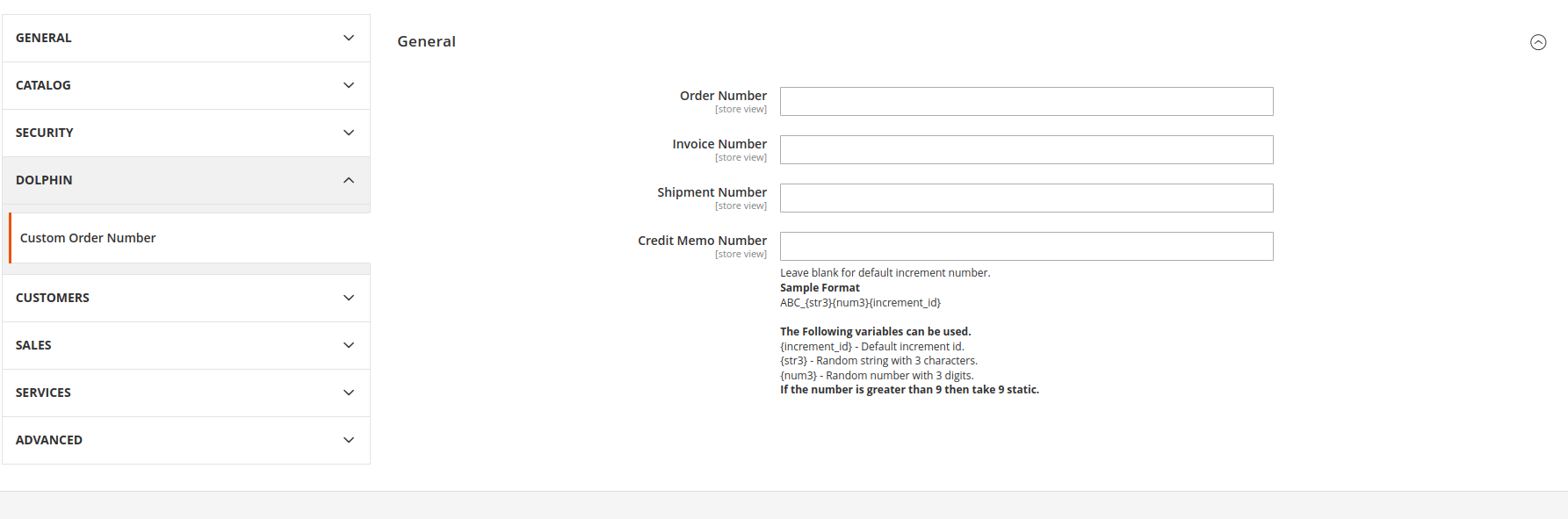](https://dolphinwebsolution.com/wp-content/uploads/2023/04/image1-1.png)
Here is the screenshot of configuration.
Leave blank for Magento default increment number.
The Following variables can be used.
- {increment\_id} – Default increment id.
- {strX} – Random string with X characters.
- {numX} – Random number with X digits.
- If the number is greater than 9 then it’ll consider 9 only.
Sample Format
- ABC\_{str3}{num3}{increment\_id}
**Step 3** : Override the Sequence.php file
Create **di.xml at app/code/Dolphin/CustomOrderNumber/etc** folder
```
```
**Step 4** : Create Sequence.php for apply custom number
Create a file **Sequence.php at app/code/Dolphin/CustomOrderNumber/Model** folder for extend class from Magento\\SalesSequence\\Model\\Sequence.
```
meta = $meta;
$this->connection = $resource->getConnection('sales');
$this->pattern = $pattern;
$this->profile = $profile;
$this->scopeConfig = $scopeConfig;
$this->storeManager = $storeManager;
$this->mathRandom = $mathRandom;
$this->orderCollection = $orderCollection;
parent::__construct($meta, $resource, $pattern);
}
/**
* Retrieve current value
*
* @return string
*/
public function getCurrentValue()
{
if (!isset($this->lastIncrementId)) {
return null;
}
$storeId = $this->meta->getData('store_id');
$metaEntityType = $this->meta->getEntityType();
if ($metaEntityType == 'order') {
$pattern = $this->getOrderFormat($storeId);
}
if ($metaEntityType == 'invoice') {
$pattern = $this->getInvoiceFormat($storeId);
}
if ($metaEntityType == 'shipment') {
$pattern = $this->getShipmentFormat($storeId);
}
if ($metaEntityType == 'creditmemo') {
$pattern = $this->getCreditMemoFormat($storeId);
} else {
$this->meta->getActiveProfile()->getPrefix();
}
$incrementId = sprintf(
$this->pattern,
'',
$this->calculateCurrentValue(),
$this->meta->getActiveProfile()->getSuffix()
);
return $this->generateIncrementId($pattern, $incrementId, $metaEntityType);
}
public function getOrderFormat($storeId)
{
return $this->scopeConfig->getValue(
'custom_order_number/general/order',
\Magento\Store\Model\ScopeInterface::SCOPE_STORE,
$storeId
);
}
public function getInvoiceFormat($storeId)
{
return $this->scopeConfig->getValue(
'custom_order_number/general/invoice',
\Magento\Store\Model\ScopeInterface::SCOPE_STORE,
$storeId
);
}
public function getShipmentFormat($storeId)
{
return $this->scopeConfig->getValue(
'custom_order_number/general/shipment',
\Magento\Store\Model\ScopeInterface::SCOPE_STORE,
$storeId
);
}
public function getCreditMemoFormat($storeId)
{
return $this->scopeConfig->getValue(
'custom_order_number/general/creditmemo',
\Magento\Store\Model\ScopeInterface::SCOPE_STORE,
$storeId
);
}
/**
* Retrieve next value
*
* @return string
*/
public function getNextValue()
{
$this->connection->insert($this->meta->getSequenceTable(), []);
$this->lastIncrementId = $this->connection->lastInsertId($this->meta->getSequenceTable());
return $this->getCurrentValue();
}
/**
* Calculate current value depends on start value
*
* @return string
*/
private function calculateCurrentValue()
{
return ($this->lastIncrementId - $this->meta->getActiveProfile()->getStartValue())
* $this->meta->getActiveProfile()->getStep() + $this->meta->getActiveProfile()->getStartValue();
}
public function generateIncrementId($patterns, $incrementId, $type)
{
$collection = $this->orderCollection->create();
$pattern = $this->generatePattern($patterns, $incrementId);
if ($type == 'order') {
$collection->addFieldtoFilter('main_table.increment_id', $pattern);
}
if ($type == 'invoice') {
$collection->getSelect()->joinLeft(
['sales_invoice' => 'sales_invoice'],
'main_table.entity_id = sales_invoice.order_id',
[]
);
$collection->addFieldtoFilter('sales_invoice.increment_id', $pattern);
}
if ($type == 'shipment') {
$collection->getSelect()->joinLeft(
['sales_shipment' => 'sales_shipment'],
'main_table.entity_id = sales_shipment.order_id',
[]
);
$collection->addFieldtoFilter('sales_shipment.increment_id', $pattern);
}
if ($type == 'creditmemo') {
$collection->getSelect()->joinLeft(
['sales_creditmemo' => 'sales_creditmemo'],
'main_table.entity_id = sales_creditmemo.order_id',
[]
);
$collection->addFieldtoFilter('sales_creditmemo.increment_id', $pattern);
}
if (count($collection)) {
return $this->generateIncrementId($patterns, $incrementId, $type);
}
return $pattern;
}
public function generatePattern($patterns, $incrementId)
{
if ($patterns) {
$patterns = str_replace('{', ',{', $patterns);
$patterns = str_replace('}', '},', $patterns);
$patterns = explode(',', $patterns);
$patterns = array_filter($patterns);
$orderNumber = '';
foreach ($patterns as $pattern) {
$pattern = preg_replace('/\s+/', '', $pattern);
if (str_contains($pattern, '{') || str_contains($pattern, '}')) {
$pattern = preg_replace('/(.*){(.*)}(.*)/s', '\2', $pattern);
if (str_contains($pattern, 'num')) {
$number = str_replace('num', '', $pattern);
if (is_numeric($number)) {
$orderNumber .= $this->mathRandom->getRandomString($number > 9 ? 9 : $number, '0123456789');
}
} else if (str_contains($pattern, 'str')) {
$string = str_replace('str', '', $pattern);
if (is_numeric($string)) {
$orderNumber .= $this->mathRandom->getRandomString($string > 9 ? 9 : $string, 'ABCDEFGHIJKLMNOPQRSTUVWXYZ');
}
} else if ($pattern == 'increment_id') {
$orderNumber .= $incrementId;
}
} else {
$orderNumber .= $pattern;
}
}
return $orderNumber;
} else {
return $incrementId;
}
}
}
```
The **generateIncrementId()** method generates a unique increment ID based on the specified pattern and type.
If the increment ID is not unique, it generates a new one and checks again until a unique increment ID is found.
Implementing a custom random order number can be a useful feature for your Magento 2 store to enhance the security and uniqueness of your order numbers. With the right steps and guidance, you can successfully implement this feature and provide a more personalized experience for your customers.
**That’s it!** I hope this technical blog will help you find what you were looking for.
---
_View the original post at: [https://dolphinwebsolution.com/how-to-add-custom-random-order-number-in-magento-2](https://dolphinwebsolution.com/how-to-add-custom-random-order-number-in-magento-2)_
_Served as markdown by [Third Audience](https://github.com/third-audience) v3.5.3_
_Generated: 2026-08-26 07:13:49 UTC_